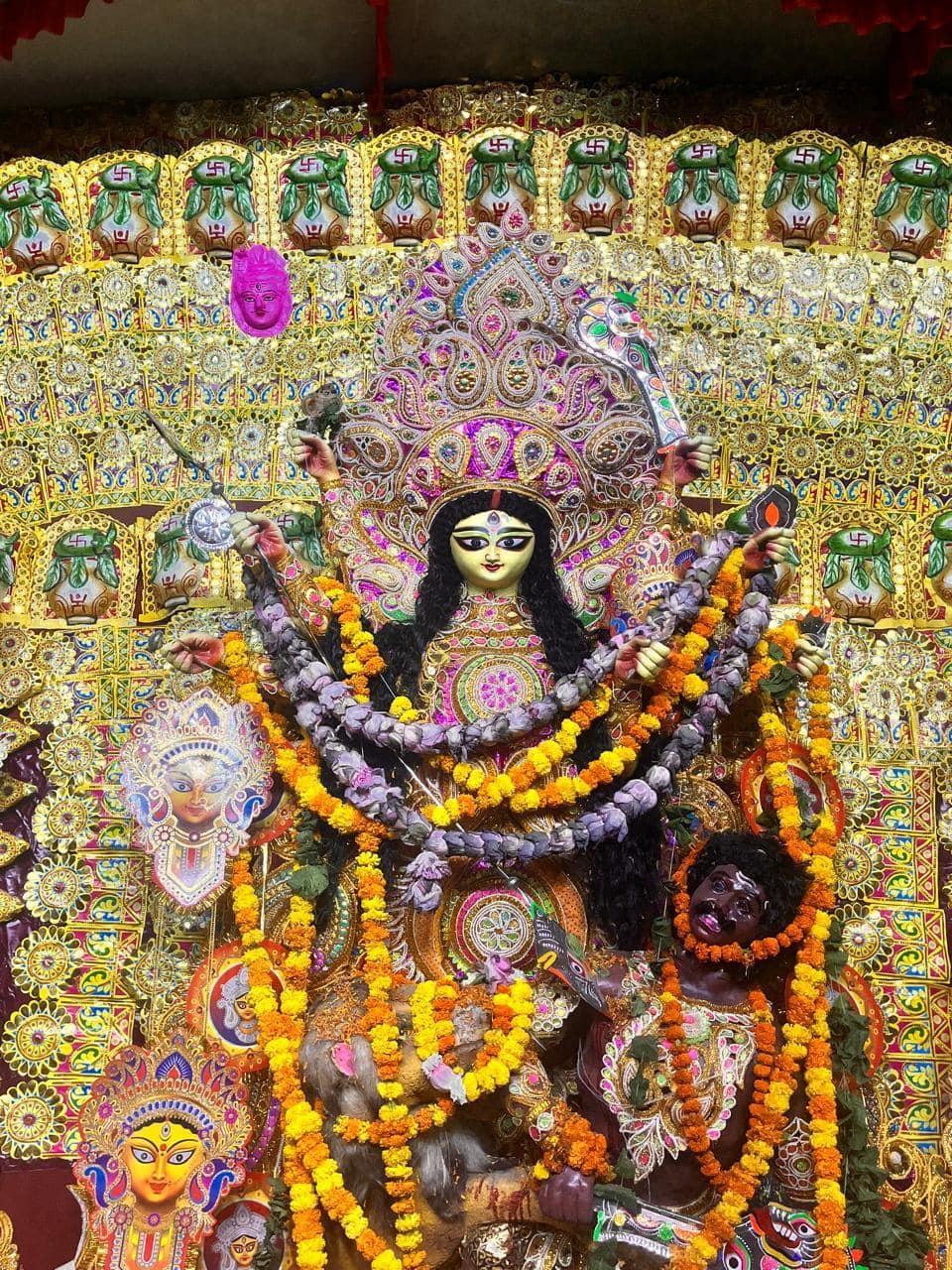
- Ghaziabad’s Kali Bari celebrates Durga Puja for 33 years.
- Pandal showcases rural Bengal crafts, cottage industry heritage.
- Beyond worship, it unifies families through arts and food.
- It preserves Bengali heritage, fostering community in Ghaziabad.
When people think of Durga Puja, the mind usually travels to Kolkata first, with its elaborate pandals, artistic installations, dazzling lights and streets filled with people. In Delhi, Chittaranjan Park, popularly known as CR Park, is often the next destination that comes to mind. But beyond these familiar centres of Bengali festivities, Durga Puja has found a home in the suburbs of the National Capital Region, where communities have spent decades preserving their cultural roots.
In Vaishali, Ghaziabad, the Vaishali Kali Bari Cultural Association has been celebrating Durga Puja for 33 years, bringing together nearly 190 families in a shared expression of faith, art and Bengali identity.
This year, the celebration draws inspiration from Graam Bangla, meaning rural Bengal, and Kutir Shilpa, which translates to cottage industries and traditional handicrafts. These are small-scale, often home-based enterprises rooted in village life, where artisans create decorative objects, household goods and works of art using traditional skills, said Ananta Ghosh, General Secretary of the Vaishali Kali Bari Cultural Association.
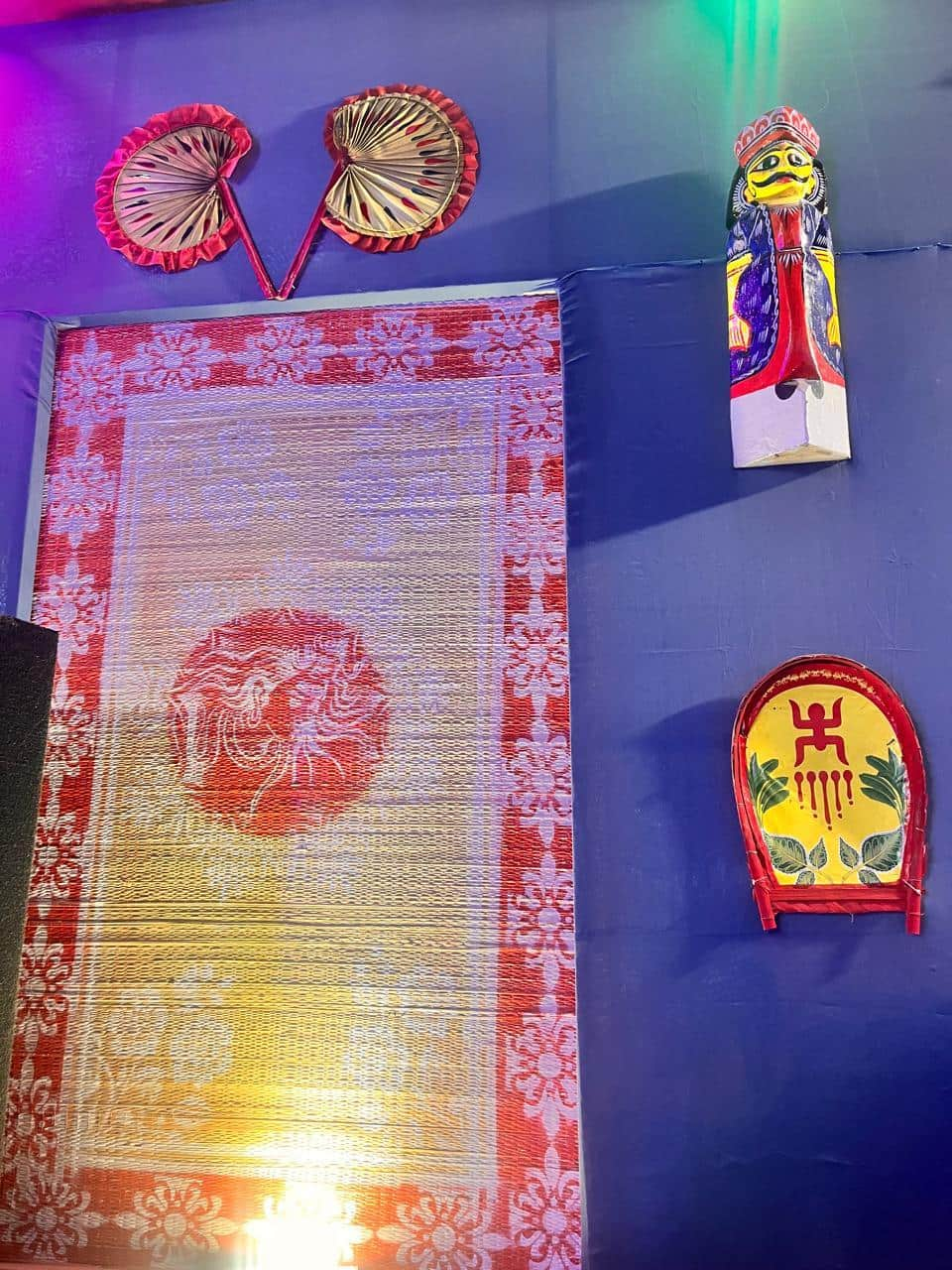
The theme is reflected in the pandal itself, where wooden sculptures, traditional craft objects and familiar Bengali decorative motifs come together to recreate the visual language of rural Bengal. But the celebration extends beyond its artistic setting. Music, competitions, food and the quintessential Bengali adda bring the community together, making the festival as much about shared memories and relationships as it is about worship.
A Pandal Decorated With The Crafts Of Rural Bengal
At the heart of this year’s celebration is an attempt to bring the artistic traditions of rural Bengal into a neighbourhood far removed from the villages where many of these crafts originated.
Wooden sculptures form part of the pandal’s decorations, bringing an element of traditional craftsmanship into the festive space. Alongside them are hat-pakha, or hand-held fans, traditionally used to provide relief from the heat and often crafted as decorative objects; jhalor, ornamental fringes or decorative hanging elements; and maadoor, the Bengali word for a traditional woven mat.
These objects, associated with everyday life and traditional craftsmanship, have been incorporated into the pandal’s decorative scheme. Their presence serves as a reminder that Bengal’s artistic heritage is not confined to monumental installations or elaborate temple architecture. It also lives in the objects made for ordinary household use, often by artisans working in small-scale, village-based industries.
Another distinctive feature is the jhalor, an ornamental decorative arrangement that forms part of the pandal’s visual identity. Its design bears a resemblance to the familiar jhalor associated with Ekdalia Evergreen’s Durga Puja in Kolkata, although the version here has been recreated on a much smaller scale. The similarity offers a recognisable reference point for those familiar with Kolkata’s celebrated pandals, while the more modest execution fits the scale and character of the Vaishali installation.
The ceiling adds another layer to the theme. Cloth material has been used to cover the roof of the pandal, featuring the kolke motif, a paisley-shaped pattern deeply associated with traditional Bengali decorative design. The recurring curved forms lend the ceiling a distinctly Bengali visual character, tying the different elements of the decoration together.
The emphasis is not simply on reproducing a village setting. It is about using familiar craft objects, patterns and materials to evoke the traditions of rural Bengal in a contemporary urban environment.
Another important aspect of this year’s arrangement is that the artist who created the Durga idol is also the person responsible for creating the pandal. This brings the central image of worship and its surrounding artistic environment under a shared creative vision, allowing the idol and the decorations to form part of a single theme.
The Challenge Of Bringing Graam Bangla To Ghaziabad
Recreating the visual and cultural character of Graam Bangla in Vaishali is not without its challenges.
Kolkata has a longstanding ecosystem of artisans, workshops and cultural networks associated with Durga Puja. In the suburbs of Ghaziabad, bringing together the materials, craftsmanship and artistic vision required for a rural Bengal theme demands a different kind of effort.
Kutir Shilpa also draws attention to the livelihoods and skills of the artisans behind these crafts. Hand-held fans, woven mats, wooden sculptures and ornamental decorations represent more than visual embellishments; they are part of a wider tradition of small-scale production and inherited craftsmanship.
By placing these objects at the centre of its celebrations, the association is attempting to preserve a connection with Bengal’s artistic heritage and introduce it to visitors in the NCR.
A Kali Bari Built Around 190 Families
The story of the Vaishali Kali Bari Cultural Association is also the story of a community’s desire for a shared cultural and religious space.

According to Somnath Mukherjee, president of the association, the Kali Bari emerged from the collective aspirations of the families living in the area. Around 190 families wanted a place where they could come together to worship, celebrate their festivals and preserve their traditions.
The association brought these families together, creating a platform through which they could organise religious and cultural activities. The Kali Bari itself took shape within a few years, giving the community a permanent focal point for its collective life.
Over the decades, the institution has grown beyond being a venue for worship. It has become a meeting place where families participate in preparations, organise cultural programmes and work together during the festive season.
The scale of the celebration is reflected in its annual food festival, which, according to the association’s general secretary, Ananta Ghosh, attracts around 10,000 people every night. The gathering brings visitors into the neighbourhood and adds a wider community dimension to the festivities.
For the families involved, the defining feature is the collective nature of the celebration. Preparations, performances and cultural programmes are organised with members working together, creating an atmosphere in which the association functions much like an extended family.
When Bengali Traditions Meet North Indian Culture
The cultural identity of the association has also evolved through its interaction with the neighbourhood around it.
Somnath Mukherjee says the establishment of the Kali Bari has helped the Bengali community and North Indian residents of the area become more closely connected. While the association continues to celebrate Durga Puja according to Bengali traditions, its years in Vaishali have also brought cultural exchanges that have influenced the way the community experiences the festival.
The influence, he explains, has worked both ways. Bengali traditions have become part of the local cultural landscape, while elements of North Indian culture have, in turn, influenced aspects of the community’s cultural life.
This exchange has not meant abandoning the festival’s Bengali character. Instead, it reflects how traditions can remain rooted in their origins while adapting to the places where communities settle.
For a Bengali cultural institution operating in the Delhi-NCR region, that balance is particularly significant. The association’s attempt to foreground Graam Bangla and Kutir Shilpa this year is an assertion of its cultural heritage, even as the community around it continues to shape its everyday life.
The Soundtrack Of Pujo
At the association, Durga Puja does not end with the rituals or the decorations. Cultural programmes form an integral part of the celebrations, bringing artists from different parts of Bengal together with performers from the neighbourhood.
The stage becomes a meeting point for different generations and artistic traditions. Rabindra Sangeet, the songs of Rabindranath Tagore, and Nazrul Geeti, the musical compositions of Kazi Nazrul Islam, find their place alongside Adhunik Bangla Gaan, or modern Bengali songs. Other musical performances and cultural presentations add to the programme, ensuring that the celebration reflects the breadth of Bengali artistic expression.
These performances do more than entertain visitors. They help keep the language, music and cultural memory of Bengal alive in a neighbourhood far from the state itself. For those who have grown up with these songs, they evoke familiar memories; for younger audiences and residents from other cultural backgrounds, they offer an opportunity to encounter Bengali music and traditions.
The participation of artists from Bengal as well as the local neighbourhood reflects the association’s wider community spirit. The celebrations are not restricted to one group of performers or one generation. Instead, they create a shared cultural space in which residents, visitors and artists can participate in the festival.
From Drawing And Rangoli To Dhunuchi Naach
The cultural calendar extends beyond the stage. Competitions are another important part of the festivities, drawing participation from residents of different ages and giving families an opportunity to engage with the celebrations beyond the rituals.
Drawing competitions encourage children to express their creativity, while rangoli competitions bring colour and artistic flair to the festivities. Dhunuchi naach, the traditional Bengali dance performed with earthen incense burners, offers participants a chance to showcase their rhythm and devotion. Shankha dhoni competitions, centred on blowing the conch shell, bring another distinctive sound of Bengali religious tradition into the celebrations.
The Pujo Is Incomplete Without Adda
There is another tradition without which a Bengali Durga Puja would hardly feel complete: adda.
Adda is the unhurried art of conversation that occupies a special place in Bengali social life. It can begin with a discussion about music or literature, move to neighbourhood affairs, drift into politics or current events, and eventually arrive at the light-hearted exchanges that make the conversation enjoyable in the first place.
The charm of adda lies in its lack of urgency. There is no fixed agenda, no need to reach a conclusion and no pressure to move on to the next task. It is a chance to sit together, exchange ideas, debate, laugh and share the small details of everyday life that often get lost in the rush of routine.
During Pujo, these conversations acquire a special warmth. People who may have met only briefly throughout the year find themselves with time to reconnect. The competitions and cultural programmes provide a natural backdrop, while the gatherings allow friendships to be renewed and new connections to develop.
When The Younger Generation Comes Home For Pujo
For many families, the connection to the association extends beyond the immediate neighbourhood. Younger members of the community have moved to different cities for education, work and other opportunities, taking their everyday lives away from the place where they grew up.
Yet Durga Puja often becomes the occasion that brings them back.
The festive days offer an opportunity to reconnect with people they may not see regularly during the rest of the year. Former neighbours meet again, childhood friends catch up, and families gather around familiar rituals and traditions. The conversations that begin over bhog or during cultural programmes often continue well into the evening.
For those returning from other cities, the association is not simply a place to offer prayers. It is a repository of shared memories — of growing up in the neighbourhood, participating in competitions, watching cultural performances and spending long hours in conversation with friends and family.
Sandhi Puja: The Sacred Moment Between Ashtami And Navami
At the heart of the celebrations remains the religious significance of Durga Puja. Among its most important rituals is Sandhi Puja, performed at the transition between Ashtami and Navami during the festival.
The ritual marks the sacred juncture between the two lunar periods and is traditionally associated with the moment when Goddess Durga took the fierce form of Chamunda to defeat the demons Chanda and Munda. It commemorates the goddess’s power to overcome evil and is considered one of the most auspicious moments of the festival, said Arnab, a priest at the Vaishali Kalibari Cultural Association.
Beyond Kolkata And CR Park
For many people outside Bengal, Kolkata remains the defining image of Durga Puja. In Delhi, CR Park has established itself as one of the most prominent destinations for experiencing the festival. Yet the celebrations in Vaishali demonstrate that the cultural geography of Durga Puja extends well beyond these better-known centres.
In the suburbs of Ghaziabad, nearly 190 families have sustained their celebrations for 33 years, creating a space where Bengali traditions can be practised, shared and passed on. This year’s focus on Graam Bangla and Kutir Shilpa highlights the artisans, handicrafts and everyday objects that contribute to Bengal’s cultural identity.
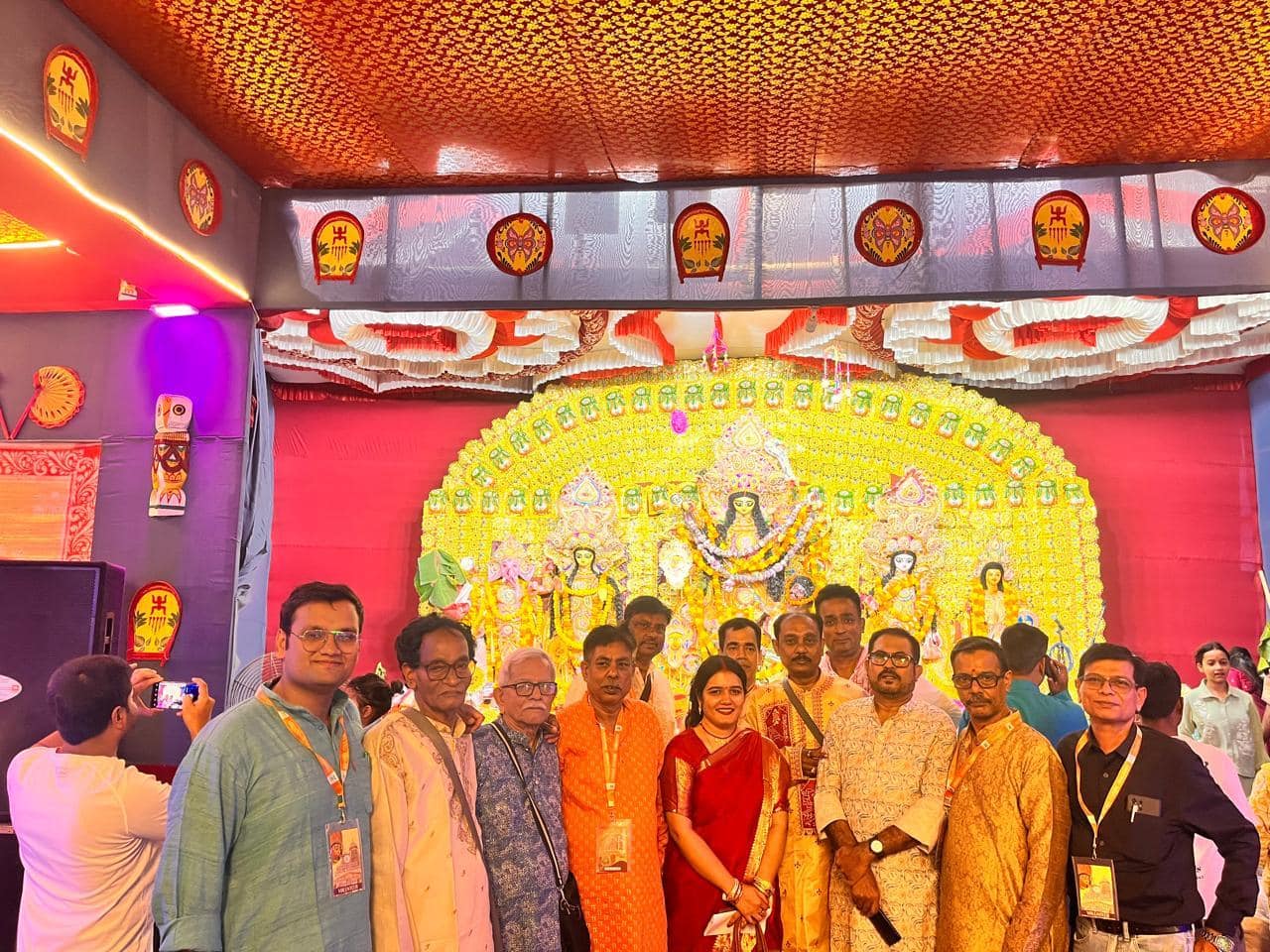
But the festival’s enduring character lies just as much in what happens around the pandal. It is in the music that brings artists together, the competitions that invite residents to participate, the adda that stretches beyond bhog hours, and the younger generation that returns from distant cities to reconnect with its roots.
Keeping those traditions alive in Vaishali requires more than putting up decorations for a few days. It depends on the participation of families, the work of artists and the willingness of a community to invest in preserving its cultural inheritance.
After 33 years, the celebration is a reminder that Durga Puja does not belong exclusively to Kolkata or CR Park. Across the suburbs of the National Capital Region, too, the festival continues to bring people together — carrying the traditions of Bengal into new neighbourhoods while allowing those traditions to grow through the communities that embrace them.
Disclaimer : This story is auto aggregated by a computer programme and has not been created or edited by DOWNTHENEWS. Publisher: abplive.com