
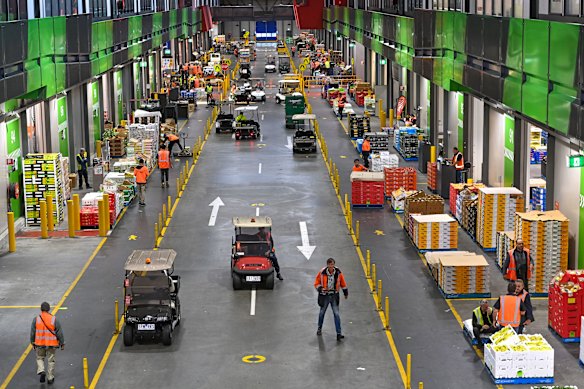

The state-owned Melbourne Wholesale Fruit and Vegetable Market would be put up for sale if the Coalition wins the November election, delivering what the opposition says would be a $578 million windfall to help pay down debt.
Opposition Leader Jess Wilson says the 67-hectare market in Epping would be better run by the horticulture industry, which has long wanted traders to take control of the site.
The Melbourne Market is Victoria’s only wholesale fruit, vegetable and cut flower market, and is home to almost 3000 traders who sell to greengrocers, restaurants, food manufacturers and florists.
The market moved from West Melbourne to its purpose-built $600-million wholesale Epping site in 2015 and is managed by the state government’s Melbourne Market Authority.
The Epping site is the only major wholesale market in Australia still government-owned, after NSW, Queensland, South Australia and Perth all sold their markets to horticulture industry membership groups.
Wilson will announce on Wednesday, when she speaks at The Age’s Melbourne Assembly civic forum at Federation Square, that the Coalition will pursue a similar deal to privatise the market if it forms government after the November 28 election.
“Victoria’s agriculture sector can run a fruit and veg market better than the government can,” she said in a statement. “Victorians need a government focused on the essentials, not one playing market landlord.”
The Coalition has not ruled out selling to a non-industry landlord, although Wilson said public interest safeguards would be put in place to protect its operation as a market, including competition protections, minimum service standards, and independently reviewed rents, fees and charges.
Fresh State Limited, an organisation representing more than 90 per cent of Melbourne Market traders, has strongly backed putting the market into industry ownership.
Its CEO, Jason Cooper, said the market was the most expensive in Australia to operate in and that traders had been struggling since moving to Epping a decade ago.
“The Melbourne Market should be run for the benefit of Victoria’s fresh produce industry, not as a cash cow for government,” Cooper said. “It’s time to put the market’s future in the hands of those who understand it best.”
As an example of an ownership model the Coalition may pursue, Queensland sold the Brisbane wholesale market in 2002 to a consortium led by Brismark, a fruit and vegetable wholesaler membership organisation. Brisbane Markets Limited now has more than 400 shareholders, mostly fruit and vegetable growers, wholesalers and retailers.
The opposition said divesting from the market would deliver a $578 million windfall, including the estimated proceeds of selling the site and savings from wrapping up the Melbourne Market Authority.
The figure is based on Parliamentary Budget Office costings, which the opposition said it would release along with its other election promise costings before polling day.
The Melbourne Market Authority’s 2024-25 annual report shows it has run at an cumulative $22.4 million cash profit over the past five years.
However, on an accounting basis – which factors in depreciation, or wear and tear of assets – the authority recorded a $48.5 million loss over that period.
The authority values its market site, buildings, equipment and other assets at $505.8 million. It had $18.7 million in borrowings from the Victorian Treasury, as of June 2025, which was down from $20.6 million in 2024.
The annual report says there was significant demand from tenants, and the market’s warehouses and trading stores were at 100 per cent occupancy.
Customer satisfaction was at 73 per cent in 2024-25, down from 75 per cent at the end of 2023 due to a dispute over rent increases.
Visits to the market – a key performance indicator for the authority – fell from 793,881 in 2022-23 to 762,280 in 2024-25.
Wilson said the market divestment was part of the opposition’s plan to save more than $24.5 billion and deliver a budget cash surplus by 2032.
The opposition has flagged other savings by freezing back-office public sector hires, capping executive bureaucrat pay and winding up the state’s venture capital firm Breakthrough Victoria.
However, The Age has previously revealed an $880 million hole in the Coalition’s election costings based on its pledge to wrap up Breakthrough Victoria, which Wilson has said would “wholly offset” the cost of sending 25,000 public patients to private hospitals for elective surgeries.
Victoria’s net debt is on track to reach $200 billion in 2030, pushing its interest bill to $12 billion a year.
Wednesday is the Melbourne Assembly’s final day. More information is available on the Melbourne Assembly website.
Start the day with a summary of the day’s most important and interesting stories, analysis and insights. Sign up for our Morning Edition newsletter.
 Patrick Hatch is state politics reporter at The Age. Contact him at patrick.hatch@theage.com.au, or via Signal at @pwhatch.61Connect via X or email.
From our partners
Disclaimer : This story is auto aggregated by a computer programme and has not been created or edited by DOWNTHENEWS. Publisher: www.smh.com.au



