
800 Pound Gorilla started its comedy company 10 years ago with the same goal as any successful stand-up: to become undeniable. That mission demanded that it tap into its very heavy spirit animal to find not only the best comics to work with but also the right ways to deliver them to comedy superfans around the world. Looking back on 800 Pound Gorilla’s decade of evolving from producing comedy albums to one-hour specials to the recent launch of its own streaming platform, Gorilla Comedy +, some fans might get the impression that this trajectory to becoming the biggest independent hub for comedy has all been very well thought out. They would be wrong.
“We definitely didn’t even know we had a business when we first started, and we didn’t even know that we’d be around for 10 months, let alone 10 years,” said Damion Greiman, leaning back in his chair in a glass-paneled conference room inside 800 PG’s Nashville headquarters. Over Zoom, he and general manager Tony Grotticelli talk about the motives that still drive the company to continue being a major player in the comedy world while maintaining flexibility to serve audiences what they want as the comedy content world continues to change. At one point the conversation turns to a recent special they produced entirely with spliced-together cellphone footage shot by people in the audience.
“The comedian came in and gave the audience an app to download, and all of them shot it from different angles. Then the community got that, and then had an editor cut it from all the different perspectives,” Grotticelli says with an excited grin on his bearded face. “We are in a constant state of conversation with comedians, or managers, or producers, or agents about new formats we’re trying, or new shows we’re trying.”
Founded in 2016 by Greiman and Ryan Bitzer — former music managers before getting into the comedy world — the independent media company thrives on big ideas and refuses to be labeled as just one thing. From producing and financing specials to distribution and partnerships with comics to further the reach of their content, 800 PG’s motive has been to solve the problems most comedians have when it comes to getting their stuff out there and giving them the space to innovate after they’ve found their tribe of fans. Their first project was producing Jim Jefferies’ comedy album “Freedumb” in 2016. By 2018 they had launched their first video project, a one-hour special with comedian Chad Daniels that pushed them into the world of streaming specials on YouTube and working with acts like Bill Burr, Matt Rife, Nikki Glaser, Leanne Morgan and many others who at some point in their careers weren’t being given a chance by big streamers like Netflix, Prime Video or Hulu.
“At the time, a lot of people said the way that you do video is you spend a lot of money doing video specials and then you sell them to Netflix,” Greiman said. “When that didn’t happen for us, we really started focusing on building an audience, and so it was the best thing that could have happened to us was that the big streamers didn’t want a lot of the things that we were producing.”
Anjelah Johnson Reyes (center) stands with the 800 Pound Gorilla team, including general manager Tony Grotticelli (far right) and company co-founder Damion Greiman (second from left).
(Mal Hall)
The company has produced more than 250 specials and estimates it currently generates just under $10 million annually in gross profits. It’s also amassed 2.3 million followers and roughly 20 million monthly views across five YouTube channels and various social media platforms.
But despite successful metrics — the company’s own or the comedians it’s considering getting into business with — Grotticelli says there’s really no way to produce comedic greatness strictly off surface-level numbers.
“Just because a comedian has millions of followers on one platform or millions of views on another platform doesn’t necessarily mean it resonates with our audience,” he said. “Just because they have a following doesn’t mean that that following is a following of stand-up comedy. It could be a following of a character. It could be the following of a viral moment. There’s a lot of different metrics that go into that.”
But assessing the audience a comic might draw is still only one way of testing whether something will work on screen. Being aware of trends in content consumption and how they match with what jokes or sense of humor a comedian creates on their own platform is also important, as well as finding the right time to bet on their success.
“Our job is to be vigilant on that and see what’s coming, but not go too early,” Grotticelli says. “A lot of our conversations are about what the next 10 years are going to look like and how do we stay looking ahead, but not too fast in front of our audience.”
Of course being tactical in their approach to comedy meant eventually getting into the streaming game and creating a streamer themselves. In May, the company launched Gorilla Comedy +, available for $9.99 a month, which puts all of 800 PG’s specials in one place along with new exclusive specials such as Patton Oswalt’s “Tea & Scotch,” which premiered on the platform. Aside from condensing the company’s various offerings on YouTube and elsewhere into one giant hub, it also makes everything easier to watch on TV. The target demo ranges from age 35 to 55 and is mostly people with families living in suburbs.
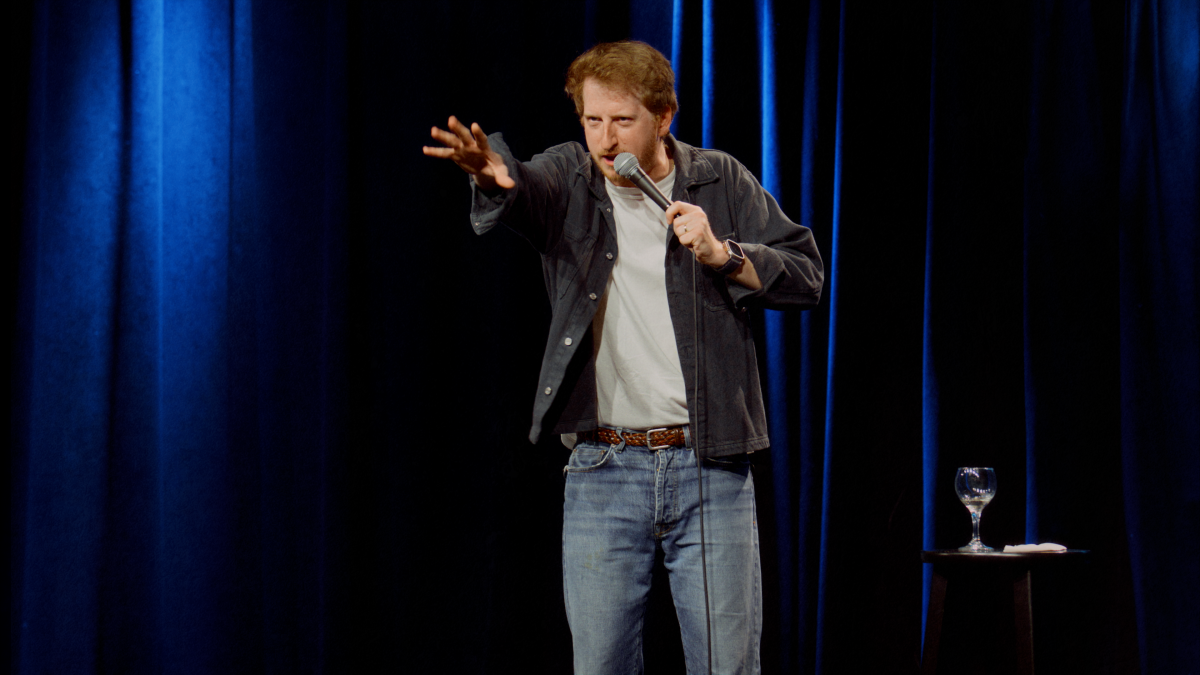
Comedian James Austin Johnson of “Saturday Night Live” on stage for his special “He’ll Yeah,” produced by 800 Pound Gorilla.
(Photo from 800 Pound Gorilla)
“We’re pretty good honed in on who our audience is, and we saw the audience saying ‘I want to watch on my TV,’” Grotticelli said. “And then from a second standpoint, we saw comedians saying, ‘Hey, we need more hours of distribution, and we don’t want to be told what we can and can’t say in our specials.’”
While it’s still in its infancy, the platform continues to follow the company’s plan to become the biggest animal in the independent comedy content jungle by simply doing what 800 Pound Gorilla does best and staying in its lane.
“It’s really about the direct relationship with the audience. We’re not looking to become Netflix,” Greiman said. ”I think if our strategy was for people to cancel Netflix and go to Gorilla Comedy +, that’s not what we’re looking to do.”
Focusing on thriving in the next 10 years is something that will only happen with innovation and opportunities that are as well-timed as a great joke.
“We’ve got a lot of things in the works,” Greiman said. “I think you’re going to see that evolve from where we’re at today, but the core of it is stand-up comedy. Right now, it’s serving those comedy superfans.”
More to Read
Disclaimer : This story is auto aggregated by a computer programme and has not been created or edited by DOWNTHENEWS. Publisher: latimes.com