
It’s almost unthinkable, but it is being spoken out loud. UBS, which can trace its Swiss origins back to 1862, is actively considering whether it should change its domicile.
Next week the lower house of the Swiss parliament will debate a proposal from their colleagues in the upper house that would force the bank to capitalise its offshore subsidiaries almost entirely with equity.
UBS says that would require it to hold about $US16 billion ($23 billion) of additional common equity tier one (CET1) capital, diluting its shareholder returns and rendering the businesses uncompetitive with its global counterparts.
The parliamentarians’ motivation is obvious. They’re afraid of history being repeated.
After the 2008 financial crisis, the Swiss government was forced to provide about $US60 billion of capital, liquidity and other relief to bail out UBS, which had plunged heavily into sub-prime mortgages in the US and experienced more than $US40 billion of losses when that market imploded.
Three years ago, the government had to provide more than $400 billion of liquidity support to Credit Suisse when a run, sparked by the regional bank crisis in the US, threatened to topple the country’s second-largest bank.
The government oversaw the forced merger of Credit Suisse into UBS and provided both a liquidity backstop and a $15 billion indemnity against losses within Credit Suisse’s portfolio. The guarantee was never called on and the liquidity support was repaid within months.
That merger of its two largest banks created a bank with $US1.7 trillion of assets – about 149 per cent of Switzerland GDP.
UBS became the definitive bank that is too big to fail – the biggest bank in the US, JPMorgan Chase, has assets of about $US5 trillion, but that’s less than 16 per cent of US GDP.
Not surprisingly, having confronted disaster twice, the Swiss government was worried about the behemoth it had created.
In both UBS and Credit Suisse’s cases, the mistakes that led to the threats to their solvency emanated from their misadventures abroad, using their low-risk Swiss bases and access to low-cost domestic funding bases to expand offshore, chasing returns from risky assets without appropriately pricing the risks and capitalising the offshore entities exposed to them.
UBS learned from its bruising experience during the global financial crisis, but Credit Suisse didn’t absorb those lessons from its rival. Indeed, a factor in Credit Suisse’s effective demise was its determination to compete with the larger UBS by taking more, and more exotic, risks.
The Swiss parliamentarians initially proposed that UBS’ offshore operations should be capitalised 100 per cent with CET1 capital, which could have meant UBS holding an extra $US20 billion of equity.
There was a proposal where half that equity could be contingent convertible (CoCo) bonds, which would forcibly covert into equity if UBS’s capital rations fell below an agreed threshold, but the current proposal is for the offshore units to be backed by 90 per cent CET1 capital, without the CoCo bonds.
It’s that proposal that UBS says could force it to hold $US16 billion of additional equity, with other measures in the proposed legislation potentially adding a further $US2 billion.
There are other proposals floating around – one would see the CET1 backing reduced to 75 per cent of assets – but the lower house will be debating and voting on the 90 per cent option.
UBS, understandably, isn’t happy. Any of the options would hurt its returns to shareholders and make it less competitive – potentially uncompetitive – against its major competitors.
In the US, the Trump administration has been heading in the opposite direction to the Swiss, winding back some of the post-financial crisis bank regulation and lowering US big bank capital requirements, which would widen the competitive advantage the US banks would have over UBS is it has to pump up its capital base.
The group only recently gained a broader banking licence in the US as a key element of its drive for international growth, and US growth in particular.
Its long-held ambition has been to build its US presence to compete with the US banking giants and be a global bank and investment bank, but the recapitalisation of its offshore operations would probably make that a pipe-dream. Successful and profitable banking and wealth management businesses in the US and the Asia-Pacific would be threatened.
UBS, and some of its bigger shareholders, have been canvassing its options out loud, although they might be brinkmanship: an attempt to bluff the lawmakers into less onerous measures.
The options range from a shift in domicile to the US, while retaining the Swiss domestic businesses, to a split of the domestic and offshore businesses into discrete entities, to a sale to, or merger with, another bank in the US or Europe (Morgan Stanley has been mentioned), or a retreat from international markets to focus on the domestic business that generates about a third of UBS’ revenues.
None of those alternatives is attractive to a Swiss board and management that has very successfully integrated Credit Suisse, a process that will finally end this year.
The parliamentarians’ motivation is obvious. They’re afraid of history being repeated.
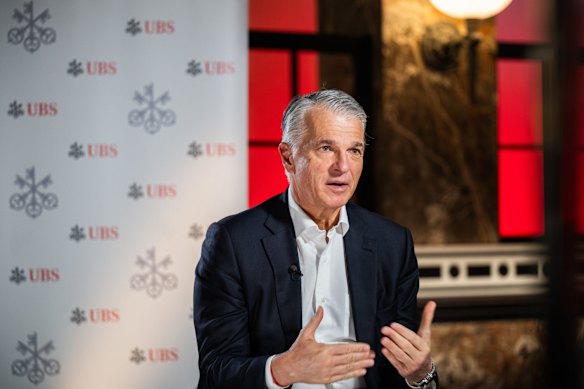
The group’s chief executive, Sergio Ermotti, has declared that shrinking is not an option.
UBS’s preference, if it has to hold more capital, is for a substantial proportion of it to be the CoCos, which are classified as AT1 capital. They might add to its funding costs, but would be less dilutive for shareholders than CET1 capital.
Swiss finance minister, Karin Keller-Sutter, played a key role in forcing through, and negotiating the structure and financial terms, of UBS’ acquisition of Credit Suisse.
Having seen the risks of having a large bank whose international operations weren’t separately capitalised driven to the brink up close, she’s been the driving force in the plan to recapitalise UBS’s offshore operations.
She has said the question for the parliament is simple.
“Who has to bear the risks that a major bank takes abroad? Is it the owners of the bank, the shareholders? Or also the taxpayers in Switzerland?”
That’s a question that bank regulators and their governments around the world have continuously asked themselves.
They can do things that reduce the risks to taxpayers of a major bank failure – like forcing the banks to hold more capital and high-quality liquidity – but there are banks, like UBS (or CBA, whose total assets are approaching 50 per cent of Australia’s GDP), that are so large in the context of their economies that they cannot be allowed to fail and therefore, in practice if not legality, are ultimately backstopped by the taxpayer.
UBS’s size relative to Switzerland’s economy was underscored by another proposed government plan create a public liquidity backstop for systemically important banks, funded by as levy on systemically important lenders with significant international operations.
UBS would be the only Swiss bank that met the criteria.
The Business Briefing newsletter delivers major stories, exclusive coverage and expert opinion. Sign up to get it every weekday morning.
From our partners
Disclaimer : This story is auto aggregated by a computer programme and has not been created or edited by DOWNTHENEWS. Publisher: www.smh.com.au



