Updated ,first published
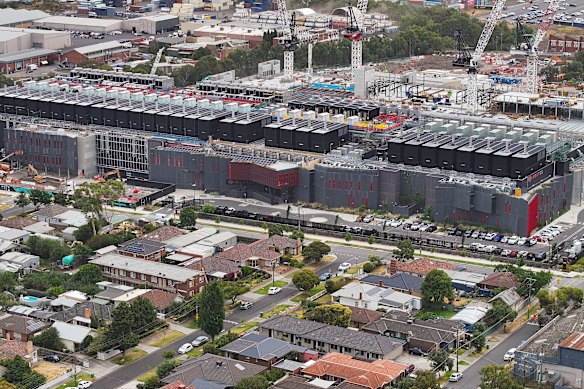
What began as a community protest in Melbourne’s inner west over giant electricity poles being installed on quiet residential streets has now rocked the nation’s highest-profile data centre developer, as it scrambles to find a new way to supply energy to its flagship facility.
On Wednesday, ASX-listed NextDC announced it would slash its expected profits and construction spending, as it deals with delays in getting more electricity supply into its West Footscray M3 data centre.
The news triggered a share price collapse that wiped about $3 billion off the company’s valuation and sparked a warning from investors and analysts that a mounting community backlash across Australia against data centres posed a worsening threat to the booming sector.
Plans to build dozens of new data centres across the country are running into social opposition, partly due to the vast amounts of electricity needed to run their high-intensity computing and cooling systems, and the proximity of some sites to people’s homes.
“Community concerns around data centre developments present a real risk to the timing of delivery of contracted capacity for data centre owners,” said RBC Capital Markets analyst Tom Beadle, pointing to NextDC’s earnings cut and warning that local opposition could disrupt projects.
That residential pushback has hit other projects nationwide: developer Green Square was recently forced to pull a proposed project in Western Australia, Goodman Group shelved a $1.2 billion facility in Sydney’s Lane Cove, and private developer Firmus was forced to abandon a planned $44 billion stock market float.
The news for the data centre industry “keeps getting worse and worse”, Ten Cap portfolio manager Jun Bei Liu said, particularly for developers with unbuilt facilities where customers hold contract-termination rights if projects are delayed.
Last week, Microsoft pulled out of a deal to anchor a flagship facility in the United Kingdom following power-supply delays.
“What’s happening with NextDC highlights the risk for companies that have secured energy and water, but whose facilities are not yet built,” she said. “These risks are playing out in real time. There will definitely be more investor scrutiny now.”
NextDC came out of its two-day trading halt on Wednesday, warning investors that the next stages of the politically contentious M3 development – which sits just metres from some West Footscray residents’ front gates – would also not be approved until after next month’s Victorian election.
A community blockade in September, revealed by this masthead, hit electricity distributor Jemena’s rollout of 15-metre-tall 66,000-volt residential power poles. Direct action by residents included blockading streets by parking cars and light trucks where power poles were to be installed, co-ordinating via WhatsApp groups to ignore door-knocks from contractors, and filling excavation pits with green waste.
The protests, and subsequent local political backlash, saw Jemena halt powerline construction until at least February. It will leave NextDC without extra power it needs to keep expanding its West Footscray data centre.
Yarraville resident Milco Bogoevski was among those who led the community protest to halt Jemena. He said while he was sympathetic to data centre operators – “no one here wants to see industry fail” – what had happened was the direct result of power companies and businesses not listening to residents.
“These power lines, this material, it was going to be in our street, we were going to have to deal with it for decades after they left – power operators like Jemena, and businesses like NextDC, they’re going to need to engage more with the community.”
Bogoevski said community opposition to the West Footscray data centre and the impact of other data centres in Melbourne’s west could help swing seats in the November 28 election. “The state government is responsible for electricity – it comes down to them. There’s a good chance an issue like this could flip this seat away from Labor,” he said.
The market reaction against NextDC was sharp: its shares collapsed on Wednesday to as low as $5.07 – down more than 40 per cent from their Monday closing price of $9.57. The price recovered slightly and shares were trading at $5.53 at about 3.30pm, still a far cry from the peak of $17.22 a year ago.
NextDC also revealed it was putting the brakes on its wider construction pipeline, in a move that could alarm state and federal governments as data centre construction has provided a rare bright spot in the sluggish Australian economy. The company had planned to spend up to $5.75 billion on construction in the coming financial year, but will now spend between $4.5 billion and $5 billion.
NextDC chief executive Craig Scroggie said the company, as well as pausing expectations from its West Footscray project, would also halt speculative expansion projects and land buys not already locked in.
“With [West Footscray] revenue deferred, we have paused projects not backed by customer contracts and put that capital behind the capacity our customers have already contracted,” he said.
Scroggie said the company was working with Jemena on community consultation and considering other options.
“We’re working with them on alternative routes that may be feasible, and alternative locations for such poles and undergrounding,” he said, although noting that undergrounding the cables would take more time.
He also flagged political uncertainty as a challenge for the project as NextDC awaits planing approval for the final expansion at M3.
“It has been with the Victorian government and planning minister for a very long time, and when the Victorian government went through recent portfolio changes and the Premier changed, obviously the decisions in relation to approvals and other things slowed down,” he said.
NextDC’s market shock represents the clearest evidence yet that Victoria’s rapid push to attract power-hungry artificial intelligence infrastructure has run into severe grid constraints and suburban backlash.
The West Footscray data centre is planned to eventually span 10 hectares in an industrial pocket adjacent to hundreds of homes. It already occupies five hectares and was undergoing a $750 million expansion – which required Jemena to replace standard wooden electricity poles with concrete poles carrying 66,000 volts along residential streets in West Footscray and Yarraville.
A typical residential power pole carries about 400 volts. A Maribyrnong City Council spokeswoman noted that some poles in the rollout rise as high as 22 metres – equivalent to seven storeys.
Read more on our data centre coverage:
Start the day with a summary of the day’s most important and interesting stories, analysis and insights. Sign up for our Morning Edition newsletter.
 Clay Lucas is an investigative reporter at The Age who has covered urban affairs, state and federal politics, industrial relations, transport, health and aged care. Email him at clucas@theage.com.au or claylucas@protonmail.com, or via Signal +61439828128.Connect via X, Facebook or email.
 Nick Toscano is a business reporter for The Age and Sydney Morning Herald.Connect via X or email.
From our partners
Disclaimer : This story is auto aggregated by a computer programme and has not been created or edited by DOWNTHENEWS. Publisher: www.smh.com.au