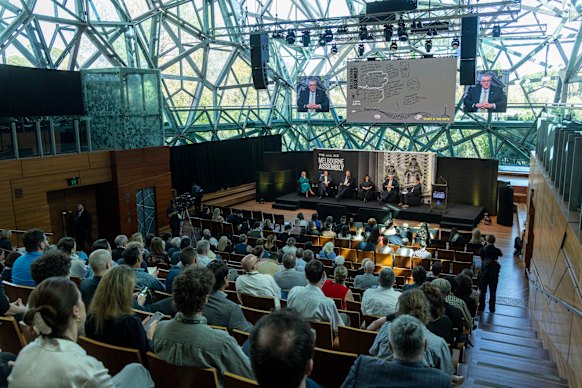
What we covered today
Thank you for tuning in to our live coverage of Melbourne Assembly, our inaugural civic forum.
We’ve heard from an impressive group of speakers who have each offered different perspectives on our city and its future. Here is a quick recap of what we heard today.
- Premier Ben Carroll shared Labor Party’s plans to combat Melbourne’s housing crisis, including announcing its plan to build 25,000 new homes for first home buyers.
- Franco-Colombian urbanist Carlos Moreno, our keynote speaker and pioneer of the 15-minute city concept, discussed the importance of proximity in cities, and why the inner city needs to be better connected with Melbourne’s suburbs.
- Opposition Leader Jess Wilson spoke about the Coalition’s plan to reduce Victorian debt, which includes a plan to sell a fruit and vegetable market if it wins the upcoming election.
- We heard a debate for the ages between The Age senior culture writer Karl Quinn against sports broadcaster Kelli Underwood – which asked whether sport or art is the true heart of Melbourne? It was a draw.
- Our sport and the arts panel discussed the future of Melbourne’s major sporting events. Victoria Racing Club chief executive Kylie Rogers said Melbourne was at risk of losing flagship events if we “rest on our laurels”.
- Former New York City mayor Bill de Blasio returned to stage, where he discussed the major impacts of AI and climate change in answers to audience questions. Moreno joined him, saying that denser suburbs fostered human connection and were the antidote to dark forces in society.
You can catch up on our Melbourne Assembly series here.
Enjoy your evening.
‘Find ways to tax AI’: Former NYC mayor
Former New York City mayor Bill de Blasio is emphasising the importance of AI regulation, and saying society needs to take a stand against big tech.
Here’s a little of what he had to say.
Let’s be clear. Our dear friends, the big tech companies, care about nothing but money. They have driven us into an incredibly dangerous situation because they were all racing against each other for profit.
If we reverse that, if we find ways to tax AI, we find ways to create product liability legislation, if we can create the right kind of consumer boycotts, if we have the power of local and regional and national governments … there’s lots of ways to start to constrain the private sector in terms of AI.
Former NYC mayor on climate change and AI
Age editor Patrick Elligett is now asking former New York City mayor Bill de Blasio about Melbourne’s outer suburbs, where the population is further away and less connected to the CBD.
During his keynote speech yesterday, De Blasio shared nine of his “fast and furious” ways in which Melbourne could be potentially improved. But how can we ensure that these strategies are applicable to all Melburnians?
The former mayor is now emphasising the importance of his two final points from yesterday – climate change and AI – which he says are not dictated by location.
“We’re not going to be able to afford – as a society – to use energy the way we have in the past. We’re not going to be able to afford to have the amount of pollution we’ve had, emissions we’ve had in the past. We have to start learning a different way,” De Blasio says.
“I would argue suburb, inner city, whatever. It doesn’t matter. We need a strategy, and we need to realise that we must take matters in our own hands.”
Denser suburbs an antidote to dark forces: Moreno
We’re back with a final session with Bill de Blasio and Carlos Moreno taking questions from the audience in a session moderated by Age editor Patrick Elligett.
The first question is if Melbourne’s growth should be focused on expanding the outer fringe or densifying established suburbs.
Moreno says Melbourne’s traditional quarter-acre blocks are obsolete and that building more density in established areas is “absolutely necessary”, given the high cost of providing essential services to sprawling new suburbs.
Building denser cities, where social connection can happen more easily, is also an antidote to many of the social forces harming communities, he says.
“In these hard times, in these times with the dark enlightenment and fake news, we need to create a social human connection, and this social human connection is only possible by this social contact with people that live in the same area”.
The future of Melbourne’s major sporting events
Moderator Waleed Aly is posing an interesting question to our sport and the arts panel. Is Melbourne at risk of losing some of its major events, such as the Australian Open or the Australian Grand Prix?
Victoria Racing Club chief executive Kylie Rogers says that Melbourne could “absolutely” forfeit some of its flagship sporting moments if it isn’t careful.
“Melbourne is renowned for the four major events, and … we activate beautifully. But we can do so much more, and if we just rest on our laurels, we’re going to lose them,” Rogers says.
“It’s too competitive out there. I’ve just seen the NFL come to town, and what they did was another level. The way they activated around our city was truly like a Super Bowl.”
Melbourne’s cultural power built on grassroots organisations
Melbourne is renowned for its major events and cultural institutions.
But Tiriki Onus says we overlook how often these have grown out of grassroots arts organisations.
“We don’t necessarily talk about how the spaces that we inhabit were built, how communities come together to build [them],” he said.
Onus pointed to how Melbourne’s beloved Moomba Festival grew out of the 1951 protest theatre show An Aboriginal Moomba: Out of the Dark, produced by the radical left-wing New Theatre and the Australian Aboriginal League.
“I think oftentimes we take a lot of these spaces for granted. We don’t necessarily understand their history,” he said.
“But we sit within a history of passionate community members who have come together and have these spaces.”
Could Flemington Racecourse soon open 365 days a year?
Victoria Racing Club chief executive Kylie Rogers is sharing her plans for a Flemington Racecourse precinct that’s open to the public year-round – as part of our sport and the arts panel.
Moderator Waleed Aly has asked how the exclusive space could be made more accessible to the public, noting it’s currently difficult to just “hop down just to the local racing club”.
Rogers says the club has ambitions of a pedestrian bridge from the racecourse to Footscray Park, pony rides for the local community and a Flemington Racecourse train station that’s open every day.
“We sit on 127 magnificent hectares, six-kilometres away from the CBD. In fact, our space is the same size as the Melbourne CBD. We have the largest rose garden in the Southern Hemisphere … It’s quite an exquisite place,” the chief executive says.
Melbourne’s a capital for watching sport, not playing it
Olympic great Kieren Perkins says it’s becoming harder for Melburnians to participate in sport rather than just watch or bet on it.
“The main functions of the highly coordinated, organised sporting environments that we operate today is that they’re streamlined, hyper-competitive, far more focused on talent ID [identification],” he said.
Perkins, who is now chief executive of the Australian Sports Commission, said most people had experienced children’s sport being played for “sheep stations”.
“As a consequence, the opportunity for people to play a variety of different things in their childhood is dramatically diminishing.”
Arts and sports leaders weigh in on Melbourne’s strengths
We’re back, and Waleed Aly is hosting a panel on sport and the arts in Melbourne. He started by asking the panel to identify the most special thing about Melbourne.
Kylie Rogers, Victoria Racing Club chief executive: “The diversity of experiences. When I worked Sydney, you would do deals over the phone with people. In Melbourne, you’re having Sunday barbecues with your clients’ families.”
Kieren Perkins, swimming great and Australian Sports Commission chief executive: “I’ve lived here for a decade now and at not time have I ever felt like it’s been hard to live here. It’s an easy place to be accepted”.
Dr Tiriki Onus, pro vice-chancellor (Indigenous), University of Melbourne: “We have all of these diverse stories. We can come together in these gorgeous, delicious spaces of flux, where we can celebrate that which is different.”
Watch: A better Melbourne through future leaders’ eyes
We’ve heard a lot about the future of Melbourne at this forum. But what does the next generation think?
We asked year 7 students, the leaders of tomorrow, to share their ideas on how Melbourne could be a better place to live in the future.
The students attend public, independent and Catholic schools across Melbourne.
From building more social housing and making the city greener, to ensuring there are more local jobs and better public spaces in the suburbs – the students’ ideas reflect a community-minded and inspiring generation.
Watch the videos below to learn more.
Disclaimer : This story is auto aggregated by a computer programme and has not been created or edited by DOWNTHENEWS. Publisher: www.smh.com.au