A message on my phone buzzes. “I pick you up at the station.” It is Erik ten Hag offering a lift in his car once my train from Amsterdam arrives in Enschede, in the east of the Netherlands. It is delayed, but he doesn’t seem to mind.
Soon after, he pulls up in a silver Range Rover and gets out to exchange a handshake. He has finished a day’s work at FC Twente’s stadium, De Grolsch Veste, where he is technical director.
A short while later, he is driving us through picturesque Dutch countryside on the way to Ros van Twente, the hotel he co-owns with his brothers, Michel and Rico, and John Berghaan and Anita Stappenbeld, who run it. “They got married two weeks ago as a surprise,” says Ten Hag, grinning.
Two years on from the end of his time in charge of Manchester United, Ten Hag is in a relaxed mood. As we weave through the flat fields, he provides a history of the place. “The Germans were here in the Second World War, but also the English and Americans afterwards – they lived here on the base of the military airport,” he says.
Heaven is a Place on Earth by Belinda Carlisle comes out of the speakers as his car stereo goes through a 1980s playlist. “In this period it was real music; now everything is computer,” he adds.
He moves on to a devastating event in the year 2000 that affected him while playing for FC Twente. A fireworks depot that supplied pop concerts exploded, killing 23 people, including four firefighters, injuring 950, and destroying 400 homes. Ten Hag says it was lucky the blast didn’t hit the propane drums at the Grolsch brewing factory on the outskirts of town; otherwise, the damage would have been even more severe.
Twente’s training ground was close by and players’ families and friends were hurt, but the club ordered the squad to complete their final match of the season the next day, a trip to Feyenoord. Afterwards, Ten Hag gave an interview to broadcast media and criticised the executives.
“The leadership of the club were mad at me, but they had made the decision to play,” explains Ten Hag. “Everyone is agreeing now: you can’t play football when your city is burning.”
Ten Hag speaking his mind is a theme that comes up repeatedly as we talk in a private dining room at the hotel. He opens up like never before on many key aspects of his time in charge of Manchester United and his career since, including:
- The use of data at United and his offer to INEOS
- Why a 2-2 draw with Sevilla in April 2023 was a turning point in his reign
- How that summer’s pre-season ‘killed’ players
- Adding dynamism to Kobbie Mainoo’s game
- The rationale of picking Noussair Mazraoui at No 10 in Istanbul
- How players are affected by United legends who are now pundits
His ‘strange’ three-game spell at Bayer Leverkusen
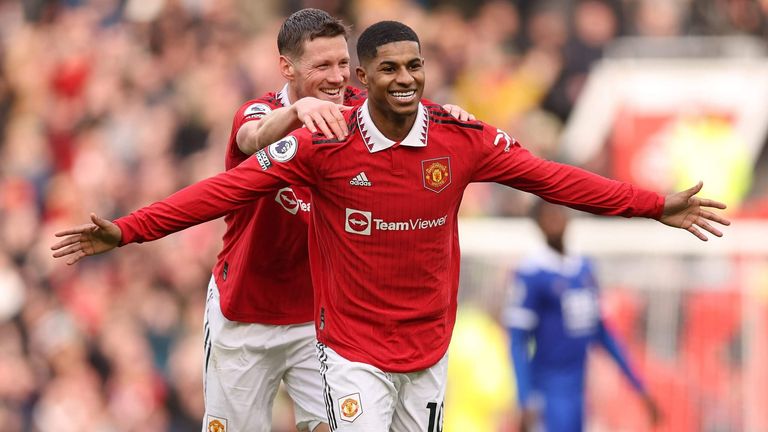
In January 2023, Ten Hag needed a replacement for Cristiano Ronaldo at centre-forward. He used his Dutch connections to loan Wout Weghorst from Burnley, and to this day feels the striker’s work off the ball was a contributing factor in Marcus Rashford hitting 30 goals that season.
“Wout did well for us; what he took out of his career is amazing,” says Ten Hag. “Like Marcel Sabitzer. We got success, winning the League Cup, third position; we were a team because they worked hard. Wout was one of the reasons Rashford was so important.”
Weghorst, standing at 6ft 6in (198cm), made an unexpected appearance as a No 10 in the Camp Nou, where Rashford went up top and scored in a 2-2 draw against Barcelona. United came from behind to win 2-1 in the home leg, a last-32 tie in the Europa League, one of the great recent European nights at Old Trafford.
Weghorst then started up top in the Carabao Cup win over Newcastle United at Wembley, sliding a pass through to Rashford, who finished to make the score 2-0.
A week later, United got thumped 7-0 at Anfield.
“The team was not consistent,” says Ten Hag. “On our good day we could match the best teams in the league, in the world, I would even say. On the worst day, we sat below the bottom. And then in Liverpool, obviously, we went below the bottom, also mentality-wise. It was the next Premier League game after we won the League Cup. We were on the high; we went up there, maybe we were too confident, and we got punished. Every attack was a goal.”
But the game in which Ten Hag feels his reign changed was the quarter-final of the Europa League a month later, when United were knocked out 5-2 on aggregate by Sevilla, having been 2-0 up in the first leg. “The team couldn’t play without two players,” he says, naming Lisandro Martinez (Licha) and Bruno Fernandes.
“Licha was so important for us to play from the back, but also the winning mentality, winning duels. And Bruno. In that game (first leg), at 2-0 up, I decided to sub Bruno, 30 minutes from time, and then Lisandro broke his foot.”
United finished the season with 27 home wins, equalling a club record across a campaign, but they would have broken it had they held on at Old Trafford against Sevilla.
Ten Hag had shown his faith in Fernandes by naming him captain. “I think it was good for the team, the best solution, and for him it was good as well. Obviously he has some pros and cons, but he has great game understanding, he’s a top professional, and he always gives his best; lifestyle good. Every day, he goes to the limit; he’s driving it.”
Ten Hag laughs. “Sometimes he’s getting emotional, but he’s a winner.”
Ten Hag allowed Fernandes tactical latitude on the pitch. “I gave him some freedom in the game plan. I think I’m always quite self-critical and reflective. I have to say I can’t see a game where the players didn’t want to transfer the game plan onto the pitch. They were always trying because I think they believed in what we did.”
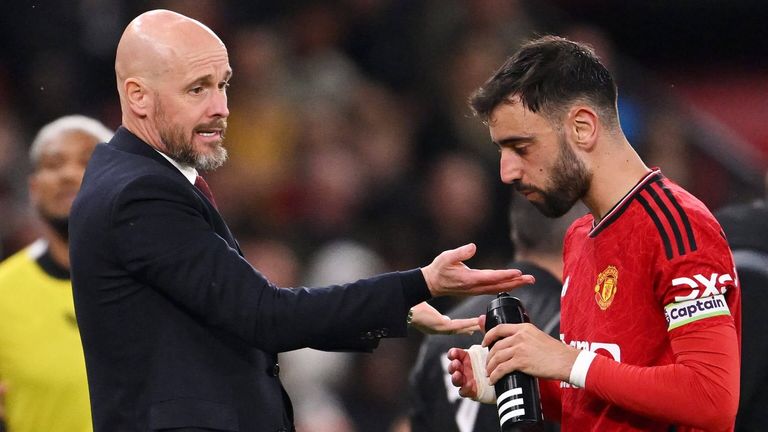
Ten Hag made Bruno Fernandes Manchester United captain
Pre-season before the 2023-24 season, during which United flew to New Jersey, San Diego, Houston and Las Vegas, pointed at issues ahead. Flying 13,650 miles across the Atlantic, from city to city, impacted the players, Ten Hag reveals.
“The tour was so much expectation on the players,” he says. “We got exhausted from all the kilometres. We started in New York, we played in Houston, we played in Vegas, went back, we gave them a couple of days off, and then we didn’t train proper tactical and physical work for 10 days because they were totally killed… We were never fit.”
Kobbie Mainoo, then 18, suffered an ankle injury against Real Madrid in Texas. When he finally made his first Premier League start, at Everton, he was named man of the match in a 3-0 win.
Ten Hag knew he had struck gold from the academy when he was first drawn to Mainoo in July 2022. “The first time I saw him, playing for the second team, I thought, ‘OK, he’s an amazing talent’. But he was too easy. I saw that we needed him to get in a higher intensity. We started to bring him in drills where we challenged him on dynamics.”
Mainoo has recently praised the sessions put on by Ten Hag and his assistant, Mitchell van der Gaag. He told Clarence Seedorf on Amazon Prime how training was “tough” but among “the best” of his career, adding: “The intensity and competitiveness of those sessions really helped me in that time.”
Ten Hag laughs. He gets sent all the quotes from players criticising his regime, but this is one that hasn’t been passed on to him. “Kobbie is, for me, special. A lot of people were building him, supporting him. But in the end, he’s doing it by himself.”
United’s injuries continued that season, though, and results suffered. Ten Hag picked 13 different centre-back combinations and changed his back four 29 times. “So it’s almost impossible to get automatism in,” he says. “But I know at the top, it’s about the result.”
Ten Hag adds: “Expectations at United are so huge, everyone is expecting the team to win the league every year. But be fair, United at that time, and also definitely two years after, are not able to win the league.
“We could have won the title if we had continued on building. But in that time we were not consistent enough; the squad was not good enough to win it.”
‘Sancho didn’t want to play on the right’
In October 2024, United’s executives decided Ten Hag was not the man to lead them to a title challenge. The writing appeared on the wall after his job was so publicly at risk around the FA Cup final triumph over Manchester City five months earlier. But he insists his maverick choice to start Mazraoui at No 10 at Fenerbahce in his penultimate game was not a last roll of the dice, but rather a selection Jose Mourinho would not predict.
“Not everything comes out in Carrington,” says Ten Hag, chuckling about news leaking from United’s training ground. “That’s me; I surprised them also in the FA Cup final, and often I got it right. That’s not a risk to put Mazraoui there… But sometimes I have to go more in the head of a fan or media, to think that they think it’s weird. For me, it was logic.”
Ten Hag started loanee Sofyan Amrabat in the FA Cup final against Manchester City, instead of Casemiro, to get more coverage in midfield. United then bought Manuel Ugarte that summer but Ten Hag thinks he could have instead kept Scott McTominay and saved money on Amrabat. He says: “I wanted to keep Sofyan Amrabat, they didn’t. I think he did a great job at United.”
Ten Hag was scrutinised by pundits for his call in Istanbul, and for much else in his tenure, but he has a sanguine response to a question about the impact on United of the host of former players giving their views as pundits. Gary Neville, Roy Keane, Wayne Rooney, Rio Ferdinand, Paul Scholes and Nicky Butt all regularly pass comment, occasionally sharply, on their YouTube shows as well as more mainstream channels.
“It’s everywhere the same; they always want to protect their legacies,” says Ten Hag. “It’s no different than Bayern Munich or Ajax; they do the same. But they are (part of United’s) history, and they do not always know what’s going on. Football evolves. For United, it’s clear: they had great contributions, they achieved massive results, trophies for the club and for themselves, so I respect them.
“I have to say, I had a very good relationship with them all, with Gary Neville, Rio Ferdinand. I did nice interviews with them both, so it didn’t hurt me. Of course, they have podcasts, they have their models. Sometimes it’s difficult for players. Some of them get affected by it, get annoyed by it.
“They achieved massive successes. But also, they can help the club more, help the players more. There should be two ways that they support it. But I think always the thing you most love, you most criticise.”
Perhaps that is why Ten Hag was so robust with his United players, even those he signed. Antony was the €100million (£84m, $112m) winger viewed as the biggest stick with which to beat Ten Hag. A player who he coached at Ajax arrived for one of the largest sums United have paid for a player, but delivered very little and had off-field issues. Ten Hag rates Antony as a player, but he twice tore into him after games over his positioning.
Antony’s cost affected perceptions. In his first summer, Ten Hag found himself needing a right-winger late in the window due to Jadon Sancho’s unexpected stance. “There came up a problem because Sancho didn’t want to play on the right side; he said that,” says Ten Hag. “Which was very weird; he played often on the right. He said he felt more comfortable on the left. So there we had an issue, and we were late.”
Antony, also recommended by the scouting department, was bought as the right-winger on deadline day, with Ajax taking advantage of United’s circumstances to extract a fee well above market rate.
Ten Hag denies a player’s background influenced his selections. “I see on performances and profiles what is needed for the game,” he says. “Not on emotion, if I like a player or dislike a player, or if I trained him before, or if I bought him or the club bought him, no, I can be acting very professional, I would say.”
His manner has been called brusque, but away from the intensity of that job, he is personable and thoughtful. He is warm with John and Anita, who serve us a steak dinner.
Ten Hag’s spell at Bayer Leverkusen was cold, even for the crazy world of football. He was sacked after three games in charge, having taken over from Xabi Alonso, who won the Bundesliga then went to Real Madrid.
“It’s a very strange story,” he says. “They ended an era with Alonso, so all the players wanted to go. We fought for some and they were not committed anymore. So it was waiting until September 1. The good players signed in the last couple of days. I never worked with them. Three games and then we parted ways.”
Talk of Leverkusen leads Ten Hag to bring up Garnacho. “I regret where he is now,” he says. “I told him, ‘Come to Leverkusen’. But luckily he didn’t. He wanted to stay in England. I understand, the best league, so he denied.”
Ten Hag helped develop Garnacho into a Premier League player. His move to Chelsea hasn’t worked out and now he is on loan at Aston Villa.
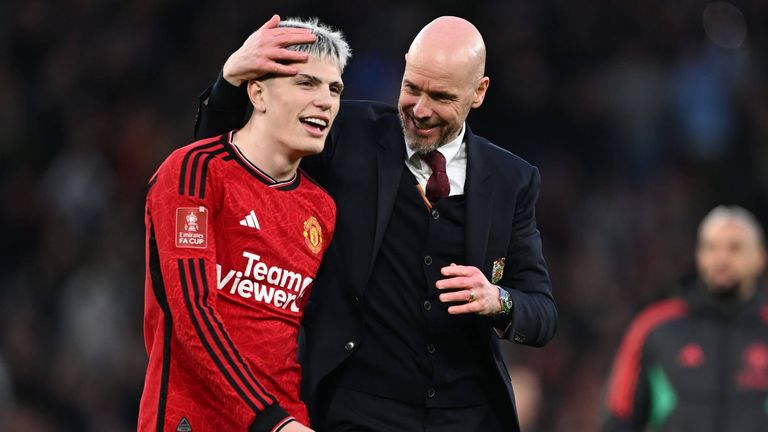
Ten Hag tried to sign Alejandro Garnacho for Bayer Leverkusen
“He’s a character, you have to manage him, but I had a strong connection with him,” says Ten Hag. “But it’s also up to him, of course, but he needs a coach, a particular coach, who will give him trust, who will give him love. He needs the love, definitely. But he’s an amazing player. What’s so special about him is he can run all day, high volume at really high speed, all game, back and forward.
“Sometimes his head is not on defending. So mentally, his mindset, you have to make sure he is focused and disciplined and does the job every transition, but he’s capable of doing it and attacking-wise he can go forward and do incredible things, making dribbles, finishing. He can do the final pass, but sometimes he’s a little bit selfish.”
Ten Hag laughs. “But yeah, you balance this.”
Ten Hag pulls out his laptop to show FC Twente’s plans and data analysis. There is an image that depicts the team as a boat going downstream, passing by landmarks they need to hit. He also has pages of detailed statistical analysis, which he uses for recruitment.
“Seven points where I judge the player,” he explains. “Technical ability, for me, is most important. Second is game intelligence and cognition. Third, you need athleticism, then lifestyle. Determination. Resilience and robustness to play every third day. And then we want to be always offensive.
“For instance, when I came to United, we didn’t have the scoring ability to be in the top four. I will not say football is mathematics, but a bit of logic is in it. For us at Twente, we need 70 goals if you want to be in fourth position. When you want to win the Premier League, you need 85, 90 goals.
“I use this every day, so it should not be a document in a drawer. That is winning culture, if we match what we described. We use a lot of data to see new signings match our style of play.”
‘Data changed the whole world’
Ten Hag continues: “Data changed the whole world, and now it’s coming, AI, and every organisation has to take this on board. I think United miss some aspects. The moment I came in, they were starting. For instance, data was already a long time on board at Ajax.”
Dominic Jordan was hired as United’s first head of data in 2022. He has left, replaced by Michael Sansoni, an appointment by Sir Jim Ratcliffe after his company, INEOS, became minority owners of the club in December 2023.
“A manager should get, by the end, all the information,” says Ten Hag. “You need others in a club to collect all the information and make everything ready to make final decisions. Top organisations innovate continually and they’re actually driving the innovations.
“I offered my knowledge and abilities to INEOS to help them to construct, but they were of the opinion that they knew already everything. They were convinced of, say, the philosophy, the strategy, the work methods. But they came from petrochemicals, from Formula 1, from cycling. Top football demands something totally different.”
The next night, Ten Hag is in his element at FC Twente’s Conference League tie against FC Thun, the Swiss champions. Ruud Nijstad – an 18-year-old left-sided centre-half already attracting interest from Europe’s big clubs, including United – helps Twente keep a clean sheet on the way to a deserved 1-0 victory.
The atmosphere at the 30,000-capacity stadium is loud, and Ten Hag goes pitchside to conduct a television interview alongside former Ajax, FC Twente and Netherlands midfielder Ronald de Boer and Youri Mulder, technical director of Schalke 04. He believes it is useful for the appropriate executives to speak at the right times, so fans do not solely hear from the head coach.
“I agree you need more than one voice,” he says later. “Selections and game plan, definitely the manager, the head coach. Culture, then it’s probably more the technical director. Financial issues, then the CEO has to step forward.”
Portraits of hundreds of Twente players line the corridors by the dressing room. Ten Hag points out one who is fondly remembered at both Twente and United. “He made the assist for Marco van Basten in the 1988 Euro final,” he says, pointing to Arnold Muhren, who won the 1983 FA Cup with United. Ten Hag’s own image is also on the wall.
Afterwards, he drives me to my hotel, and we discuss his work as a UEFA technical analyst. He is covering Paris Saint-Germain versus Barcelona from home because Twente travel to Gibraltar for their next Conference League game at Lincoln Red Imps, two days later.
Now 56, his love of football is undimmed.
This article originally appeared in The Athletic.
© 2026 The Athletic Media Company
Disclaimer : This story is auto aggregated by a computer programme and has not been created or edited by DOWNTHENEWS. Publisher: skynews.com