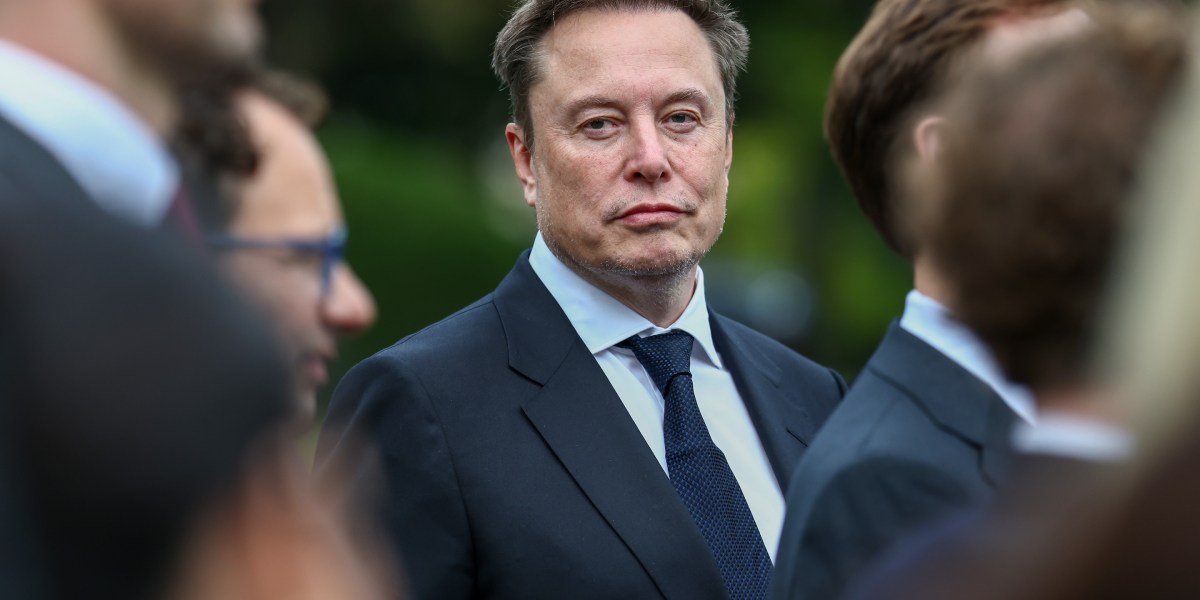
Elon Musk said Tuesday that independent directors at Tesla and SpaceX have formed special committees to explore combining the two companies—a deal that, at current market values, would create a roughly $3.5 trillion giant. Musk said he can’t take part in the talks because he is a “conflicted party.”
“This is definitely the kind of question where I feel like I’m tap dancing through a minefield,” Musk said on SpaceX’s third-quarter earnings call, adding that it would be “overstating it” to call a merger a certainty.
The talks put a fresh spotlight on a question that has followed Musk since SpaceX’s June IPO made him the world’s first trillionaire, at least on paper: When one person holds this much wealth and controls this many companies, who holds him accountable?
A trillion-dollar fortune, on paper
SpaceX priced its shares at $135 and began trading under the ticker SPCX on June 12. The stock closed its first day at $161.11, up nearly 20%, and the company’s market value topped $2 trillion during the session. According to SpaceX’s IPO filing, Musk held about 4.8 billion shares plus 350 million options exercisable at $8.39 each—enough to push his net worth past $1 trillion at the offering price, CBS News reported.
That status has proved fragile. Musk has since called himself a “former trillionaire,” and his fortune has hovered around the line. Forbes said he regained trillionaire status on Oct. 9, then pegged his net worth at $977.2 billion on Oct. 13 after SpaceX shares slid. Much of that wealth is also tied up in stock he can’t sell for a year under the IPO lockup.
Even so, the scale is hard to overstate. Only 19 countries have a GDP above $1 trillion, according to World Bank data cited by CBS. Nabil Ahmed, Oxfam America’s senior director of economic justice, said Musk’s fortune represents a “new Gilded Age” of wealth inequality. “Elon Musk’s rise to trillionaire status marks a new pinnacle of oligarchy,” he said.
A company built for one person’s control
The sharpest accountability questions center on how SpaceX is governed. The company went public with a multi-class share structure in which Class B shares carry 10 votes apiece. Musk owns about 45% of SpaceX but controls roughly 82% of its voting power, Fortune reported.
As Fortune detailed ahead of the IPO, only Class B holders can remove Musk as CEO, chairman, or director. SpaceX uses the “controlled company” exemption to skip a majority-independent board and independent nominating and compensation committees. The company reincorporated from Delaware to Texas in 2024, and its charter pushes shareholder claims into mandatory arbitration and limits derivative suits to investors holding at least 3% of the stock—a stake worth tens of billions of dollars.
In a May 13 letter, CalPERS and the New York City and New York State comptrollers warned that the structure “would constitute the most management-favorable governance structure ever brought to the U.S. markets at this scale.”
Musk’s potential upside is also outsize. SpaceX’s board set aside 1 billion super-voting shares for him that vest only if the company hits market-cap milestones of up to $7.5 trillion and establishes “a permanent human colony on Mars with at least 1 million inhabitants.”
Deals between Musk’s own companies
Transactions among Musk’s businesses are another pressure point. In November 2025, Tesla shareholders weighed a nonbinding proposal for the carmaker to invest in xAI, Musk’s AI startup. About 1.06 billion shares voted for it and 916.3 million against, with more than 473 million abstaining. Because Tesla’s bylaws count abstentions as votes against, the measure failed, Bloomberg reported.
In January, Tesla disclosed a $2 billion investment in xAI anyway. “We’re just doing what shareholders asked us to do, pretty much,” Musk said. Days later, SpaceX acquired xAI in a deal that valued the combined company at $1.25 trillion.
Tesla also did more than $573 million in business with Musk-controlled companies in fiscal 2025, including $430.1 million in Megapack battery sales to xAI and $143.3 million in Cybertruck sales to SpaceX, according to an analysis of Tesla’s SEC filings by Transparency Lab. Tesla’s audit committee deemed the deals to be at arm’s length, and the analysis does not allege illegal conduct.
Regulators and courts have had limited reach
Musk’s run-ins with regulators show how difficult he can be to rein in. In 2018, he tweeted: “Nothing stopping Tesla team at our car plant from voting union… But why pay union dues & give up stock options for nothing?” The National Labor Relations Board ruled the post was an illegal threat and ordered it deleted, and a Fifth Circuit panel upheld that decision in 2023. The full court reheard the case in January 2024, and in October 2024 ruled 9-8 that the NLRB had no power to order the tweet removed, citing the First Amendment.
The Securities and Exchange Commission sued Musk in January 2025, alleging he waited too long to disclose his Twitter stake and cost other shareholders more than $150 million. He settled for a $1.5 million penalty without admitting wrongdoing. U.S. District Judge Sparkle Sooknanan approved the deal in July despite “serious misgivings,” noting the court is “not a rubber stamp” but can reject only settlements that are clearly unreasonable.
Safety questions at Starbase
Worker safety at SpaceX’s Starbase site in South Texas has also drawn scrutiny. A TechCrunch analysis of OSHA data found Starbase recorded 4.27 injuries per 100 workers in 2024—almost six times the average for comparable space-vehicle manufacturers and nearly triple the 1.6 rate for aerospace manufacturing overall. Rival sites run by United Launch Alliance and Blue Origin reported rates near 1.1.
NASA is paying SpaceX more than $4 billion for two crewed Starship landings on the moon. But under its contracts, a high injury rate alone isn’t an automatic trigger for action and doesn’t meet the definition of a “major breach of safety,” which covers events such as a fatality or a willful or repeat OSHA violation, TechCrunch reported.
In January, OSHA cited SpaceX for seven “serious” violations tied to a June 2025 crane collapse at Starbase, with penalties totaling $115,850; SpaceX is contesting them. Then, on May 15, a worker died at the site. OSHA opened an investigation and said it could take months to complete.
Who else shares in the upside
Musk isn’t the only one getting richer. About 4,400 SpaceX employees stood to become millionaires once the stock began trading, the New York Times reported, and Fortune profiled workers from top executives to welders whose equity is now worth seven figures or more.
The proposed Tesla tie-up may be the clearest test yet of whether outside shareholders still have a meaningful say. Musk said a combination would require approval from a majority of all outstanding Tesla shares—“quite a high hurdle,” in his words. Tesla’s annual proxy, filed Monday, includes no merger proposal.
Disclaimer : This story is auto aggregated by a computer programme and has not been created or edited by DOWNTHENEWS. Publisher: fortune.com