Before “You Can See Everything” and before “The Dropout,” there was “The Inventor.”
Subtitled “Out for Blood in Silicon Valley,” Oscar-winning filmmaker Alex Gibney’s documentary about Elizabeth Holmes and the rise and fall of her biotech company Theranos, which she vowed would revolutionize the blood-testing industry, is attracting renewed attention in the wake of the explosive response to “You Can See Everything.”
The new documentary, which captures the former CEO’s final days of freedom before beginning an 11-year prison sentence, presents Holmes and her partner Billy Evans in twisty, often uncomfortable interactions with comedian and co-director Nathan Fielder as he presses them about their relationship and her past with Theranos. Since its premiere last week and subsequent successful box office, awards season buzz has been escalating around the film, Fielder and co-director Lance Oppenheim.
While “You Can See Everything” is primarily an intimate portrait of an emotional Holmes at home with Evans and their two young children, “The Inventor,” which premiered on HBO in 2019, provides a different landscape, showing a laser-focused Holmes carrying out her singular directive to make Theranos a dominant force in preventive medicine.
Gibney shows the photogenic Stanford dropout’s evolution into a major celebrity and tech power broker, rubbing shoulders with world leaders. Her quirks of wearing only black turtlenecks and her apparent disinterest in anything not related to her medical quest (“I don’t have any secrets,” she says early in the film) are also on full display.
The attention surrounding Holmes also sparked the release of the bestselling book “Bad Blood” by Wall Street Journal reporter John Carreyrou, and “The Dropout,” a Hulu miniseries starring Amanda Seyfried. The actor, who won an Emmy for her portrayal of Holmes, is a significant presence in “You Can See Everything.”
“The Inventor” and “You Can See Everything” can now be positioned as cinematic bookends to the Holmes phenomenon. Here are major takeaways from the Gibney documentary, which provides additional insight into Holmes.
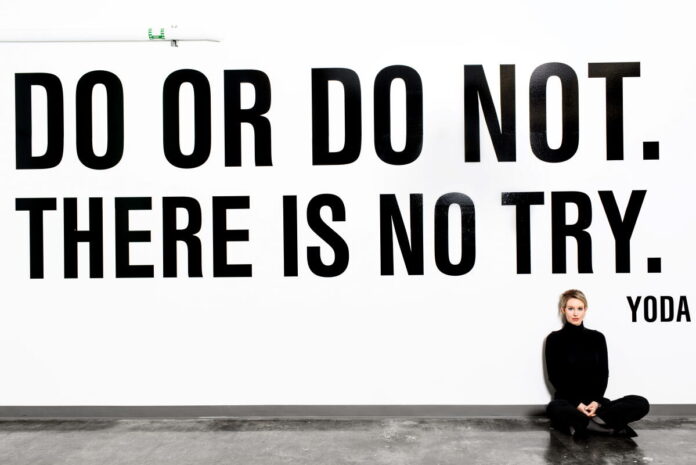
Elizabeth Holmes posing by a quote from “Star Wars” character Yoda.
(HBO)
The voice and the eyes
When Holmes first speaks, her bold voice is markedly different from the more casual tone in “You Can See Everything.” Insiders at Theranos spoke about how Holmes intentionally lowered her voice to sound less feminine in the male-dominated tech world.
Her intensely blue eyes are showcased at the pull-focus feature of her face. Staffers interviewed in the film say they noticed that Holmes never blinked, which they found unusual and somewhat intimidating.
She had a sense of her life goals early on
Holmes frequently related how she grew up spending summers and holidays with her uncle, who she adored. She recalled how much he loved the beach, and was devastated when he was diagnosed with skin cancer, which transitioned into brain cancer. “I never got to say goodbye.”
Her grief ignited her desire to want to change the world so that everyone would have access to their personal health information, “a world in which no one has to say, ‘If only I had known sooner.’”
She developed an interest for creating things at a young age, including plans for building a time machine when she was 7, she told New Yorker writer Ken Auletta. Through her early school and high school years, “I never really watched TV. My best friends were books,” singling out “The Iliad” and “Moby-Dick.”
She also spoke of her long-standing terror of needles, calling it “torture” when she had to give blood.
“When she was talking about some subject other than diagnostic testing, she was very unprepossessing, very disingenuous,” said Fortune magazine reporter Roger Parloff. “When she began to talk about the mission, or you know, her business, then there was a shift. She became very focused, very intense, firm, in control of all of the facts. No question surprised her, very impressive and idealistic.”
Black is her uniform
Holmes reveals the reasons behind her wardrobe, which is exclusively black. Saying she wants to give “every bit of energy I have” to Theranos, Holmes shows off her closet, which contains black jackets and turtlenecks.
“I have these exact set of clothes so I don’t have to think about it,” she said. Part of her reasoning is due to her hero, former Apple CEO Steve Jobs, although she points out that Jobs wore blue jeans.
She adds that she had been wearing black turtlenecks since she was 7.
Theranos is her ‘spouse’
Auletta details how Holmes’ apartment was basically just a mattress. “The only thing in her refrigerator was bottled water. She ate all her meals at the office. She slept four hours a day. She worked in the office until midnight, or thereabouts.” Asked if she dated, she responded, “Oh no, I’m married to Theranos.”
Holmes was ‘Beethoven’ to her board of directors
The Theranos board of directors included luminaries such as former U.S. secretaries of State Henry Kissinger and George Shultz, and former U.S. Secretary of Defense James Mattis. Auletta said they seemed awed by Holmes: “They were talking about her like she was Beethoven, that she was this rare creature that maybe one in a century or maybe two in a century come along who really can change the world.”
Stanford University professor of medicine Phyllis Gardner said of Holmes, “She aligned herself with very powerful older men who seemed to succumb to a certain charm, and those powerful men could influence people in the government, the Department of Defense.”
Holmes’ dynamic with her lovers
In “You Can See Everything,” Evans appears to have a controlling dynamic with Holmes, whether it’s in the way she stirs her eggs or the posts published on her social media account while she’s in prison.
But the romantic and professional relationship between Holmes and former company president Sunny Balwani seemed to be the opposite. The two lived together in a Palo Alto condo. He was 49; she was 30.
“He talked about her in a very differential way,” Auletta said. Perloff said Balwani called Holmes “the most important inventor of our times.” Theranos biochemist Doug Matje said, “Sunny saw her as this iconic figure that he could never be, and so I think he found this vehicle to advance himself in her, and she was on board for it, too.”
Truth and lies
A key sequence in “You Can See Everything” revolves around Holmes telling Fielder she has never told a lie, and his incredulous response.
But several Theranos staffers and journalists say Holmes was frequently deceptive and would lie repeatedly, especially when confronted with facts.
Perloff was incensed by one letter where Holmes said she did not realize he was writing a story about her.
“This was real lunacy,” he said. “I realized there was something wrong with her mind. I don’t know if she’s lying or has an unconscious self-protective reconstruction of reality that’s going on. But what’s coming out of her mouth is not mapping onto reality as you or I know it.”
More to Read
Disclaimer : This story is auto aggregated by a computer programme and has not been created or edited by DOWNTHENEWS. Publisher: latimes.com