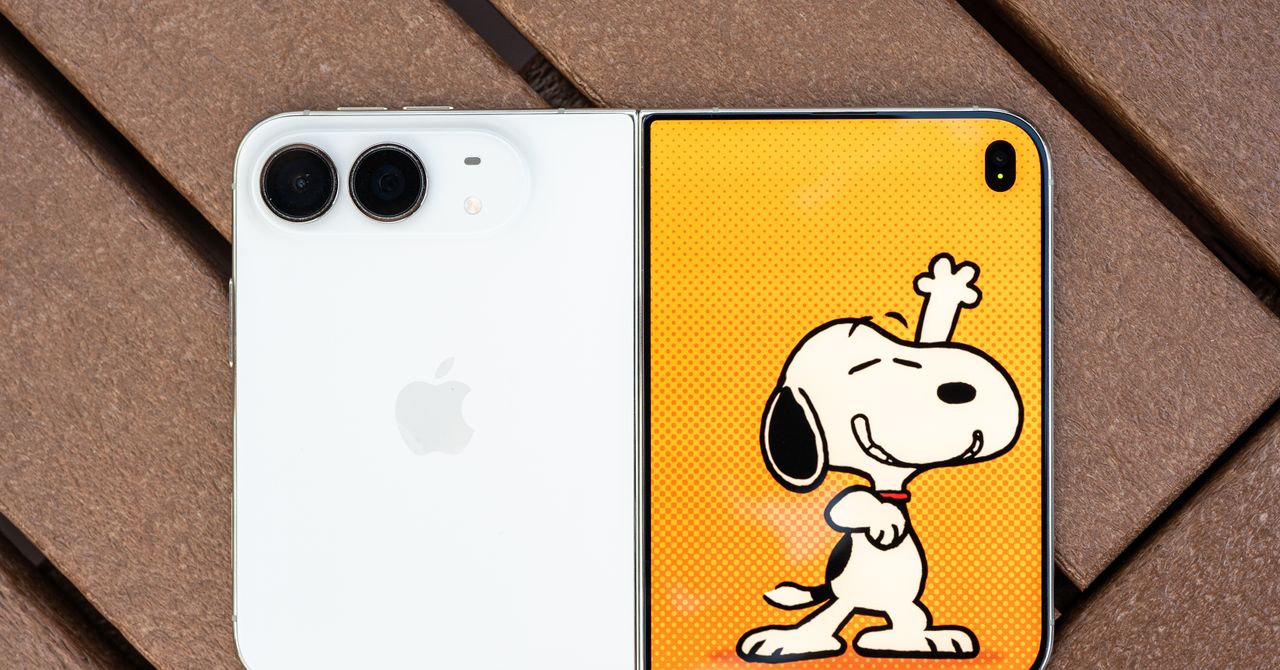
Then there are the physical quirks. The Duo supports MagSafe, so you can magnetically stick the phone to MagSafe tripods, mounts, and the like. (When it’s open, the Duo’s weight makes the phone sag to one side.) But what about MagSafe wallets? They’ll work, but Apple’s official wallet sticks out past the phone’s lower edge—not what you’d expect from a company that pores over every detail. Apple doesn’t have an official solution, so you’ll have to rely on a third-party accessory (and I suspect there will be many Duo accessories).
The iPhone maker follows the industry standard with a dual rear-camera system, lacking the third zoom camera from its Pro iPhones, which I sorely miss. At least the selfie cameras—the one on the outer screen and the “hidden” under-display inner camera seem to produce good results. On a Zoom call, my editor remarked that the video quality looked “really good” with both selfie shooters. (Zoom, by the way, wasn’t optimized.)
Dynamic Duo
When an app is properly optimized, the experience is chef’s kiss. Multi-pane views let you see a lot more in an app than candy-bar phones, a boost to productivity. Split-screening two optimized apps looks excellent, with plenty of room for each app to breathe and let you multitask. I haven’t found myself putting the Duo in angled positions much, mostly because I’ve really enjoyed using it with Apple’s Folio With Kickstand case, so much so that I wish the kickstand were integrated into the phone itself; I strongly recommend investing in an accessory to prop the Duo up.
Battery life has been pretty great. With average use, I’ve ended most days with around 40 percent left by bedtime. Right now, with over six hours of screen-on time because I’ve been working off the Duo for most of the workday, it’s almost 6 pm, and I’m at 45 percent. Impressive.
Disclaimer : This story is auto aggregated by a computer programme and has not been created or edited by DOWNTHENEWS. Publisher: wired.com