Houthis say they targeted Saudi operations room in Aden, southwest Yemen
Yemen’s Iran-backed Houthi rebels said they had targeted a Saudi military operations room at Badr Camp in Aden, in southwest Yemen, with a ballistic missile on Wednesday.
Houthi military spokesman Brig. Gen. Yahya Saree, in a post on X, called the strike a direct hit.
“Our armed forces successfully targeted the enemy Saudi operations room at Badr Camp in Aden with a ballistic missile. The strike was accurate and direct,” he said.
Aden is the de facto seat of power of Yemen’s Saudi-backed government, which was forced to decamp after the Houthis occupied the national capital Sanaa more than a decade ago.
The attack claimed by the Houthis Wednesday was the third in a week on Aden.
A police official in Aden told the French news agency AFP earlier that there had been a blast “caused by a Houthi missile.” Two other security sources told AFP the strike targeted a site near the city’s airport.
Iran threatens undersea internet cables in Strait of Hormuz
A senior official from Iran’s Revolutionary Guard threatened to target undersea internet cables in the Strait of Hormuz if Iranian infrastructure comes under attack.
Brig. Gen. Yadollah Javani, the IRGC’s deputy for political affairs, warned Iran would use its full capabilities to retaliate if the U.S. and its allies launch new attacks against Iranian infrastructure. He said various investments and assets, including undersea cables carrying internet data in the strategic waterway, could be among the targets of Iranian retaliation if hostilities resume.
“The Americans and their allies have significant investments, and if they want to damage our infrastructure, it is natural that the Islamic Republic will use all its capabilities and easily destroy their investments and assets, including the internet cables that pass beneath the waters of the Strait of Hormuz,” he said.
Analysts say cutting the cables in the waterway would most likely affect internet connectivity in Persian Gulf countries.
Iran says Tehran and Washington still engaged in negotiations, ceasefire proposal still in play
Iranian Foreign Minister Abbas Araghchi said Wednesday that Tehran and Washington were still engaged in indirect negotiations via mediators over the seven-day ceasefire proposal presented by Iran in September.
Araghchi said the U.S. was seeking to add further clauses to the Iranian proposal, which Mr. Trump rejected last month.
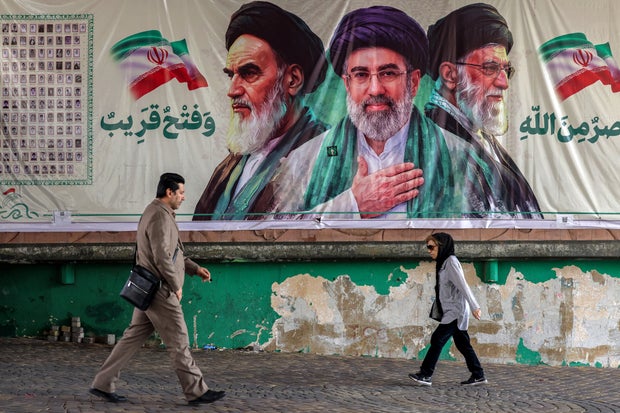
ATTA KENARE /AFP via Getty Images
The proposal called for the end of the U.S. naval blockade of Iranian ports and vessels, the lifting of sanctions on Iranian oil sales, the reopening of the Strait of Hormuz and the release of frozen Iranian assets.
He said Pakistan and Qatar were among the nations facilitating the indirect talks between Iran and the U.S., as they have been for months.
“The negotiating table remains in place,” Araghchi said. “It is the American side that is closing the path, not Iran.”
U.S. ramps up warnings to Americans in Middle East after deadly Houthi strikes
U.S. diplomatic missions across the Middle East have issued a new round of security warnings to Americans amid escalating attacks by Iran-backed Houthi militants against Saudi Arabia, including an Oct. 10 strike on Riyadh’s international airport that killed an American citizen.
The alerts, issued Sunday by U.S. embassies in Saudi Arabia, Bahrain, Qatar, the United Arab Emirates and several other countries, warned that hostilities could rapidly and without warning spread beyond areas already affected by the fighting. The advisories urged Americans to exercise vigilance and prepare for possible flight cancellations, airspace closures and other travel disruptions.
“We are actively warning U.S. citizens about the very real threat the Houthis pose and urging them to heed official guidance,” Edgar Vasquez, the State Department’s deputy assistant secretary for press, told CBS News.
“These alerts are part of a proactive effort by the Trump administration to ensure Americans are aware of potential risks,” Vasquez said, adding that the safety and security of American citizens remain the department’s “top priority.”
Trump says he’s deciding how to win Iran war: “We’re doing very well with Iran”
President Trump said the U.S. is “doing very well with Iran” and he’s just deciding how he wants to win the war.
“As you know, we’re doing very well with Iran,” Mr. Trump said as he took questions from reporters in the Oval Office at an unrelated executive order signing. “We just have to make a final decision of which way do we want to win? Do we want to win the nice way or the not nice way? But we’re doing very well.”
The war, which Mr. Trump said would take only a few weeks in March, has now dragged on for almost eight months with no apparent end in sight. Iran said on Tuesday it would not return to the negotiating table unless the U.S. drops its sanctions, threats and pressure campaign — an unlikely demand.
The president also discussed Europe not helping the U.S. with the war with Iran, saying, “We don’t need any help. But I was testing them.”
“I just called individual presidents and prime ministers to ask, would they like to help us? And they said, ‘No,'” Mr. Trump said. “I said, ‘Well, that’s not nice.’ You know, we spend hundreds of billions a year on NATO. And they said no.”
Disclaimer : This story is auto aggregated by a computer programme and has not been created or edited by DOWNTHENEWS. Publisher: cbsnews.com