- US Secretary Rubio concluded second India visit amid tensions.
- He focused on energy cooperation, visiting Reliance’s refinery.
- Rubio discussed trade deal progress, aiming for quick conclusion.
US Secretary of State Marco Rubio concluded his second visit to India in one year even as tensions between Washington and New Delhi continued to remain. This was Rubio’s second visit in five months and it was focussed solely on securing United States’ economic interests by way of securing energy cooperation with Mukesh Ambani-owned Reliance Industries, whose Jamnagar refinery facility the US Secretary of State visited Wednesday.
Rubio last visited India in May when he came to New Delhi for the Quad Foreign Ministers meeting. Since then a lot of tensions have crept into the bilateral relationship from US’ move to put a break on H1-B visas, to threat of sanctions on India for purchasing Russian crude to a substantial postponement of the trade negotiations for having a bilateral trade agreement (BTA).
Rubio spent the entire Wednesday in Jamnagar even as he visited the oil refinery facility, accompanied US Ambassador to India Sergio Gor.
“Over the past year, India’s imports of U.S. LPG have surged from under 10% to 67%, making the United States India’s largest LPG supplier. Reliance’s planned investment in the first new U.S. oil refinery in 50 years is another major opportunity to expand American energy production and create jobs,” said Gor after Rubio visited the facility.
The Department of State said, second trip to India this year focused around two major hubs of finance, energy, and culture: Mumbai and Jamnagar.
“The U.S.-India relationship is central to U.S. security and prosperity. This visit underscores our commitment to commercial investment, energy cooperation, and the strategic partnership between our two democracies,” it said.
Earlier in the day, while addressing the press in Mumbai’s iconic Taj Mahal Palace Hotel where Rubio was staying, the Secretary of State said, “I think for us it’s more an opportunity to see their operations and have a broader discussion about their presence globally at a time in which energy is featuring prominently in many of the geopolitical decisions that are being made.”
He made these remarks to the press before leaving for Jamnagar.
“This (RIL) is a very large and prominent energy company. They also have a pretty large investment already in the United States. They have extensive refining capacity. As I highlighted to you yesterday, this is a company, for example, that has the capability to refine the heavy crude that’s produced in the Western Hemisphere, including from Venezuela, so I’m sure that’s a topic we’ll discuss. It’s – and I think through our conversations we’ll hopefully identify other opportunities to partner and work together,” said Rubio.
RIL is now under the radar of the US due to Washington’s complex balancing act owing to its own energy crisis. On one hand, the US is trying to punish buyers of Russian energy to cut off funding for Moscow.
On the other, it is trying to keep global oil prices contained as its confrontation with Iran escalates, while also managing rising diesel prices at home ahead of a crucial midterm election.
The stakes are higher because Reliance has only recently committed to a major investment in the US. The Trump administration has publicly held up that investment as proof of its success in attracting global capital to America.
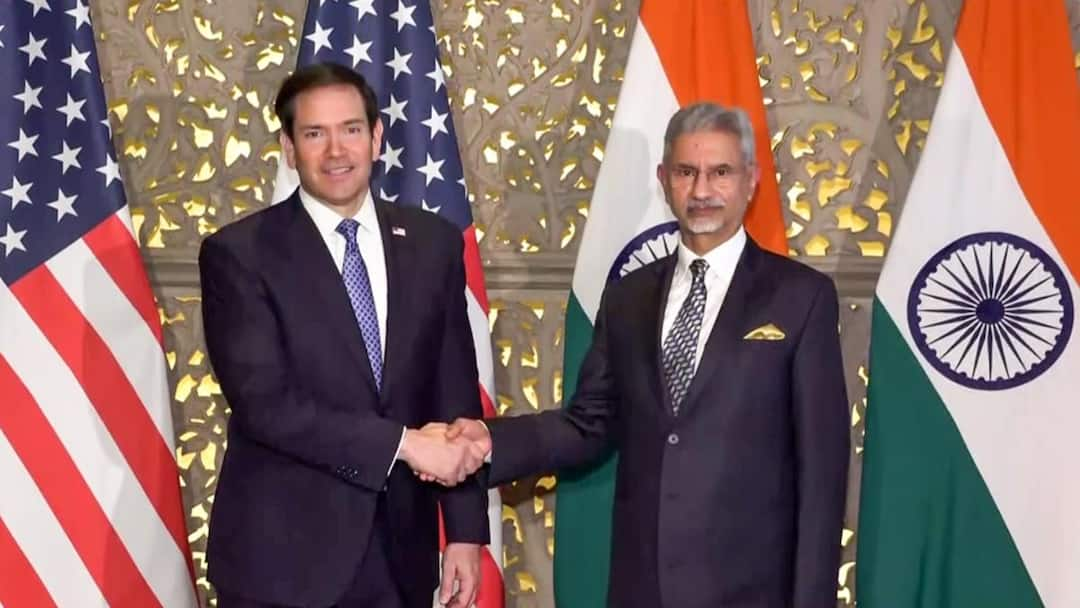
On Tuesday, Rubio met External Affairs Minister S. Jaishankar in Mumbai. Both of them then jointly held another meeting with the Foreign Minister of United Arab Emirates (UAE) Sheikh Abdullah Bin Zayed Al Nahyan, also in Mumbai.
The so-called trilateral meeting also took place at a time when the three partners were equally concerned over Iran’s blockade of the Strait of Hormuz owing to the US-Israel war on Iran, which has disrupted energy global energy networks.
Also Read: Observe Existing Agreements And Understandings: Modi Tells Xi On LAC
In a striking turn, the US itself has now signed a mega deal to directly secure huge volumes of diesel from Russia, even as it pressures others to cut Russian energy ties. The move comes as retail gasoline prices in America have skyrocketed, forcing Washington to prioritize domestic supply and price stability over its own sanctions rhetoric.
At a time when tensions between the US and India have reached unprecedented levels, the US Secretary of State skipped a stopover to the capital New Delhi. A number of friction points have emerged in the bilateral relationship from stopping of H1B visas to constant threat of sanctions over Russian oil, Iran war dynamics and delay in concluding the talks for the trade deal.
“If you look at geopolitics, no matter what you make, no matter what you innovate, it has to get from you to the places you’re sending it to unless you only want to sell to your own economy. That requires a free and unfettered ability to trade. That requires open sea lanes, as an example, and in particular for the United States and India, a free and secure Indo-Pacific,” Rubio said at a gala held in Mumbai on Tuesday.
Rubio also said separately during a presser that both the US and India are “very, very close” in closing the talks for securing the pending trade deal.
“I think there’s a small number of items to wrap up, so I think that will happen shortly – we’re hoping; it should. And hopefully I’ve got some good news to announce fairly soon … we feel very optimistic that we will have something in place here very soon.”
Ambassador Gor said, US and India are now “laser-focused” on taking the bilateral trade to $500 billion in the next three years from around $240 billion currently.
Also Read: EXCLUSIVE | India Will Face Limitations Of Its Room For Manoeuvre: Political Analyst Marc Saxer
Nayanima Basu is a senior independent journalist.
Disclaimer : This story is auto aggregated by a computer programme and has not been created or edited by DOWNTHENEWS. Publisher: abplive.com