American Cancer Society Chief Executive Officer Shane Jacobson says he is currently in the process of creating a new plan that will look at how his nonprofit has leveraged data and artificial intelligence in the past and what future bets should be made on the technology to support its mission to eliminate cancer.
All of Jacobson’s technology investments will support three goals: cancer prevention, early detection, and treatment for patients. “We view technology and AI as an enabler across these strategies,” says Jacobson. “We do not approach artificial intelligence as the strategy, but a tool that’s meant to be tied to the mission and governed responsibly.”
By November, Jacobson hopes to have his board’s blessing on the new strategic roadmap. The American Cancer Society’s more concerted effort to focus its AI bets come as a recent study found that while seven out of ten nonprofits report that they believe there are meaningful opportunities to extract benefits from AI, only 8% have a formal roadmap for implementation over the next one to two years. AI is integrated into the workflows of just 4% of nonprofits, according to a survey of 917 industry leaders and staff that was published in September by the nonprofit organizations Bridgespan Group and Nonprofit Technology Enterprise Network.
Nonprofits are a resource-constrained sector in terms of both staffing and funding and so embracing AI can be extra meaningful if done properly, but bad bets could also be especially bruising, especially when considering that 92% of nonprofits operate with less than $1 million a year, according to data from Nonprofit Impact Matters.
Industry insiders say some donors have been pressuring nonprofits to use AI to ensure the dollars they spend are effective. But this also requires a balancing act for a mission-driven industry and a workforce that can be more wary of the societal and environmental impact of AI.
“We have a lot of proximity to the community-level impacts of technologies like AI—the data centers, the carbon emissions, and the potential job displacement,” says Remy Reya, director of AI and thought leadership at Compass Pro Bono, a nonprofit that connects other nonprofits with business professionals to provide consulting services.
At Compass Pro Bono, Reya says his approach has been to roll out a broad set of AI tools from startups like OpenAI and Perplexity, authorize AI features in Slack and Google, and provide training, but never mandate usage. “It’s really important that people have the opportunity to try something out in an AI tool and not just report a success,” says Reya. “We really encourage people to share their roadblocks and their failures.”
In addition to piloting AI tools like Microsoft Copilot and Anthropic’s Claude, the American Cancer Society has deployed a medical content translation AI tool and has authorized the usage of legal AI contract tools from vendors including Sirion and Harvey AI. Another AI use case that’s being explored focuses on donor engagement.
“We’re using AI technology to try to more effectively organize groups of donors by areas of interest and the impact they are trying to accomplish, and then convert our engagement to be more customized,” says Jacobson, referring to the use of AI to generate more targeted outreach materials.
Jim Balfanz, CEO of City Year, says the education nonprofit has established an AI roadmap that’s focused on using the technology to enhance tutoring and mentorship—not replace humans—while also establishing responsible AI guardrails and piloting new tools before deploying them broadly.
City Year recruits thousands of young adults each year and trains them to serve as mentors and student coaches at 250 schools across the U.S., focusing on districts where a large percentage of students don’t complete high school. Balfanz says coaches spend a lot of their time lesson planning, learning each school’s curriculum requirements, and understanding the learning style of an individual student, but time for social and emotional connection is also critical for success.
In one district, City Year is testing a personalization planning AI tool that’s intended to streamline the process. Early results show it has led to 70% less planning time and a 30% improvement in academic outcomes.
Balfanz says that in leadership meetings with City Year’s staff, he reminds his team that “if our purpose is to create the conditions for young people to meet their potential, AI is going to be highly influential in ways that can be really positive and in ways that could potentially be detrimental and harmful. We need to engage with the pathways to the positive outcomes.”
Dan Rhoton, the CEO of Hopeworks, a nonprofit focused on professional training and career placement, says he is especially bullish about AI’s impact on the workforce. “AI has been a supercharger for better jobs and higher wages,” says Rhoton.
Hopeworks has established a partnership with PC maker Dell Technologies to invest in AI servers that can run large language models locally at all of the nonprofit’s locations. Dell has also given Hopeworks access to an AI tool that allows job seekers to upload a job listing and get feedback to improve their resume and prepare for a mock interview.
“We’re still doing in-person mock interviews,” says Erich Smith, Hopeworks’ director of learning and development. But using AI helps staff streamline some of their workflows and dedicate more time to in-person coaching, says Smith. Dell’s AI tool can perform an analysis of how many filler words were used in a mock interview, how fast the interview subject was talking, and the job seeker’s strengths and weaknesses.
Sagar Aryal, the chief technology officer at the environmental nonprofit Plant-for-the-Planet, says that he has to balance the organization’s sustainability mission with the benefits he lauds from AI. “There’s a part of the team that says we should not use AI because of water consumption,” says Aryal.
Others at Plant-for-the-Planet are more amenable, and for them, Aryal says project managers and researchers are starting to embrace AI for translation, to create documents and templates, and for data extraction. Plant-for-the-Planet also uses AI to automate payment transfers from international donors.
“I think there are going to be AI-led nonprofits where all the decisions are made by AI,” Aryal posits. “We will see people put money in a pot and let AI make the decisions.”
John Kell
NEWS PACKETS
European government websites go offline over hack concerns. Reuters reports on fears that hackers may be trying to exploit vulnerabilities in the PHP programming language have led the Netherlands and Finland to take government websites offline as a precaution, though the disruption could be far more widespread. The popular PHP programming language is used by 69% of all websites, according to data from W3Techs. Because of its massive reach, many CIOs and their IT teams across the globe have been advised to urgently apply the fixes and in some cases, consider taking their websites down until they do so. OpenAI says that it helped identify the vulnerabilities and flagged them to the PHP security team.
OpenAI is reportedly planning to raise capital before Anthropic’s IPO. Reuters reports that ahead of Anthropic’s anticipated public market debut in the middle of November, rival OpenAI is aiming to complete a capital raise that could value the ChatGPT maker at over $1.4 trillion, citing two people familiar with the discussions. The outlet says that OpenAI wants to capitalize on revenue growth from its GPT-6 Astra model and higher usage that’s come from its decision to trim prices on its cheaper models. OpenAI has also reportedly told investors that it expects it can further decrease the price of AI models, which would be alluring to CIOs that have been keeping a close eye on their constantly rising AI bills.
Meanwhile, Anthropic’s S-1 leaks to WSJ. The news outlet got a look at a new draft prospectus with key details that show Anthropic reported a loss of more than $80 billion in the first half of 2026. Revenue soared to $16.3 billion for the six-month period ending June 30, up from $1.1 billion a year earlier, though around one-fifth of the top line was from just two customers. There are also plenty of warning signs: Anthropic says it could spend $750 billion to buy more computing capacity in the coming years and outlined risk factors that include cyberattacks and uncertainty about the harm that AI models could cause.
Salesforce buys Braze; OpenAI scoops up Orchestra Bio. On Tuesday, Salesforce announced it agreed to pay $5.66 billion to buy customer-engagement platform Braze, a deal that will bolster the AI tools that the enterprise software giant sells to marketers. Specifically, Braze’s AI marketing tools are used to manage messaging and customer data, which are intended to deepen relationships with customers. Separately, OpenAI also announced a deal on Tuesday, acquiring biotech startup Orchestra Bio and its technology focused on building AI agents to help pharmaceutical firms manage drug development. The financial terms of the OpenAI-Orchestra Bio deal weren’t disclosed.
DeepSeek is banned from some U.S. government agencies. DeepSeek has been banned by President Donald Trump’s administration from civilian U.S. government agencies, which means that these agencies will need to remove the China-based AI startup’s products and services from their IT systems and will also be barred from procuring them in the future. On the flip side of an escalating geopolitical squabble between the world’s two largest economies, the Wall Street Journal reports that China is mulling export controls that would cover 23 AI-related technologies, including large language models, chip design, and AI agents.
Nvidia, Apple, and Meta have new AI model news. AI chip giant Nvidia has released a new open-weight model called Nemotron 3.5 Super VL that’s designed for always-on agents, as well as two Bolt models that bring agentic intelligence designed to run locally on new AI PCs. Meta and Apple, meanwhile, are collaborating on a new Muse AI model that will run locally on Mac computers and will allow customers to use Muse Spark for coding, video analysis, and other agentic tasks.
ADOPTION CURVE
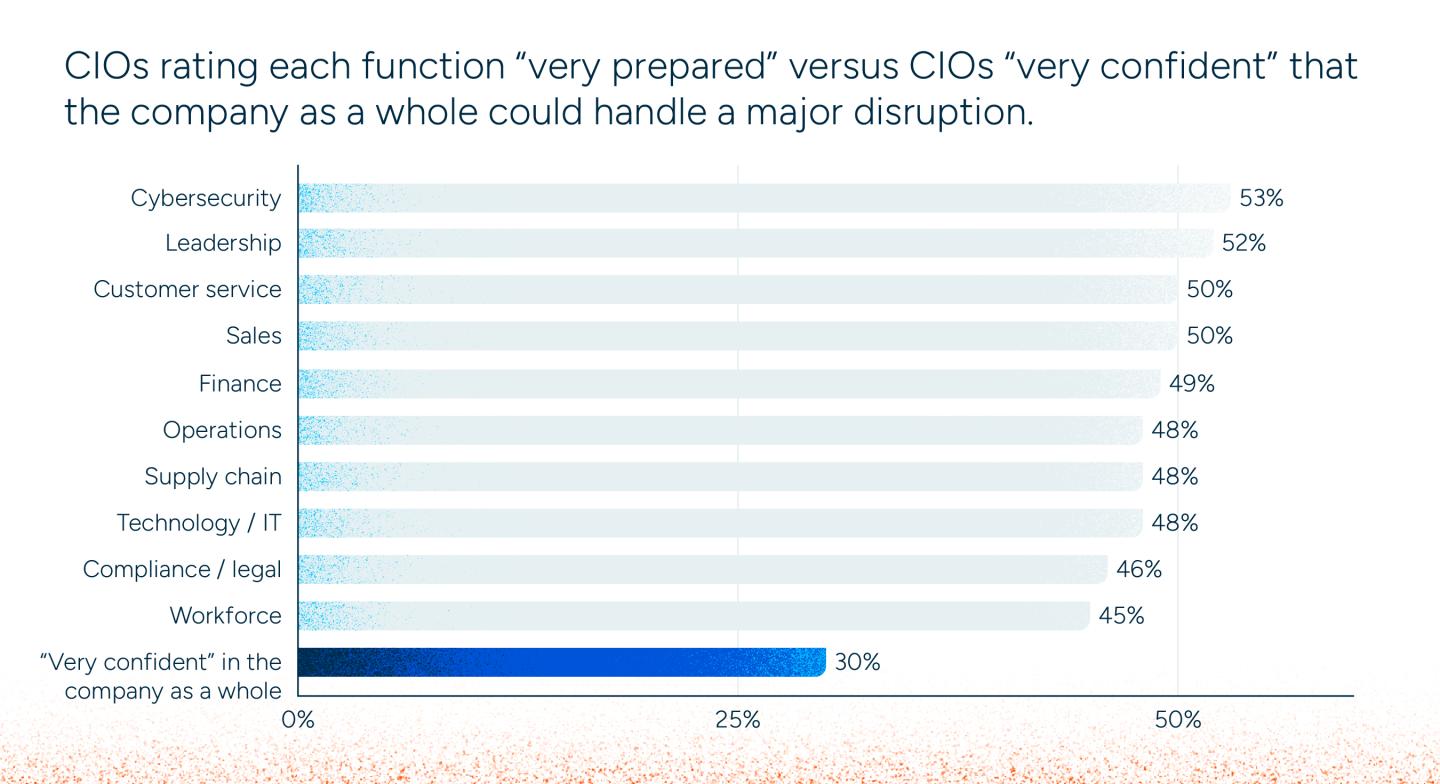
CIOs are less confident than CEOs that their business could handle a major disruption. Businesses are constantly facing challenges ranging from tariffs, to issues with suppliers, new competitors, and critical roles that they couldn’t fill. A new survey of 1,137 U.S. and Canadian executives conducted by consulting firm Highspring found that nearly every company reported facing at least one of those issues in the past 12 months and a majority faced more than one of those challenges.
CEOs are more optimistic when asked about their company’s resiliency, with more than 52% saying they were “very confident” that their company could handle a major disruption. But only three out of ten CIOs felt the same way. Yet another area where they diverge is risk management. Seven in ten CEOs reported conducting strategic risk reviews on a monthly basis, compared to 50% of CIOs.
Ben Bernecker, SVP at Highspring’s talent and staffing division Vaco, tells Fortune that CEOs have a lot on their plate, thinking deeply about revenue growth, expense reduction, and the intricacies of running a public company or dealing with investors or private equity backers. CIOs, he says, “might not necessarily be thinking about the full bigger picture, which is where that collaboration needs to happen.”
Courtesy of Highspring
JOBS RADAR
Hiring:
– Caterpillar is seeking a divisional CIO, based in Cary, North Carolina. Posted salary range: $189.1K-$283.6K/year.
– Atlanta Housing is seeking a CIO, based in Atlanta. Posted salary: $211.8K/year.
– Jacuzzi Group is seeking a VP of IT. Posted salary: $200K/year.
– Teikametrics is seeking a CTO, based in Boston. Posted salary range: $200K-$250K/year.
Hired:
– Alaska Airlines appointed Amaresh Siva to serve as chief information technology officer, a newly created role at the airline carrier to set an enterprise-wide technology, data, and digital strategy. Siva joins Alaska from CVS Health, where he most recently served as chief digital and technology officer for the company’s health care delivery. He also previously held senior technology roles at Target.
– Ticketmaster appointed Jim Freeman to the role of CTO, where he will be responsible for developing new agentic, AI-powered tools for the ticketing company. Previously, Freeman served as CTO at German-based e-commerce company Zalando and held VP roles at Amazon’s Prime Video and Alexa Mobile divisions.
– Publix promoted Laurie Douglas to the role of EVP and chief information and digital officer. Douglas joined the grocery retailer in 2006 as SVP and CIO. In 2019, she added new responsibilities for Publix’s digital, mobile, and omnichannel capabilities as chief digital officer.
– Woodward named Paxton McVoy as CIO, a newly created role to oversee the company’s global IT organization and steer its digital strategy, which includes AI, data and analytics, and cybersecurity. Prior to joining the designer and manufacturer of control systems, McVoy served as CIO at industrial technology firm Veralto. He also previously held senior IT leadership roles at Medtronic.
– ModernRails announced the appointment of Raghu Sastry as CTO, where he will lead the payments infrastructure company’s technology strategy, platform architecture, and product innovation. Prior to joining ModernRails, Sastry held senior engineering and leadership roles at Agilent Technologies, PMC-Sierra, and Zeuss Technologies.
– Dynata named Marcus Casal to serve as chief product and technology officer, where he will lead product development, AI and data, and engineering for the data and market research company. Most recently, Casal served as CTO at translation services provider Lionbridge.
– Dark Matter Technologies announced the promotion of Don Oliver to CTO, who joined the software company when it launched in 2023 as director of cloud infrastructure. He also served as VP of platform engineering for Dark Matter and previously spent nearly eight years as a director at software, data, and analytics firm Black Knight.
– Arms Cyber appointed Jay Manni to serve as CTO, overseeing all aspects of engineering, product development, and the technology strategy for the cybersecurity firm. Previously, Manni served as SVP of product engineering at cybersecurity and risk management company DTEX Systems. He also previously was a founding engineer at FireEye, which merged with McAfee Enterprise in 2021.
Disclaimer : This story is auto aggregated by a computer programme and has not been created or edited by DOWNTHENEWS. Publisher: fortune.com