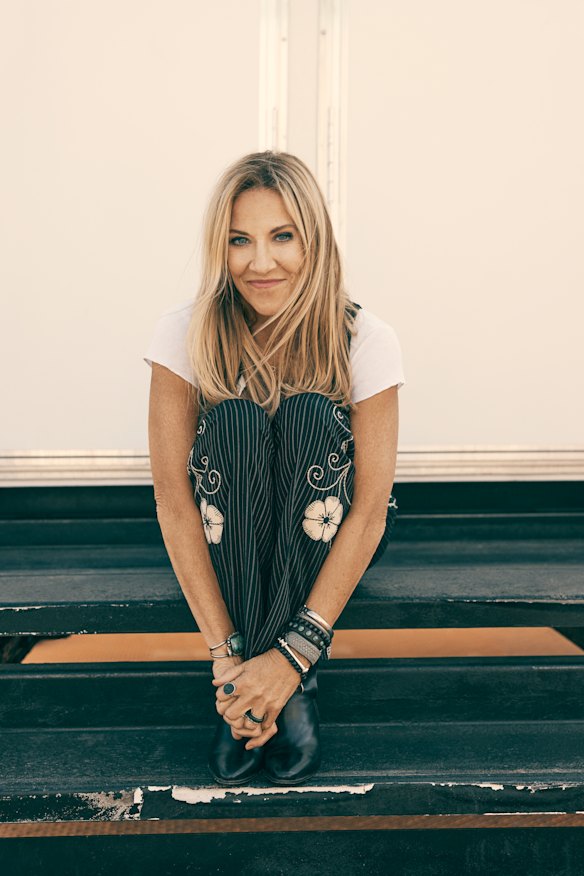

In many ways, Sheryl Crow hasn’t changed much since she rose to household fame with her 1994 hit All I Wanna Do. At 64, her blonde wavy locks and megawatt smile remain constant features of the nine-time Grammy winner’s image.
But behind the relaxed visage on our Zoom call, Crow has dealt with illness and grief, most recently over the death of her friend Dolly Parton.
In 2023, Crow recorded a cover of You’re No Good with Parton and Emmylou Harris for Parton’s Rockstar album in the same room she’s speaking to me from; she is still feeling the loss.
“I have always looked up to Dolly and Emmylou and wanted to emulate how they lived their lives and went about their business,” Crow says. “Just being in their orbit is a masterclass in how to communicate, how to bring love, joy and humour to all you do. Dolly wrote some of her best stuff in this last quarter of her life. That gives me hope about being older, and a reminder to keep going. ”
It’s been 33 years since Crow’s breakthrough album, Tuesday Night Music Club, and 32 since its hit single All I Wanna Do. With its catchy soft-rock tune by Crow and optimistic message, taken from a poem by Wyn Cooper, it became a surprise global hit which gets radio play to this day.
Now she’s back with a new album, Pick You Up, full of songs that stick quite closely to the blueprint of her younger self – observations of the world still make the cut, as does commentary on social issues and personal struggles.
Pick You Up is essentially a call-to-arms for human connection. In the protest song Freedom Bus, Crow tries to make sense of the political polarisation happening in her country. “Freedom Bus is a reminder that people fought for our freedoms,” she says. “We seem to be forgetting that as a nation. I feel like we are groomed as Americans to become distracted and desensitised to losing our decency. I hope we can return to our better selves in time, but it will get worse before it gets better.”
It’s a sobering reflection, but with Crow in charge the future is also a place of hope.
Crow was born in Kennett, Missouri, “not close to anything, and I had never been on an airplane until I was 19 or out of the country until 28”. In 1986, armed with a skill for songwriting, she relocated to Los Angeles. “I was naive but very determined to get there,” she says.
Drawn to write music thanks to heroes such as James Taylor, Carole King, Stevie Wonder and Elton John, she swapped a career as music teacher to become a back-up singer for Don Henley, Rod Stewart and Michael Jackson on his Bad tour in 1986-87. She also still owns the first guitar she ever bought – at Earl’s in Hollywood in 1991 for $1500. It’s a 1964 Gibson acoustic that’s become known as “the Moneymaker” thanks to all the hits she’s written on it.
But for the past two decades, Crow has lived in Nashville, Tennessee, on a 20-hectare farm, where she keeps the reminders of her early success close by. “The Grammys are still sitting in my piano room – winning them is an astounding memory for me,” she says.
“The Grammys was the one time of the year when the world tuned in, and the next day your record sales skyrocketed. My first two records put me on the map, made me a household name.”
But her early success was followed by personal struggle when, in 2006, at the age of 44, she was diagnosed with breast cancer. In the years that followed, she adopted two sons, Wyatt, now 19, and Levi, 16, and for a long time prioritised them over her work. But she never completely stopped making music or touring.
“Cancer was my life- and career-reckoning moment,” she says. “I was lucky it was caught early and was treatable. But it definitely made me take a hard look at my life.
I have always felt connected to my kids, but social media is designed to create a wedge and sort of drive us apart.
SHERYL CROW
“As women, we are constantly managing others and helping others, and if you don’t let somebody else nourish you, or take care of you, then you really are at the bottom of the heap. I have lived in that position, where all that mattered in life was, ‘Is everybody happy with me?’ And if they were, then I’d tell myself it was a sign they loved me. Sometimes that’s just a mythology you live by – and it winds up being burst.”
Crow now trades people-pleasing for self-care – something she’s become better at as she’s got older. She’s also better at understanding her younger self; a sense of melancholy she couldn’t pinpoint as a child makes sense to her now – it was a form of depression. Another song on the new album, Perfect, is her way of acknowledging that.
“Accepting myself, being gentle and going for a walk, is how I take care of myself nowadays,” she says. “Some days I like a fast walk and want to hear birds and trees, and if I can run on other days, great. But if I can’t, that’s fine, too.”
Despite her celebrity status, Crow says she faced the same challenges everyone faces when it comes to raising her sons. “Any parent who is going through raising teenagers on social media winds up being the bad guy, the police, the one who reads phones, who interrogates, who puts the parameters down,” she says. “And it drives a wedge between you and your children.
“I have always felt connected to my kids, but social media is designed to create a wedge and sort of drive us apart. It makes you feel lonely. That’s when I ask myself, ‘Where are my people?’ I have to actually make the effort to get people together, to talk. This album is inspired by that very feeling.”
Crow has also used her platform to call out sexism in the music industry, having shared her own experiences in a documentary film she released in 2022. “If you wanted to get your record played on the radio, it seemed like you had to sit on somebody’s lap,” she says of her early years in the industry.
Now, being an older woman in music comes with its own challenges. “It’s a strange mantle to hold, but the beauty of being a ‘legacy act’ is the great liberation in being able to write whatever you want,” she says. “I’m writing my best stuff now and it’ll probably never get heard because I’ve aged out. But that is not why I write.
“Our power comes from being human and sharing in that humanity, not using [sex] to sell it. If my new music was on Spotify without my name on it, maybe younger listeners would take notice. But that I’ll never know.”
Pick You Up by Sheryl Crow is out now.
Get the best of Sunday Life magazine delivered to your inbox every Sunday morning. Sign up for our newsletter.
 Jane Rocca is a regular contributor to Sunday Life Magazine, Executive Style, The Age EG, columnist and features writer at Domain Review, Domain Living’s Personal Space page. She is a published author of four books.Connect via X or email.
From our partners
Disclaimer : This story is auto aggregated by a computer programme and has not been created or edited by DOWNTHENEWS. Publisher: www.smh.com.au