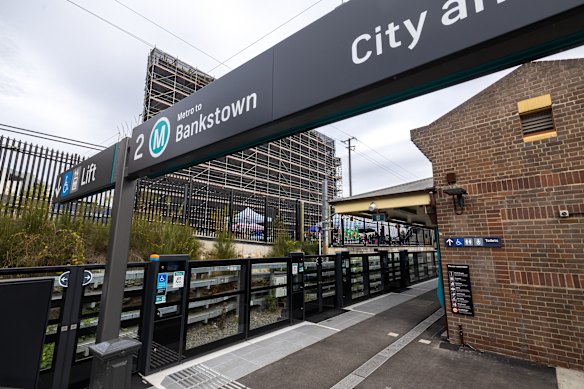
The announcement that the final section of Sydney’s $30 billion M1 metro rail line will open to passengers on Friday next week is a major transformative moment in the life of our city.
The commissioning of the 13-kilometre stretch of the metro rail line between Sydenham and Bankstown is also a godsend to people in south-west Sydney, many of whom have been waiting patiently amid more than two years of disruptions. Commuters have had to catch replacement buses along congested corridors while the project to convert the steam engine-era line to metro train standards was plagued by delays.
The south-west has been crying out for major new infrastructure such as this. The line will undoubtedly attract new residents and drive the local economy to the next level, as well as encourage more housing in an area of Sydney that is relatively close to the CBD yet still has many single homes on quarter acre blocks.
Like the rest of the M1 line, trains will run every four minutes during weekday peak hours, every five minutes between 10am and 3pm, and every 10 minutes in the evenings and at weekends. A trip from Canterbury to Chatswood will take 31 minutes, a time saving of 23 minutes compared with previous heavy rail commutes, while Lakemba to Victoria Cross in North Sydney will take 37 minutes, saving passengers 24 minutes.
Sydney Metro is forecasting a 13 per cent rise to 300,000 passenger trips on weekdays as commuters are whisked in driverless trains to their destinations.
The new line is the latest addition to Sydney’s computer-driven rail network, stretching 66 kilometres from Rouse Hill in the north-west to (from next Friday) Bankstown. A new metro line servicing Western Sydney Airport and a Metro West under the city’s east-west spine, between the CBD and Parramatta, are also under construction.
Credit for this latest major moment in Sydney’s infrastructure history belongs to previous Coalition governments and former premiers Mike Baird, Gladys Berejiklian and Dominic Perrottet. Their collective vision helped to modernise Sydney’s public transport. That said, the Minns government also deserves recognition for completing the south-west project, which could have been put in the too-hard basket in the final stretch to the finish line.
However, this will most probably be the last public transport infrastructure retro-fitted to Sydney’s ancient heavy freight network.
The modification of an old line caused expensive, tricky problems. Among the unexpected costs were “mind the gap” mechanical solutions to mitigate possible safety risks with the old curved railway platforms.
Meanwhile, delays mounted: in mid-2018, commuters were told that the line would close for three to six months. Even before it closed in September 2024, the Minns government said the shutdown might last longer than the estimated 12 months. In the end, tens of thousands of people spent 24 months on pink-coloured replacement buses, which significantly lengthened commutes and cost taxpayers about $200 million.
The extended wait for the Sydenham to Bankstown line opening remains the one dark spot since the city section of the M1 Metro line opened in August 2024 to wide acclaim and higher than projected patronage.
For the people of south-west Sydney, the arrival of their new line is transformative. It will allow the rest of Sydney to access and explore this under-appreciated region more easily. But the cost blowouts and delays also carry a wider lesson: 130-year-old rail lines were designed for the 20th century, not the computer age.
 The Herald’s View – Since the Herald was first published in 1831, the editorial team has believed it important to express a considered view on the issues of the day for readers, always putting the public interest first.
From our partners
Disclaimer : This story is auto aggregated by a computer programme and has not been created or edited by DOWNTHENEWS. Publisher: www.smh.com.au