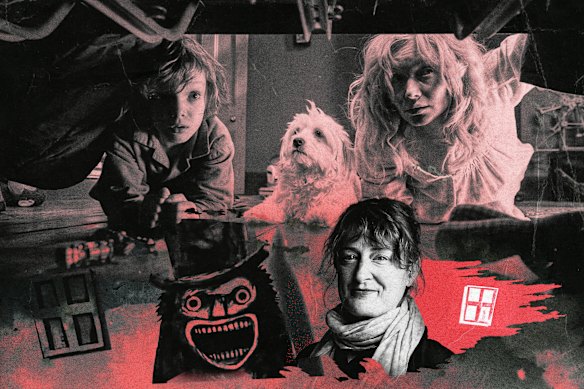

The black top hat and cloak. The creepy face. The claw-like feet.
Twelve years after Mister Babadook became a nightmarish figure on screen, terrifying a single mother and her child, writer-director Jennifer Kent is delighted that her film The Babadook has become not just an Australian classic but a Halloween screening tradition.
“To have my first film so appreciated and still kicking on is a delight,” Kent says. “I have such a fondness for the whole experience.”
One American critic even described The Babadook recently as the best horror film so far this century, not just frightening and unnerving but a groundbreaking feminist pic with stunning psychological depth that shows a woman recovering after suffering.
Kent is preparing to shoot her next film, The Girl Who Was Plugged In, based on a 1973 sci-fi novella by James Tiptree Jr, in Sydney early next year.
Her first film since returning to horror for The Murmuring, part of the Netflix miniseries Guillermo del Toro’s Cabinet of Curiosities, it will have Sophie Thatcher (Yellowjackets) playing a disfigured young woman who is hired to virtually operate a beautiful but brainless “flesh body” to sell products.
“It’s quite spookily about the dilemmas of our modern age, particularly the loss of humanity to technology and to big tech corporations,” Kent says. “I haven’t ever felt such an urgency to make any film as I have with this one.”
But The Babadook’s return to currency – as part of a Halloween season at Sydney Opera House and the puppetry exhibition Lifelike at Melbourne’s Australian Centre for the Moving Image – has Kent reflecting on why it became so acclaimed and influential for later Australian horror films.
“I’d just lost my dad at the time so I was mourning for that big loss,” she says of writing the screenplay. “I threw myself into that grief.”
The Babadook centres on a grieving woman (Essie Davis) who battles her young son’s (Noah Wiseman) fear of the freaky vision in their home that is Mister Babadook.
While Australia has been making horror pics since the revival of the film industry in the 1970s, they have often been in the “Ozploitation” tradition of scaring the bejesus out of audiences.
After the early impact of psychological horror (Patrick) and the haunting supernatural (arguably Picnic At Hanging Rock), many B-grade examples have featured sharks, crocodiles, other out-of-control animals, zombies, ghosts, vampires, werewolves, cannibals, killer trucks, crazed scientists, serial killers and monsters.
Kent was obsessed with horror films growing up but it wasn’t Australian films that inspired her creatively when she became a director.
“It was the ’70s when I was a kid, and it was a little less restrictive on what kids could watch, so I saw all sorts of things,” she says. “I remember being traumatised by Nightmare on Elm Street, the original, and – what’s that slasher movie? Oh my God! – Friday the 13th.
“These sorts of films were emblazoned on my mind at a very formative age. As far as Australian films go, probably things like The Howling [while the original was American, the next two sequels were directed by Australian Philippe Mora] and Razorback but it wasn’t such a big genre when I was a kid.”
The Babadook was a highly successful Australian example of “elevated horror” – films that use the genre to address social issues. It took Get Out, about middle-class white racism, to a best picture nomination at the Oscars in 2018 and describes such later Australian films as The Invisible Man, Talk To Me, Bring Her Back and Leviticus.
While she thinks it was rare for an Australian horror film to centre on a mother at the time, Kent does not see The Babadook as groundbreaking.
“I look back to a tradition of horror that started in silent cinema,” she says. “That was my playground and inspiration for The Babadook. There are a lot of films in the tradition … that deal with the human condition really deeply. I think horror is built for that.
“It’s been relegated at times to B-grade films but it’s at its best when it has depth.”
One direct influence for Kent was the 1961 gothic and psychological horror film The Innocents, which had Deborah Kerr as a governess whose job looking after two orphans at a country estate takes a very dark turn.
“It has a woman of a certain age going quietly insane or is she being visited by something?,” Kent says. “I was very intrigued and inspired by films that were both psychological and supernatural.
“They could be read [as] either/or and still be bulletproof. An obvious example of that is The Shining. You can read it as a haunting or you can read it as a man going mad. Or you can see it as both.”
While The Babadook flopped in Australian cinemas, it was recognised as a visionary film overseas.
“It was just apathy audience-wise and also distributor-wise,” Kent says. “Prior to that time, there was quite a snobbery towards horror. Now the only thing that ends up in cinemas is horror – elevated horror if you want to use that term.”
At the AACTA Awards, where The Babadook controversially tied with The Water Diviner for best film, she says people were “lining up to apologise for not really understanding the film in development or even in production – it’s funny that we need awards to authenticate the value of something – but I took it graciously.”
The Babadook found an appreciative Australian audience when it started streaming. Kent thinks horror has become easier to make in Australia because of it and other films around the same time.
“It was very hard for us to make but if it’s paved the way for other filmmakers to get their films made – I’m really thrilled,” she says. “Horror is one of the most impactful forms in cinema.
“It’s the closest to dream. Cinema is dream. It can be documentary, as well, but it really lends itself to these kinds of worlds that are not completely realistic.”
The Babadook is screening, with an introduction by Jennifer Kent, at Sydney Opera House as part of the Hellhouse season of horror films from October 27 to 31. In Melbourne, The Babadook is in the Lifelike exhibition of puppetry on screen at Australian Centre for the Moving Image from November 20.
From our partners
Disclaimer : This story is auto aggregated by a computer programme and has not been created or edited by DOWNTHENEWS. Publisher: www.smh.com.au