Max Stephens and Neil Johnston
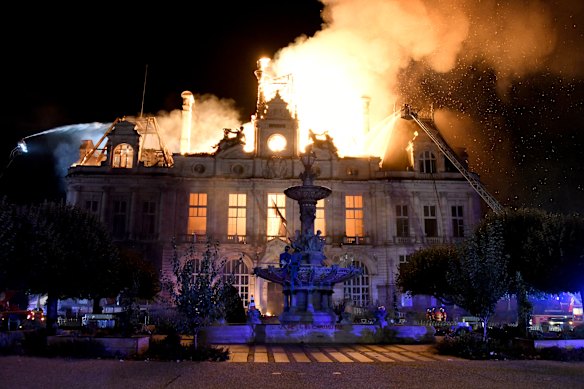
London: Hodei Ciarra Docampo only had to turn to his father for advice on how to burn down the 143-year-old town hall in the French city of Limoges.
The 34-year-old “ultra-left” agitator was arrested by French special forces at his parents’ home three days after allegedly setting the building alight. Wearing a black balaclava, ski goggles and a bucket hat, the suspect was filmed allegedly tending to the blaze as it spread from the ground floor to the belfry.
Arson appears to be something of a family tradition in the Ciarra Docampo household.
His father, Fernando Ciarra, a 70-year-old Basque separatist, was sentenced to three years in prison last April for arson attacks in Limoges, according to the French regional newspaper La Dépêche, and an investigation by The Objective, a Spanish online newspaper. He is said to have burnt eight vehicles belonging to Enedis, the national electricity distributor, in February 2020 and carried out attacks on a broadcast station and mobile phone tower.
The latest act of arson in Limoges caused the neo-renaissance clock tower to collapse in a ball of flames in front of a baying crowd, encapsulating the devastation unleashed by rioters during protests across France on Saturday.
Limoges Mayor Guillaume Guérin quickly labelled Ciarra Docampo as the alleged “mastermind” of the attack.
Prosecutors said Ciarra Docampo, who has links to the group Les Soulèvements de la Terre (The Uprise of the Earth), was on a terror watch list and convicted of assaulting a police officer two years ago during a protest at a wood pellet factory.
At 6am on Tuesday, armed police from RAID, France’s elite tactical unit, broke down the door of his family home in the village of Bussière-Boffy, 40 kilometres from Limoges, and arrested him. Ciarra Docampo faces up to 20 years in prison if convicted.
Prosecutors do not believe the town hall’s destruction was the work of a single overzealous protester, but that it was deliberately targeted by an organised far-left group.
“What happened is unacceptable,” Guérin said. “The involvement of the far-left has been clear from the start in this fire. You don’t destroy a 200-year-old building in a few hours with a box of matches and a lighter.”
He claimed they brought fireworks, mortars and battering rams to break down the building’s doors. “You don’t just carry such items around in a backpack,” he said.
France’s intelligence agencies and counter-terror police are assessing to what degree the nationwide riots, which began as student protests weeks ago, were infiltrated by members of the “black bloc”, an umbrella term for far-left violent anarchists.
Its members are a loose assortment of extreme-left organisations without any leadership or hierarchy. They frequently clash with police and target symbols of wealth and capitalism, such as banks and insurance companies.
Security experts have estimated that about 5000 black bloc or far-left violent actors were on the ground during the riots in Paris, Marseille, Lyon and Limoges.
Jean-Yves Camus, a political scientist and expert on extremism, stressed that the violence was planned and involved many non-French nationals.
“It is not a political group; it is a bunch of anarchists clad in black who act together with the demonstration and with the intent of violently confronting the police,” he said. “They are really treated as a threat by the intelligence community.
“Apparently, on October 17 people were speaking English and German during the riots; it’s a very strong possibility people came from Germany, Belgium, the Netherlands, Switzerland to take part in what was a planned demonstration.
“There was a plan, there was an exchange of information; those people did not simply get a train to Paris and join the demo [by chance].”
Questions have also been raised by commentators about whether hostile states were seeking to exploit the destabilisation and violence for political gain.
“Russian and Iranian actors would gain from the chaos,” said Dr Elias Forneris, a French citizen and head of research editorial at the British defence think tank Rusi.
“Back in autumn 2018, there were already questions about whether Russian bots were amplifying the Yellow Vests movement on Twitter.
“Social media amplification would be easy to execute. Direct interference is more difficult and would require a great scale to make any impact, in movements involving hundreds of thousands of protesters.”
Determining which rioters were far-left agitators and which were opportunistic looters from the city’s outskirts is expected to prove an almost impossible task.
French President Emmanuel Macron denounced comments that blamed “migrants, jihadists and communists” for the violence in a veiled swipe at US President Donald Trump.
Speaking during a visit to Qatar, Macron did not name anyone but said that the “manipulation of information” after Saturday’s riots had led to “comments that are as unacceptable as they are stupid, from many people, including foreign leaders”.
On the streets of Paris, the clean-up continued, with rows of shops and cafes still boarded up. Glass littered pavements and burnt-out cars were still being removed four days after the violence.
At Good Vibes cafe on Magenta Boulevard, owner Gregory Desfoux, 49, surveyed the damage to his bakery, which opened just two weeks ago. Baguettes and shattered glass were still strewn across the floor, with bricks from the building’s exterior having been removed and thrown at police.
“They smashed the window with metal bars. They took the bakery items. They eat all they could eat and after, they break everything,” he said.
“When we arrive at 10, we saw them. There were still some people in the shop, and they are crazy.”
Further up the boulevard, Aidons Hassan Rashadul, a mobile phone shop owner, said his insurer was refusing to pay out €90,000 ($144,000) in damages and stolen stock.
He said rioters also stole 500 parcels and he was helpless as more and more descended on his shop.
“They destroyed everything inside and they took absolutely everything,” he said. “There was nothing I could do to stop them.”
‘They came to destroy’
In nearby O’Fleurs de Magenta, Clemence Ramon, a florist, said masked men had used iron bars to break into the shop before destroying it and raiding the flowers.
“They broke the glass of the shop; they took all the plants, all the flowers, the money, and the day after, when we came back in the shop, it was like war, war in the shop,” she said.
“On the street, the flower pots were on the floor and there was glass everywhere. They came here to destroy, and they don’t care what they are destroying. Flower, phone shop, pharmacy, bakery, all destroyed. They even broke into people’s apartments.”
Macron pledged to prevent a repeat of last weekend’s riots and looting, as the Yellow Vest movement filed plans for a Paris march on Saturday, presenting the government with its next big test.
From our partners
Disclaimer : This story is auto aggregated by a computer programme and has not been created or edited by DOWNTHENEWS. Publisher: www.smh.com.au