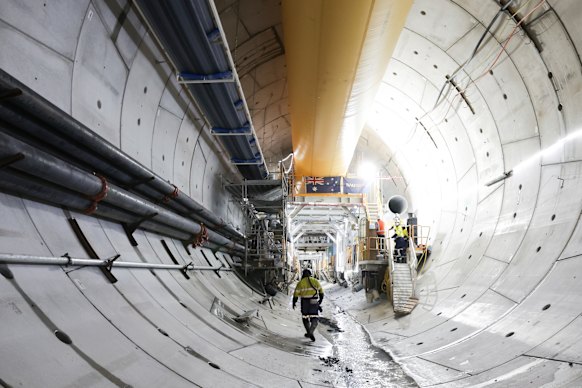

The cost of the Commonwealth government’s troubled Snowy 2.0 pumped hydro scheme has exploded to potentially $25 billion – more than four times its original estimate – and its completion date has been pushed out to late 2029 as its builders grapple with severe geological challenges and soaring construction pressures.
Updated advice released by Snowy Hydro Limited on Thursday night moves the estimated cost of the problem-plagued mega-project from $12 billion to $22.2 billion, with a contingency buffer bringing the potential price tag to $25 billion, marking the most severe setback yet for Australia’s largest renewable energy development.
Snowy 2.0, a massive 2200-megawatt energy-storage project in the Snowy Mountains of NSW, is designed to act like a giant battery, storing vast amounts of energy by pumping water uphill when electricity is plentiful and then releasing it downhill through turbines when the grid needs a critical boost. Energy planners consider it a project of national significance in Australia’s shift away from ageing coal-fired power stations because of its ability to back up renewables during stretches of low wind and sunlight, with enough storage capacity to power 3 million homes for a week.
When the project was first conceived in 2017, then-prime minister Malcolm Turnbull thought it could be built for $2 billion in just four years. But a year later, when the project received final investment approval in 2018, its estimated cost had already risen to nearly $6 billion. This week’s latest revision means the potential cost has quadrupled since construction began.
One of the largest and most challenging engineering projects undertaken in Australia, the project faced a succession of setbacks and delays, bogged down pandemic-related disruption, supply chain pressures and difficult tunnelling conditions deep beneath an alpine national park. The complexity of excavating extensive underground tunnels through unpredictable rock has compounded construction delays and added to costs.
The latest cost revision, however, arrives at a sensitive time for the Albanese government, which is under pressure from the Coalition and One Nation over the cost of its ambitious renewable energy rollout plans.
It also intensifies broader anxieties about Australia’s ability to build enough renewable energy and storage capacity in time to keep power supplies and prices steady as the majority of the nation’s ageing coal-fired power stations reach the end of their operational lives over the coming decade.
Dennis Barnes, chief executive of Snowy Hydro, on Thursday acknowledged that the cost increase was “incredibly disappointing”, but insisted the long-term value of Snowy 2.0 to Australia’s energy reliability was stronger than ever.
“The scale of Snowy 2.0’s energy storage is world-leading – more than half of the total energy storage the grid needs by 2050 will come from Snowy 2.0 alone,” he said.
“Snowy 2.0’s massive, long-duration storage will be the grid’s insurance policy against multi-day wind and solar droughts, helping to prevent blackouts and control price spikes that would otherwise flow through to household electricity bills,” he said.
Barnes attributed the bulk of the cost blowout to “design immaturity”, saying underdeveloped planning work when the project was first conceived had obscured the true scale and geotechnical complexity. He said the decision to reset Snowy’s contract with its principal construction contractor, Future Generation Joint Venture, in 2023, had protected the project from the threat of an even larger cost overruns.
“Moving from a fixed-price contract, which was never suitable for such scale, uniqueness and complexity, has protected the project from an even greater cost increase,” he said.
Federal Energy Minister Chris Bowen and Finance Minister Katy Gallagher pointed the finger at the previous Coalition government for signing off on underprepared plans.
“This revised cost and delivery schedule has been driven by cost pressures in the construction sector and the significant geological challenges of the project, exacerbated by design immaturity when it was first announced by the former government,” they said.
“The government remains transparent about the pressures facing this project and securing the best possible outcome for taxpayers, energy consumers and the grid. The former Coalition government left behind a project facing major delays, rising costs and serious delivery risks.”
The ministers cited the findings of a new independent economic assessment of Snowy 2.0’s net benefits, which include improving the availability of low-cost renewable energy and limiting wholesale power price spikes by reducing the need to call on expensive gas-fired power generation during peak evening demand periods and ageing, failure-prone coal-fired power plants.
“The Coalition itself said Snowy 2.0 was ‘critical to the security and stability’ of the national electricity market and will ‘put downward pressure on wholesale electricity prices’ – those facts have not changed,” they said.
However, opposition energy spokesman Dan Tehan called on Bowen to apologise to taxpayers for the extent to which “costs have blown out under his watch” and said Bowen should resign or be removed as energy minister. “If the CEO of a company oversaw such blowouts, the board would have no choice but to sack him – Anthony Albanese should do the same to Chris Bowen,” he said.
As Australia’s energy transition approaches a critical juncture, state and federal governments are relying on Snowy 2.0 to play a major role in the future make-up of the grid. More than half of the remaining coal-fired generators are scheduled to close by 2035 as their owners grapple with rising maintenance costs, declining reliability and competition from cheaper renewables, especially during daylight hours.
The Australian Energy Market Operator and major electric companies insist that replacing those plants with wind and solar – backed up by gas-powered generation, large batteries, and pumped hydroelectric systems like Snowy 2.0 – is the cheapest way to maintain grid reliability, rather than forcing the extensions of coal-fired power plants that can break down with no notice and cause huge price rises.
There are clear signs that the clean energy transition is having a positive impact on prices. New data from the market operator, to be released on Friday, reveals wholesale electricity costs – what retailers pay generators before selling power to customers – fell 27 per cent year-on-year across eastern Australia in the September quarter, the lowest average for that period since 2021, partly due to a boom in grid-scale batteries smoothing out price spikes by shifting greater volumes of lower-cost renewable energy from the daytime to the evening peaks.
“Electricity use continues to grow, but more solar and storage is changing when energy is produced, drawn from the grid and shifted across the day,” AEMO executive manager of policy Violette Mouchaileh said.
The Business Briefing newsletter delivers major stories, exclusive coverage and expert opinion. Sign up to get it every weekday morning.
 Nick Toscano is a business reporter for The Age and Sydney Morning Herald.Connect via X or email.
From our partners
Disclaimer : This story is auto aggregated by a computer programme and has not been created or edited by DOWNTHENEWS. Publisher: www.smh.com.au