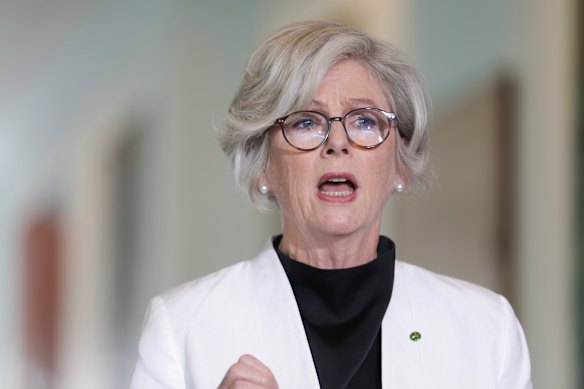

Most Australian MPs’ paths to parliament are via well-honed political structures. From youth branch to staffer to elected office, perhaps via a union or a private firm run by party powerbrokers. This has, rightly, prompted community concerns that MPs are too deeply entrenched in their political bubble to have much experience of life outside it.
Helen Haines is not that kind of politician. She grew up on a dairy farm in Victoria, and became a nurse and midwife. Few professions are more exposed to the challenges faced by ordinary families than frontline health workers. One can only imagine the joys and agonies Helen saw daily while working with women and babies, and the empathy and patience she needed to guide them through.
She came to parliament armed with decades of expertise in healthcare, as well as a deep understanding of and love for regional Australia. As an independent, she was free of the baggage of party affiliations, and able to develop her own positions on issues. She did so thoughtfully and bravely.
Australia could do with more politicians with the life experience, rigour and integrity of Helen Haines. But after Monday’s attack, women who might be thinking of following in her footsteps would be forgiven for deciding that the cost of entering public life is too high.
We’ve heard myriad stories this week about skyrocketing threats to the safety of Australia’s politicians, and women seem to be disproportionately targeted.
On the eve of the attack on Helen Haines, someone posted a meme to a NSW National Party MP Nichole Overall’s social media page saying, “not enough politicians are afraid for their lives right now and I think that’s a problem.” On Wednesday afternoon, a man was charged for making threats and swinging nunchucks outside West Australian MP Hannah Beazley’s office. After calling for a return to civility, Governor-General Sam Mostyn was abused on her social media account.
Public life is hard enough. Politicians have always had to deal with political ruthlessness, job insecurity and public criticism, and it’s worse for women (including Queen Victoria, as Julia Baird wrote today). But if you add this relatively new element of living in fear, the scales tip heavily against giving it a try.
A Women for Election survey of women who have been elected or are running for office found 90 per cent have experienced online abuse. Fifty per cent are questioning whether they would run again, or should have run in the first place.
There are no simple solutions. More civility from our political classes might improve the tone from the top, but the barometer of what’s acceptable has shifted so significantly in Australia and overseas – the mockery of Jacqui Lambie’s vaginal prolapse in a One Nation video is just one example – that change would need a level of multilateral agreement that we have yet to see, despite Monday’s shocking attack.
Even if politicians lifted their tone, the malaise runs deep. I remember a time when we could disagree. Now, however, there are many who interpret a different opinion as a personal insult, and respond to this perceived insult with not only explosive fury, but also threats of – and sometimes actual – violence. To these people, the offence comes not from the nature of the opinion expressed, but from the fact it was expressed at all.
Law enforcement bosses have repeatedly warned about the real-life impact of violent words, and how an environment with increased levels of grievance, intolerance and polarisation have made violence seem permissible. And this is happening in an era in which we have less and less in common as a society, and live within our own algorithms, which keep reinforcing our worldview. Perhaps Australians are losing their tolerance of opposing views because they have less exposure to them.
As Waleed Aly wrote today, “focusing on [how politicians respond to these crises of violence] can be a form of self-exoneration, as though citizens are not participants in our political culture … yes, it matters how we speak to one another. But maybe the problem is we’re too obsessed with speaking. It might matter even more how well we listen.”
The Sydney Morning Herald supports plans to allow Australians to opt out of algorithms, because we should be allowed the choice. Any insistence that we stay in these vortices against our will is its own limitation of freedom.
The Herald will also continue to publish a range of views on topics, because we believe our readers are broad-minded, educated adults who are able to weigh perspectives and make their own decisions. We also believe democracy is stronger for having an informed voting public.
We know some readers disagree with some of the opinions we publish or express, but we also know you have the intellectual bandwidth to consider those views anyway, and make your own decisions. We welcome your thoughtful feedback when you disagree.
Our thoughts are with Helen Haines and her family. Monday’s attack was a dark day for our democracy. Hopefully, Australia responds by focusing on the myriad factors that contributed to it, and making an effort to address them.
Get a weekly wrap of views that will challenge, champion and inform your own. Sign up for our Opinion newsletter.
From our partners
Disclaimer : This story is auto aggregated by a computer programme and has not been created or edited by DOWNTHENEWS. Publisher: www.smh.com.au