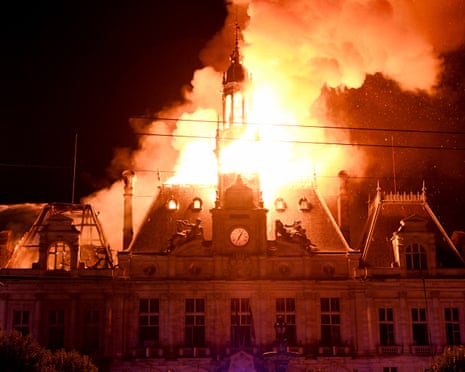
After weeks of protests and a weekend of riots in which a town hall was set ablaze, 2,000-plus shops were looted, 2,300 people were arrested and 1,000 police injured, the repercussions for France – for its society and its economy – continue. Allegations of police brutality surfaced, and the violent protests unnerved investors, resulting in a debt sell-off, with borrowing costs rising higher than for Greece. All of this ahead of a hotly contested presidential election that’s now just six months away.
The French government’s escalating financial problems were covered by the Guardian’s Europe correspondent Jon Henley who wrote: “France’s national debt, at 119% of GDP, is at its highest level since 1946. Its budget deficit, at 5.1%, is also among the highest in the EU. There is just no money in the bank to ease the cost of living squeeze that brought 550,000 people on to the streets on Saturday.”
Columnist Paul Taylor commented that “Last weekend’s violence has increased the likelihood of a law-and-order backlash among voters that could propel (Marine) Le Pen into the Élysée Palace. But if the financial situation worsens and the campaign turns on who can save the economy, she may yet lose out to a candidate who is firm on security and more orthodox on fiscal policy.”
And the Guardian’s editorial noted that “In an increasingly febrile atmosphere, France is heading towards a seismic reckoning in May. Alarmingly, the civil strife witnessed at the weekend may only be a foretaste of what is to come.”
What are your views on the riots, their causes and their aftermath? Are they paving a path to the presidency for Le Pen? In his final months in charge, can embattled incumbent Emmanuel Macron meaningfully address the situation in which France finds herself?
France-based Guardian Europe columnists Rokhaya Diallo and Alexander Hurst will be live here at 1500BST today to answer your questions on what happened, why, and where France goes from here.
Post your questions in the comments below or email conversations@theguardian.com
Michael1611 asks: As Jon Henley suggests in his recent column, public attitudes to Macron have toxified the entire centrist bloc. But if (as seems very likely) Marine Le Pen’s RN party wins the election what on earth can they do that is viable in economic terms, given the financial crisis the country faces? It seems to me there is a risk of a huge backlash when the promises they are making cannot be kept?
Alexander: I’m going to repurpose a trite phrase and say that nobody’s political programme is going to survive first contact with France’s coming debt crisis. The French thinktank Terra Nova did a breakdown of the RN’s error-riddled economic plan, which seemed to have been co-created with or at least edited with AI. Interest rates on French debt are already unsustainably high, and the RN has already voted against raising taxes on the wealthy and the ECB isn’t going to run to bailout a far right government promising to go to battle with EU’s institutions, so it will be left with budget cuts and betraying everyone who thinks Le Pen will actually lower the retirement age.
Unfortunately, the same probably goes for Mélenchon (even though I think the chances of him defeating Le Pen are extremely small, given the persistent polling on that matchup), who will probably face a similar situation of spiking interest rates and EU partners who will want things in return … and he’s already made ‘disobeying’ a central point of his future relationship with the EU. So, why would they offer a condition-free bailout to a country with a lower retirement age than their own citizens enjoy (even in the Nordics where many benefits, like year-long paternity leave, are more generous than they are in France), and that’s made antagonism and confrontation its starting point?
The EU mismanaged the last financial crisis in ways that were more costly than it should have been, and resulted in a lot of lost time. Hopefully it won’t repeat those mistakes the next time – but that’s also predicated on having national governments in power that are able to build coalitions around what those different approaches might look like.
As far as public attitudes, I think the major point is that France has very low tolerance for rising inequality, or for the suspicion that the rich are getting off easier than everyone else – and this is certainly what tanked Macron from the beginning with a huge chunk of the electorate. There’s no path forward to social calm without the wealthiest people paying more than they are today.
wyrcommunity asks: How do you envisage the financial contribution by France to the EU playing out across the various political groupings at the next elections, given France’s escalating financial problems, and that Macron has previously defended the funding of €2tn for the 2028-2034 EU budget, which will equate to a French contribution of c. €38bn-a-year?
Rokhaya: The RN is likely to use this to argue that France is financing Europe while neglecting its own population. Other parties will need to explain what European spending delivers and how it should be funded, which is legitimate. The proposed €2tn budget is still being negotiated, so I would be cautious about presenting the €38bn annual French contribution as a settled commitment.
To me public finances involve political choices, including choices about raising revenue. France’s debt cannot become a permanent justification for leaving schools understaffed and buildings deteriorating. As I wrote in my Guardian column last week, the economists Élise Huillery and Romane Paris, for example, propose an inheritance tax reform that could generate €11.8bn in additional education spending. It would target only the largest inheritances, the wealthiest 1% of heirs. So there are alternatives to asking that public services are cut back and ordinary households to absorb further austerity.
The presidential election debate should address who contributes, who benefits and which investments serve the public interest. Defending European cooperation requires showing how it improves people’s lives concretely; it cannot remain an abstract commitment disconnected from urgent material concerns.
Alexander: Financing the EU based on national contributions is an error that should be corrected. It immediately gives the right an argument that “we” are “sending” money to the EU. It would make so much more sense to replace contributions with an EU-level corporate tax floor to give the EU its own resources, and at the same time prevent race-to-the-bottom style tax policies that fuel tax evasion schemes. I’ve never understood the opposition to this (other than corporate capture, I guess) by states that maintain low corporate tax rates; they would be fully free to go above the tax floor or keep their tax rates as close to it as they wished. And it wouldn’t harm any single state’s competitiveness, since the common corporate tax rate would apply across the board.
As far as France’s domestic spending goes, interest payments on the debt will soon become the government’s single largest expenditure, soon exceeding total spending on education. Allowing that to happen isn’t coherent with a vision of social and comic justice. Interest payment on the debt – ie. money paid out to creditors – is going to be €73bn next year, and rising quickly. That is money that cannot be spent on education, healthcare, rural areas, green transition … Raising taxes on the wealthy and on inheritances and cracking down on corporate subsidies and tax evasion is a necessary step, but in the long term, there are other models that France might learn from as well, like sovereign wealth funds that generate returns for the public, instead of leaving the market’s returns to be captured primarily by the wealthy.
Eamon McCrisken notes: Comparisons are being made with May 1968 but I think the following should be borne in mind from those times:
‘De Gaulle and Pompidou warned the country was threatened with a Communist coup. De Gaulle announced a snap election, calling upon the French to choose between legitimate government and revolutionary anarchy. The May Events in France were curiously peaceful by the standards of revolutionary turbulence elsewhere, or in France’s own past. The French ‘psychodrama’ (Aron) of 1968 entered popular mythology almost immediately as an object of nostalgia, it was above all a victimless revolution. (Tony Judt, Postwar)
Rokhaya: This comparison reminds me how familiar the political framing sounds: a social movement with concrete grievances is presented as a threat to the nation, and the public is asked to choose between the government and chaos. That framing allows those in power to elude questions about their own policies and responsibility for the escalation, as it is the case for the current protest.
May 1968 was not really “victimless”: people died during the May–June events, including striking workers at a Peugeot factory in Sochaux. Relative restraint compared with other historical upheavals should not erase those deaths.
France’s relationship with nostalgia is also something that can be underlined. We celebrate past rebellions while treating those protesting in the present as dangerous or irresponsible. We should take their demands seriously now, while they can still be answered and not wait for the future to romanticise them.
Alexander: Part of me loves to talk about national mythologies and how they can also become our national pathologies, and part of me hates it because I know I’ll inevitably end up reducing and simplifying things because I haven’t, unlike Tony Judt, written a chef d’oeuvre like Postwar on it.
But to go there anyway, if the US mythology has a large dose of “someday I can get rich, too” in it, I think the French mythology has a dose of “someday, I too can overthrow a despotic government”. I obviously wasn’t around in May 1968, and I didn’t grow up in France, but it does often seem to me like every generation wants to have its own “Revolution” that then cements its place in the national narrative. The country obviously has a high propensity for large-scale street protests and confrontations that don’t really happen in the same way as the US or UK. Lately, I’ve been wishing the US would take some inspiration from the French. But is the confrontational nature of French politics a sign of it working, or a sign that it’s not really working? I’d lean towards the latter.
After weeks of protests and a weekend of riots in which a town hall was set ablaze, 2,000-plus shops were looted, 2,300 people were arrested and 1,000 police injured, the repercussions for France – for its society and its economy – continue. Allegations of police brutality surfaced, and the violent protests unnerved investors, resulting in a debt sell-off, with borrowing costs rising higher than for Greece. All of this ahead of a hotly contested presidential election that’s now just six months away.
The French government’s escalating financial problems were covered by the Guardian’s Europe correspondent Jon Henley who wrote: “France’s national debt, at 119% of GDP, is at its highest level since 1946. Its budget deficit, at 5.1%, is also among the highest in the EU. There is just no money in the bank to ease the cost of living squeeze that brought 550,000 people on to the streets on Saturday.”
Columnist Paul Taylor commented that “Last weekend’s violence has increased the likelihood of a law-and-order backlash among voters that could propel (Marine) Le Pen into the Élysée Palace. But if the financial situation worsens and the campaign turns on who can save the economy, she may yet lose out to a candidate who is firm on security and more orthodox on fiscal policy.”
And the Guardian’s editorial noted that “In an increasingly febrile atmosphere, France is heading towards a seismic reckoning in May. Alarmingly, the civil strife witnessed at the weekend may only be a foretaste of what is to come.”
What are your views on the riots, their causes and their aftermath? Are they paving a path to the presidency for Le Pen? In his final months in charge, can embattled incumbent Emmanuel Macron meaningfully address the situation in which France finds herself?
France-based Guardian Europe columnists Rokhaya Diallo and Alexander Hurst will be live here at 1500BST today to answer your questions on what happened, why, and where France goes from here.
Post your questions in the comments below or email conversations@theguardian.com
Disclaimer : This story is auto aggregated by a computer programme and has not been created or edited by DOWNTHENEWS. Publisher: theguardian.com