
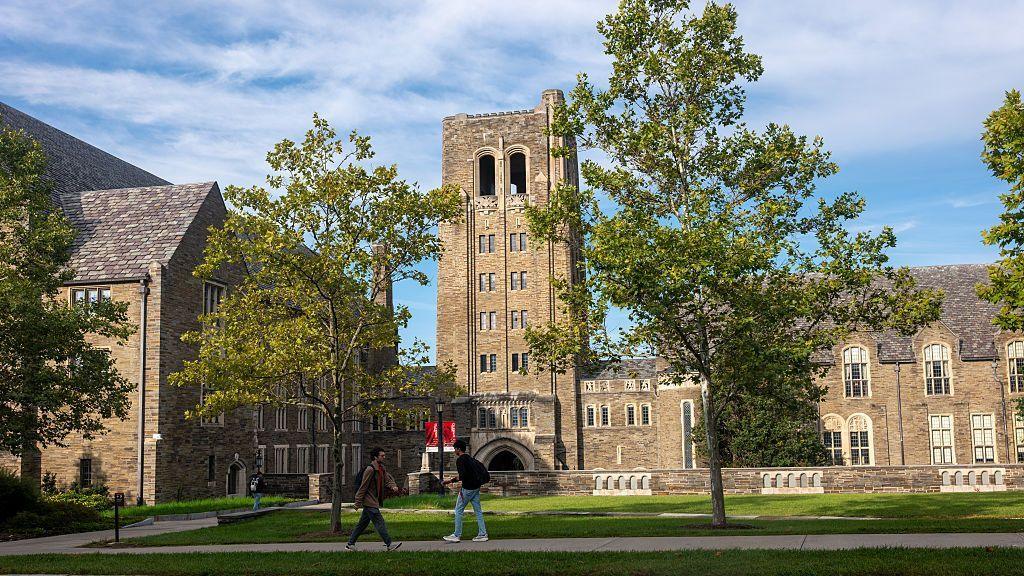
Woman at centre of Cornell University rape inquiry in ‘constant fear’, lawyer says
-
Published
The life of a woman who filed a lawsuit alleging she was drugged and raped at a Cornell University fraternity house has been completely upended, her lawyer has said.
Speaking to the BBC ahead of a hearing in the civil case on Friday in New York, her lawyer Thomas Giuffra said: “She feels under fire.”
The woman, known anonymously as Jane Doe, is suing her former school and the fraternity over the alleged incident involving several men at the Chi Phi fraternity house in October 2024.
When the case went viral, a series of “I am Jane Doe” solidarity posts appeared, but there was a separate campaign aimed at unmasking her and defending the men, who have all denied any wrongdoing.
The men, who are also being sued by the woman, have not been charged with any crimes.
 Image source, Getty Images
With initial proceedings now under way in the civil case, Giuffra told the BBC that these last few weeks have been “a very hard time” for his client, who isn’t doing a lot beyond “surviving”.
Her decision to sue was rooted in a desire for closure and to take power back, he said.
Giufrra visited Jane Doe this week and found that she hadn’t been sleeping well – relying on medication to get rest.
Now in trauma therapy, he says she doesn’t feel safe in her own home following malicious threats that were directed at her and her family.
After her address was published online without her consent, someone called in a fake emergency that led to police in full tactical gear drawing assault rifles on her father, her friend and her brother at their family home.
“It’s just constant fear,” he said.
He added that despite this her resolve hadn’t been shaken and she remains determined to overhaul the university system at Cornell, and across the country, to protect survivors.
Cornell University, after initially defending its disciplinary measures, acknowledged it fell short in its handling of Jane Doe’s case.
After facing intense pressure, the college’s president announced that fraternity parties would be suspended until the end of the academic year to allow for a thorough review to determine whether and how they can safely continue.
The school also said it would add sexual assault investigators to its police force.
Giuffra, however, says he is surprised that Cornell has not reached out to him and believes they have been focused solely on “damage control”.
He says any agreement with Cornell to resolve the civil lawsuit will need to include “steps to ensure there are no more Jane Does” and if there are, that they are going to be supported.
The BBC contacted Cornell for comment who directed us to the university’s previous statements and comments on its internal investigation in 2024.
New York’s governor Kathy Hochul appointed a special prosecutor, New York’s Attorney General Letitia James, to oversee a reopened investigation into whether criminal charges are warranted.
Giuffra expects it will take a long time to do a proper investigation but is concerned that they will be going after evidence that is now “stale”.
“A lot of the communication was on Snapchat, Snapchat goes away,” he told the BBC.
“The best time to get evidence is around the time of the crime and that just didn’t happen.”
However, Giuffra believes he can win the civil case against the university, the men and others, where the burden of proof is lower than a criminal case.
Civil cases require a preponderance of the evidence, that it’s more likely than not it happened, while criminal cases require proof beyond a reasonable doubt.
Recent high profile cases have shown the way juries evaluate consent can be unpredictable.
“I wouldn’t have taken the case if I didn’t think it was a strong case that I could win and get her some closure.”
-
-
Published5 October

-


Disclaimer : This story is auto aggregated by a computer programme and has not been created or edited by DOWNTHENEWS. Publisher: BBC




