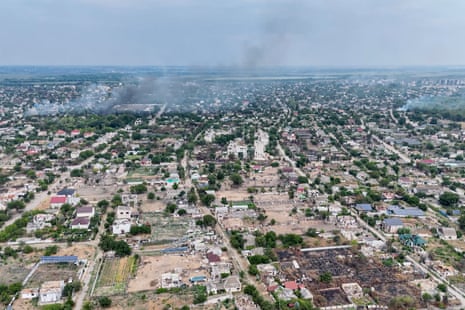
The White House has issued a statement saying Melania Trump has helped broker a ‘ceasefire’ in the Russian-occupied city of Oleshky, where residents have been enduring a worsening humanitarian crisis due to the lack of food, electricity and other resources.
The small town in southern Kherson has been the centre of an increasingly desperate humanitarian crisis under Russian occupation.
Since May, Russia has failed to deliver food, medicine or other essential goods to the area leading to deaths from starvation and disease. There has also been problems with the burial of bodies and sanitation, as the local morgue has been destroyed and there is no running water.
Russia and Ukraine have accused the other of blocking supplies to the population of the town which Ukrainian forces want to retake.
Ukraine has previously appealed for a ceasefire to evacuate the estimated 2,000 civilians left in the town – but Russia hadn’t made any commitments.
Earlier this week, Pope Leo called for an intervention while the Kremlin said Putin had discussed the situation with Donald Trump.
The White House now say both countries have agreed to pause military action “to allow for humanitarian aid to enter and to prepare a civilian evacuation through a designated safe passageway. A ceasefire is set to come into effect on 29 October.
“The situation in Oleshky is dire. Oleshky is a front-line war city on the brink of disaster. Oleshky’s remaining population is comprised primarily of elderly residents who urgently need medical attention, medicine, food, and clean water,” Melania Trump said in the statement.
“It was abundantly clear that without my intervention, the possibility to bring humanitarian aid into the city and to evacuate the elderly would be impossible,” she added.
There is no comment from Moscow or Ukraine yet. The Guardian’s international correspondents are looking into the statement and attempting to corroborate it with their sources.
Ukraine and Russia have signed an agreement clarifying details for the “humanitarian mission” in Russian-occupied Olekshy, Reuters reports.
In comments to the news agency, Kyiv’s ombudsman Dmytro Lubinets said Ukraine is also working on “expanding the mission” to other areas.
The multi-staged mission will involve demining roads to Oleshky, food deliveries and evacuations, he said, and should be implemented starting 27 October. That date is in line with the one given by the Kremlin earlier, but is different to Washington’s date of 29 October.
Melania Trump’s “personal involvement” made the agreement possible, Lubinets added.
Earlier on Friday, Emmanuel Macron met directly with around 20 student representatives for the first time since protests began a month ago, as his government prepares for further demonstrations over the weekend.
Macron promised an overhaul of France’s much-criticised university admissions system Parcoursup, student groups said after the meeting at the presidential palace, according to France24.
The French president is now in Trappes, where he will speak this evening alongside the mayor, “to express his solidarity with all those mobilized following today’s racist terrorist attack,” the Élysée Palace said.
A ceasefire aimed at providing humanitarian aid to the ravaged Russian-occupied Ukrainian city of Oleshky will begin in the early hours of Tuesday, Russia’s army chief has said.
“The Russian army are ceasing fire in the Kherson sector and entering a regime of silence from 4am Moscow time on October 27,” army chief Valery Gerasimov was quoted as saying on Friday by the Russian defence ministry, AFP reports.
The White House said earlier that the ceasefire would begin on 29 October. I’ll bring you more clarity on the timings of the truce as we get it.
In other news, guests representing countries across Europe visited Hungary’s capital on Friday to take part in an event commemorating the 70th anniversary of the 1956 anti-Soviet uprising — and to signal a new chapter in their countries’ relations with Budapest after this year’s ousting of former prime minister Viktor Orbán.
The visiting dignitaries – including European Commission president Ursula von der Leyen and president of the European Council António Costa – were in Budapest at the invitation of prime minister Péter Magyar, who has spent his first months in office rebuilding Hungary’s ties with Europe that had unraveled under his predecessor.
Addressing tens of thousands of people in Kossuth Square beside Parliament, Magyar praised the bravery of Hungarians who rose up against Soviet oppression in 1956 and “gave their lives for a democratic and independent Hungary.”
He said he wanted Hungary to be a “reliable ally” after the Orbán era:
Since 1956, every Hungarian leader, and I repeat every Hungarian leader, must know that his power can never be more important than the freedom of his country.
Hungary is not a country that can drift forever between east and west. In 1956, the Hungarians made a clear choice: We belong to a free and democratic Europe.
We want to be reliable allies who sit at the shared table with our heads held high, not fortune-seekers who isolate themselves through blackmail and pursuing a separate path.
Earlier on Friday, Magyar placed flowers at the graveside of Hungarians who were killed during the popular 1956 uprising that began with a students’ march in Budapest on 23 October and spread across the country.
Later, he oversaw a ceremonial raising of Hungary’s flag on Kossuth Square beside Parliament, accompanied by President András Baka and speaker of the national assembly Ágnes Forsthoffer.
Von der Leyen, the head of the EU’s executive Commission, was expected to deliver a speech alongside Magyar later in the day. She and other foreign dignitaries were scheduled to take part in a formal commemoration in the Parliament and attend a gala performance in the National Opera.
Pjotr Sauer and Peter Beaumont
Despite the White House’s claim the Oleshky ceasefire had been brokered by Melania Trump, there had already been protracted efforts to organise a humanitarian ceasefire, with claims by Ukrainian officials that it had been Russia that had rejected previous calls.
Calls for a ceasefire had been issued by Pope Leo XIV – who discussed the issue with the Ukrainian president, Volodymyr Zelenskyy – the United Nations, EU officials and the Council of Europe. As recently as 18 October, Ukraine’s ombudsman, Dmytro Lubinets, had also said he thought agreement was close without any mention of the first lady’s involvement.
Ukraine has for weeks been pushing for a civilian evacuation from Oleshky and nearby settlements, at times using drones to airdrop emergency food and medical supplies into town.
Here’s Pjotr and Peter’s report:
A suspect has been arrested and taken into police custody after a gunman fired from a vehicle in a Paris suburb on Friday, killing one person and wounded several others, including a 12-year-old girl, in a “deadly rampage” that French authorities suspect may have been a “racist, likely Islamophobic” attack.
France’s National Anti-Terrorism Prosecutor’s office took charge of the case and interior minister Laurent Nuñez spoke of a “terrorist crime.”
The shootings happened at three separate locations in the towns of Trappes and La Verrière, near Paris, and took less than 15 minutes in total, Nuñez said.
“A deadly rampage took place this morning,” he told reporters in Trappes. According to Nuñez, the attacker fatally shot one person and wounded five others, three of them very seriously, with their lives in danger.
Nuñez said the attack was considered a “terrorist crime” by prosecutors, with a possible racist motive.
Aurore Bergé, the minister for gender equality and fight against discriminations, said the 12-year-old girl was very seriously injured.
As quoted by the Associated Press, she added:
If a racist motive is established, I hope that the whole nation will stand alongside the residents of Trappes, La Verrière, and the victims. We cannot tolerate even the slightest racist remark in the French Republic.
Nuñez said the suspect fired “what appears to have been a military-grade weapon, or at least an automatic weapon.”
Trappes mayor Ali Rabeh said earlier that the gunman appeared to have fired relatively randomly, targeting passersby at several locations including a playground.
He told reporters:
This is probably one of the first attempted mass killings motivated by Islamophobia and racism. This was a terrorist attack with racist, likely Islamophobic, overtones.
Rabeh previously said the person killed was of African origin, while one of those critically wounded was of North African origin.
France’s National Anti-Terrorism Prosecutor’s office said it opened a criminal investigation into several offences, including “murder in connection with a terrorist enterprise with the aggravating circumstance that the act was committed on account of the victim’s actual or perceived membership of a particular race, ethnic group, nationality or religion.”
Further detail on that now with Donald Trump saying that he would speak to Elon Musk if there are still problems with Ukraine’s military-grade version of the Starlink service.
“If there is a problem, I will get it straightened out,” Trump told reporters at the White House after Ukraine said it was still having problems with the Starshield communications platform.
Asked if he had contacted Musk to restore access, Trump replied: “I have not spoken to him. I might have to, but I have not. I’ve heard it was fixed, but if it’s not, I’ll speak to him.”
As we’ve been reporting, it comes after Trump had said on Thursday that Musk, whose SpaceX is behind the Starshield system, had restored access.
The US president on Friday also rejected suggestions that Musk had too much power over a system that is vital for Ukraine’s fight against Russia’s invasion, now in its fifth year.
“I don’t think he does,” Trump said. “Elon will never do anything wrong. I know him very well, he is a fair person.”
Trump has had a complicated relationship with Musk, who led the (supposedly) cost-cutting Department of Government Efficiency (DOGE) last year before an almighty falling out last year. The pair appear to have made up again in recent months.
Further to that, Donald Trump was just asked by a reporter at the White House if he was aware of who ordered the Starlink access in Ukraine to be restricted.
Trump replied:
Well, I wouldn’t tell you if I did know. I have no idea. But I wouldn’t tell you if I did know.
He also said that he had not spoken to Elon Musk regarding the issue, but suggested he would do so if the access wasn’t fixed.
Pjotr Sauer and Peter Beaumont
Ukrainian forces continue to report widespread disruptions to the Starlink satellite network, despite Donald Trump’s claim that Elon Musk had lifted restrictions on the service.
The slowdown, which has affected the key communications system used by Ukrainian troops, began last week after Trump and Starlink founder Musk publicly criticised Ukraine’s president, Volodymyr Zelenskyy, over continued strikes on Russian oil refineries.
The restrictions have raised questions and confusion about who ordered the slowdown and why, with both Trump and Musk denying responsibility.
“I don’t comment one way or the other,” Trump said on Thursday when asked about reports that he had personally called Musk to demand the restrictions be lifted.
The bottom line: he put it back.
But Ukrainian officials said on Friday morning that speeds remained capped at about 100mph, with no indication that the restrictions had been lifted.
“At present, we have not observed any lifting of the restrictions on Starlink,” said Serhii Beskrestnov, a military expert who advises Zelenskyy.
“There have been isolated cases in which Starlink has operated at speeds slightly above the imposed limits, but this is likely due to SpaceX’s algorithms or specific conditions of use, rather than any lifting of the restrictions,” Beskrestnov added.
The speed restrictions have prevented Ukrainian military equipment, including drones, from maintaining a connection to the satellite network when travelling at high speeds, hampering both offensive drone operations and efforts to intercept incoming Russian attacks.
The slowing down of Starlink, coupled with Zelenskyy’s complaints that Washington had temporarily suspended intelligence-sharing with Kyiv, have plunged relations between Ukraine and the US to a new low in recent days.
For more on this, my colleague Jonathan Yerushalmy has this explainer on the Starlink row:
And word now from the Kremlin which, in step with the White House, hails Melania Trump’s “significant contribution” in helping broker the ceasefire in Oleshky. (Kyiv also noted her role, along with that of the Pope).
Confirming that a US-brokered local ceasefire agreement had been struck regarding the Russian-controlled town, the Kremlin has said that the Russian and Ukrainian militaries were working to determine the dates for implementing it.
The White House said earlier that the ceasefire would begin on 29 October.
As reported by Reuters, Kremlin spokesman Dmitry Peskov told reporters on Friday that all civilians wishing to leave Oleshky would be allowed to do so and that the evacuation operation itself was expected to take at least several days.
There have been efforts for some time now to organise a humanitarian ceasefire with claims by Ukrainian officials it has been Russia that has rejected previous calls, including from the Pope.
However, there were indications last week that progress was being made. On October 18 Ukraine’s ombudsman Dmytro Lubinets said he thought agreement was close without any mention of Melania Trump’s involvement.
The reason the talks have been so difficult is reportedly Russian concern that without them holding the several thousand civilians still in the town effectively hostage, the proximity of Oleshky, just the other side of the Dnipro river from Kherson, will see it come under much heavier attack from Ukraine, perhaps even an effort to take it.
Russian troops have also been struggling with food which has seen what supplies have been available to Ukrainians under military occupation taken from the, sometimes violently.
Ukraine’s top negotiator has also confirmed the Oleshky ceasefire, which was helped brokered by Melania Trump and the White House. He also thanked Pope Leo who raised concerns about the Russian-occupied town this week.
Daivd Arakhamia says an operation to “unblock the settlement of Oleshky and its surroundings will begin in the near future.”
The goal was to create “permanent humanitarian corridors for the safe evacuation of civilians and the delivery of aid”, he said on Telegram.
This was a long process in which many people at different political levels took part. We would especially like to note the role of the Pope and the First Lady of the United States, Melania Trump. We express our sincere gratitude to them.
Russian media report that dozens of flights were cancelled or suspended this afternoon at Moscow’s four airports following long-range drone strikes from Ukraine.
FlightRadar 24 says 88 flights were cancelled and 239 delayed at Moscow’s largest airport, Sheremetyevo International, on Friday afternoon.
As Ukraine has stepped up its reach deep into Russian territory with long-range drones, temporary airport shutdowns have become more common.
Zelenskyy last month said Ukraine posed no threat to civilian aircraft but Russian airspace was becoming part of the warzone.
Today, we wish to issue a warning to every airline using Russian airspace, every insurer, and everyone still utilizing key Russian airports: the Russian skies are becoming entirely unsafe.
Ukraine poses no threat to civil aviation as such—not to a single civilian aircraft. However, the presence of drones in the skies over Russia is a reality that must be taken into account.
Ukrainian leaders have been calling for a pause in fighting to get civilians out of Oleshky for months but the Russian authorities hadn’t budged.
In a statement, Melania Trump said it had become “abundantly clear that without my intervention, the possibility to bring humanitarian aid into the city and to evacuate the elderly would be impossible.”
She said she’d worked with both Russian and Ukrainian leaders on the plan, and evacuating residents would have a choice to either go to Russia or Ukraine.
Oleshky was captured by the Russians in the first week of the war, and about 2,000 residents are estimated to still be living there under Russian rule.
The first lady has made helping children in conflict a focus of her tenure. Last year she surpried everyone inrevealing she had a backchannel communication with Putin, in personally arranging for children displaced in the war to be reunited with their families.
In some cases, the children had been abducted by Russia. So far she has helped reunite 34 children with their parents, her office says.
Some more details on the shooting this morning in the town west of Paris which killed one person and injured five others, including a 12-year-old girl.
The mayor of Trappes says the gunman was was most likely carrying out “a racist, probably Islamophobic attack”.
Mayor Ali Rabeh said the gunman, who had opened fire from a car between Trappes and La Verriere, had been shooting at random and “seemed intent on carrying out a massacre”. Two of the victims were of African and North African origin, he said.
Authorities are investigating it as an act of terrorism. The gunman had “clearly” committed a “terrorist crime”, said Interior Minister Laurent Nuñez.
The White House says the first lady has led the charge in negotiating this evacuation corridor for civilians in Oleshky; we’ll have more details soon.
My colleagues Peter Beaumont and Artem Mazhulin however had this report last month on just how dire the situation has become in the war-ravaged town:
Oleshky, across the Dnipro River from the southern city of Kherson, has become “a hell on earth”, according to Ukrainians familiar with conditions there.
Food had finally run out for the 2,000 or so civilians, including 50 children, remaining in the city and its surrounding villages.
In messages shared with the Guardian, residents said they were down to one meal a day: soup without potato, made with courgette grown in what once were the flower boxes of the city’s apartment houses, sometimes with the addition of foraged purslane, an edible weed.
“We’re running out of everything,” said a resident early in the summer. “By August, the situation will be critical for us. And come autumn, we’ll definitely die. I’m already dying. I’m getting weaker by the day.”
“We’re in Oleshky [and] we can’t get out. We’re going hungry … Right now, I’ve got absolutely nothing to eat,” read another message from a woman in the besieged city who was waiting to be evacuated by the occupying forces. Before the war, she had weighed 110kg (17st); now she weighed just 67kg, she wrote.
In September, military authorities in Kherson carried out a large-scale airdrop of emergency food, water and medical supplies into the city and surrounding areas, using large drones, after Russia reportedly again rejected a ceasefire to evacuate civilians.
The Ukrainian foreign minister, Andrii Sybiha, raised the situation in Oleshky at the UN general assembly in New York in September. He told those gathered: “Russia is deliberately making life there impossible. They are starving them to death.”
The White House has issued a statement saying Melania Trump has helped broker a ‘ceasefire’ in the Russian-occupied city of Oleshky, where residents have been enduring a worsening humanitarian crisis due to the lack of food, electricity and other resources.
The small town in southern Kherson has been the centre of an increasingly desperate humanitarian crisis under Russian occupation.
Since May, Russia has failed to deliver food, medicine or other essential goods to the area leading to deaths from starvation and disease. There has also been problems with the burial of bodies and sanitation, as the local morgue has been destroyed and there is no running water.
Russia and Ukraine have accused the other of blocking supplies to the population of the town which Ukrainian forces want to retake.
Ukraine has previously appealed for a ceasefire to evacuate the estimated 2,000 civilians left in the town – but Russia hadn’t made any commitments.
Earlier this week, Pope Leo called for an intervention while the Kremlin said Putin had discussed the situation with Donald Trump.
The White House now say both countries have agreed to pause military action “to allow for humanitarian aid to enter and to prepare a civilian evacuation through a designated safe passageway. A ceasefire is set to come into effect on 29 October.
“The situation in Oleshky is dire. Oleshky is a front-line war city on the brink of disaster. Oleshky’s remaining population is comprised primarily of elderly residents who urgently need medical attention, medicine, food, and clean water,” Melania Trump said in the statement.
“It was abundantly clear that without my intervention, the possibility to bring humanitarian aid into the city and to evacuate the elderly would be impossible,” she added.
There is no comment from Moscow or Ukraine yet. The Guardian’s international correspondents are looking into the statement and attempting to corroborate it with their sources.
Paris Saint-Germain’s clash with Lyon in Ligue 1 has been moved from Sunday to Monday evening at the request of Paris police.
The French football league said it had agreed to comply with the police order.
Disclaimer : This story is auto aggregated by a computer programme and has not been created or edited by DOWNTHENEWS. Publisher: theguardian.com