
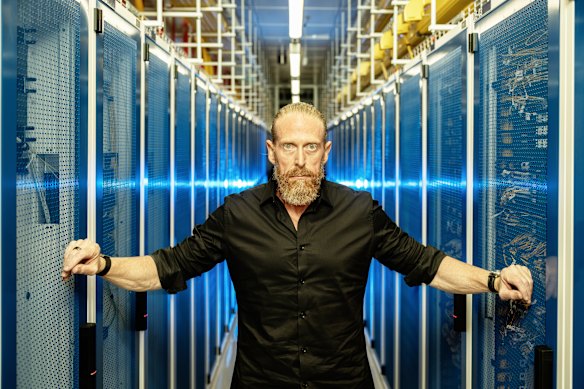

Nobody plays the role of mythological tech founder quite like NextDC boss Craig Scroggie.
A relentless gym regime gives Scroggie the look of a ripped Mike Cannon-Brookes. Add in his strict uniform of identical black jeans and shirts and the impression veers between tech titan and ageing nightclub bouncer.
Scroggie is the sort of leader who has also conjured up AI clones of his senior executives so he can have queries answered late at night, according to an AFR profile this year.
But the data centre guru does not have the kudos of having founded the data centre operator – as Cannon-Brookes has with Atlassian – nor the riches that go with it just yet.
Luckily, the AI boom has turned the boring backwater of data centres into one of the hottest tech stories in town.
As Scroggie told investors and analysts this week: “We’ve never seen a shortage of digital infrastructure like we are seeing right now.”
NextDC – which develops massive data centres and sells the computing power it generates to giants such as Microsoft – saw its valuation soar north of $11 billion as recently as this year.
It was ready for the limelight, and so was Scroggie after a decade slogging away with the warrior ethos he enthusiastically shares to Linkedin followers.
“Shit always happens, flights delay, systems fail, schedules collapse. Leaders don’t look for excuses. They build systems that allow them to endure and still perform,” he posted in September last year with a video of him deadlifting what appears to be more than 200 kilos, to an AC/DC soundtrack.
“The road doesn’t get lighter. You get stronger.”
The fortunes of NextDC and Scroggie took an abrupt about-turn this week as one of the major sources of its growth story hit a power pole in suburban Melbourne.
The stock plunged more than 40 per cent on Wednesday, wiping $3 billion from its market valuation in hours. The shock drop was triggered by NextDC slashing its profit forecasts and construction spending in response to community outrage that has now delayed the installation of high-voltage power lines to its West Footscray M3 data centre.
As the group told investors, energy distributor Jemena was forced to suspend the upgrade in response to community and stakeholder opposition to the works and the local council is “not giving its consent until more community consultation takes place”.
While analysts point to the delays being limited, NextDC’s response indicated that the issue was being taken very seriously by the group – which explains the panicked market response.
This includes considering whether it can get relief under force majeure, and other provisions, on contracts with its AI-hungry customers who will not get their computer power delivered on time.
“We are not going to continue any work on any sites that don’t have an existing customer commitment,” Scroggie told an investor conference call on Wednesday after the disastrous news was announced.
He sought to assure the market that the changes to its financial outlook would not pose a risk to its massive debt, saying the group would continue to be “in compliance with financial covenants”. But NextDC would also pause further land purchases and did not rule out sales.
“We are obviously disappointed to face these challenges and being in a position that we hadn’t planned to be in,” Scroggie said.
The news is not just bad for NextDC. Questions were already being raised about the valuations of these AI infrastructure players, and it helped to kill the float of Firmus which was scheduled to list on the ASX this week.
Profitability is also coming under more scrutiny as interest rates rise and pile further pressure onto a business model that needs lots of debt to fund its infrastructure – a lot of which is spent on rapidly depreciating chips – but relies on relatively short-term customer contracts.
Market leader CoreWeave is under immense pressure despite having Nvidia as its top institutional investor, as some of the debt cost of funding its expansion rises into the mid-teens.
And its woes have dragged on the entire sector, including US-listed Aussie player IREN.
NextDC is considered a top-tier player due to its experience developing data centres, excellent funding and energy contracts.
But the Melbourne disaster highlights rising execution risks and how easily a player such as NextDC can be derailed by some determined home owners.
In the case of NextDC it may have been the haste to get its Melbourne data centre operational, and get money flowing from customers, that brought it unstuck.
The massive power requirements needed at the M3 data centre meant local provider Jemena needed to upgrade the power lines from your typical suburban 400 volts, to 66,000 volts.
Putting these power lines underground would have cost substantial time and money, so the plan was to upgrade wooden power poles to steel structures up to 22 meters in height along quiet suburban streets.
“It was going to be in our street. We were going to have to deal with it for decades after they left – power operators like Jemena, and businesses like NextDC, they’re going to need to engage more with the community,” Yarraville resident Milco Bogoevski told this publication.
Another local who lives across from the development, Jacqui Glover, described it as a “constant battle”.
Analysts have portrayed the incredible share sell-off as overdone given NextDC’s well-run and well-funded operations.
“This pessimism implies concerns around contagion,” Morgans analyst Nick Harris said, describing the low price as “unwarranted if these issues are just short term in nature”.
But he also acknowledged that “Investors are becoming concerned more delays could occur and question what the knock-on effect might be given NextDC’s substantial funding load.”
Morningstar’s Dan Baker says these community concerns may increase developers’ costs for data centres and force new developments further away from built-up areas.
Some investors, such as UniSuper’s chief investment officer John Pearce, are not fans of the data centre hype that has boosted valuations. He thinks the big winners will be companies that harness AI, not those building its infrastructure.
“We are not that keen on the pure infrastructure players like the data centres,” he told Bloomberg.
Pearce drew a parallel with the new businesses that emerged from the internet and telecommunications boom.
“It wasn’t the owners of the infrastructure, it was the Netflixes of the world,” he said. “So we’ve got to find the next Netflix.”
But that won’t be the immediate worry for Scroggie and NextDC.
Questions are already being asked about when exactly NextDC knew about this disastrous power issue in Melbourne. Its ASX statement this week noted that work on the power upgrade was suspended in September and NextDC was “subsequently notified”.
Shine Lawyers is already investigating a potential class action on behalf of NextDC shareholders. “We have now opened an investigation and will focus on whether the company issued financial guidance that lacked reasonable grounds, and/or whether the company failed to inform investors of material impacts after issuing its financial guidance. This will include examining what representations the company made to investors as part of any recent capital raisings,” Shine’s class actions practice leader, Jonathan Wertheim, said.
The company is expected to provide many answers before its November 20 shareholder meeting in Sydney.
Scroggie used Wednesday’s conference call to remind everyone what a great company NextDC is, despite the disaster.
“The rest of the business is doing incredibly well in a demand environment that we’ve historically never seen, with some of the best credit rated customers on the planet,” he said.
The Business Briefing newsletter delivers major stories, exclusive coverage and expert opinion. Sign up to get it every weekday morning.
 Colin Kruger is a senior business reporter for the Sydney Morning Herald and The Age.Connect via email.
From our partners
Disclaimer : This story is auto aggregated by a computer programme and has not been created or edited by DOWNTHENEWS. Publisher: www.smh.com.au



