
Declan Fry
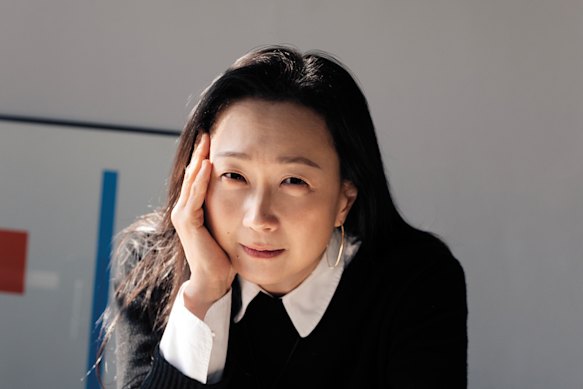
Speaking from her home in Harlem, New York, Min Jin Lee asks if it’s a good time to call. It’s a perfect time. Commiserating about time differences, I recall visiting a (very cold) Harlem years ago, where I accidentally mistook someone’s wash detergent for communal use. Min’s voice picks up at this juicy gossip. She has no New Yorker-berating to share (the woman at the laundromat really chewed me out) but she admits – despite everyone telling her it has an “attitude” – feeling that Melbourne is nice.
“I love Australia. People are so open. You can get into a fight with someone in a train here by looking at them wrong. Everyone told me Melbourne is like the New York of Australia because they’re very artistic and intellectual and cool. They meant cool as in avant-garde – but they also meant it as in, a little more chilly,” she says, laughing.“People aren’t triggered at a laundromat by using 10 cents worth of soap. Then again, I do sort of assume in life that everyone is cooler than me.”
Her contentment with not being the coolest person in the room speaks to the generosity that drives her. In her 2007 debut, Free Food for Millionaires, and 2017’s bestselling Pachinko, the fortunes of people striving to change their lives in a tumultuous world are the focus. At the heart of her new novel, American Hagwon, are the Kohs, a well-off family brought down in the world after the Asian financial crisis. As they move from Seoul to Sydney and then California through the 1990s and the early years of this century, their relationships are subject to the tyranny of distance. Boarding schools offer the opportunity for a new life but also distance from the family home. White-collar workers are liable to suddenly wind up working in fast food joints. Wherever the Koh children live – studious Bo, athletic DH, artistically minded Mido – education is not just a matter of aspiration but a continual struggle of re-evaluation and self-reflection. The hagwon, a Korean cram school, becomes symbolic of the promise of another life.
Australia, Lee says, offered a fascinating social experiment in which to set much of the novel – especially as an alternative to the more ruthless aspects of American society. Among her affections in this regard she counts HECS, TAFE (“genius” for offering vocational rights sans university – “I was so, so impressed”) and mandatory voting (“the sausage sizzle!”).
“There’s a reason why even the coolest person in Melbourne is probably warmer and more relaxed than a New Yorker – [in the US] you have to bankrupt yourself to get your cancer treated. If I give a speech about violence against Asian-Americans, or lobby for reproductive rights, which is under threat in America, I pay the price of that as a writer,” she says. “It’s really difficult to survive. In America, if your employer doesn’t give you the time to vote, you can’t vote. To me, it’s not a true democracy.”
She’s not unaware of the White Australia policy or Indigenous dispossession, she says. But truths coexist. Animating Min’s writing is her tangible sense of compassion. You don’t know what people are going through, she says. Someone may look fine but have troubles that are not visible on the surface.
“I want to persuade people to recognise the full humanity of people who have been very invisible. I also wanted to show the lie behind it. You can have this highly selective education and yet end up working as a fried fish cook. You get old. No one wants you. I’m talking about being made obsolete in the era of capitalism.”
Lee bemoans the loss of play and of third spaces, of less rabidly competitive and structured lives. It is possible – indeed almost normal now – to walk through streets where people wander alone, haloed by phone light, returning to homes whose other occupants have long since retreated to their own isolation. The world is becoming automated and predetermined in a way where even the attempt to escape isolation – to ask for a human being at a shop, to seek almost any form of human contact, physical or otherwise – is treated as a perverse eccentricity rather than an essential element of life.
“People need to play. It’s really sad when I hear someone ask, ‘how did you get your job? What did you do?’ As if they could reverse engineer the process. I look at them and I kind of think, ‘it doesn’t really work that way’. People are fairly circuitous. And the people who are good at what they do are often more circuitous,” she says with a laugh. “I’ve seen so many people with selective education break down. They tend to be the most direct, process-wise. You think they’ll go far in life. And it just does not work out. ”
I mention that a character like Mido – who has no intention of entering the theatre but finds, when she begins writing scenes in Sydney, that she is forced to think about everyone else in the scene and even the people offstage – connects to one of the book’s epigraphs: a 1963 James Baldwin lecture about how, as one is educated, one begins examining the society in which one lives.
“Yes! Oh my gosh, that scene was such a hard one to write. My novels are Trojan horses. I really am trying so hard to say, ‘please look at this’. Please look at how we are destroying ourselves. It’s a radical gesture just to live the life you didn’t think you could live. We lose so much when we have cynical young people who have been heartbroken by what our generation has delivered to them. I really do think it’s possible to fix this. But it’s going to take us older people reaching out to them. We have to take care of children who are not our children.”
The seduction of believing that education – a nice job, a certain decision – can protect or shelter you is precarious, Lee says. Especially in neoliberal environments where, in the absence of regulation, the conditions of life and existence itself “can become a kind of hell”.
“The only people I really saw survive the IMF crisis who didn’t have generational wealth – which destroyed so many paths – are those who would choose a different path.” Lee interviewed many people in writing the book, she says. She met people like John, the family patriarch, cornered by economic crises out of their control. Many of those who fell came from the middle class, people who had been taught to believe in the promises of the social compact.
“Literature all the time is saying: look at the character. Look at the context. I want to know what people are doing when no one’s looking. And also look at the fact there are so many contradictions.”
Yet research has limits, and the imagination has to go where research cannot. In size and scope, American Hagwon is comparable to the big, baggy monsters of 19th-century realism. Balzac’s Human Comedy. Zola. Like the celebrated novels of that era, it is also a story of class and upward mobility. Unlike them, though, it is written in a plainspoken style. Lee describes the precision of its sentences – what she calls “clean” writing – as acting in service to the delivery of the message. She looks to the nonfiction of Joan Didion and V.S. Naipaul, she says, to find ways of delivering the same immersive qualities of authors like Zola and Hardy without their grand, omniscient narrative style. “I want it to be so clean that there’s actually no room for misinterpretation. I’d like it if you don’t even think about me. To just be about the story.”
Before she has to go, we talk about some of our shared loves. “I like dogs,” she says. “I like children. I think adults are kind of scary sometimes, but mostly they mean well. That’s the way I look at things.”
Truer words have never been spoken.
American Hagwon by Min Jin Lee (4th Estate, $38) is available now.
What else is happening in the book world?
From our partners
Disclaimer : This story is auto aggregated by a computer programme and has not been created or edited by DOWNTHENEWS. Publisher: www.smh.com.au



