Alora, Spain – The train chugs steadily out of Malaga station, its rhythmic clatter carrying it inland towards the mountains of the Guadalhorce Valley, where whitewashed villages cling to hillsides.
Beyond the window, pomegranate trees grow close to the tracks. Palms and cypress trees stand alongside young orange saplings planted in neat rows and, farther out, olive groves whose leaves shimmer between green and silver in the breeze. Above the rugged mountains, small white clouds float across an immense blue sky, like pieces of popcorn.
Over the train’s rattle, an announcement in Spanish comes through the speakers: “The next station is Aljaima.”
The name derives from the Arabic al-khaima, meaning “the tent”, a small echo of another language, another time.
And then Alora, where the town rises around a rocky hill crowned by the remains of an old fortress. Some etymologists suggest the town’s ancient name may derive from the Arabic al-lawra, loosely translated as “the light”.
The railway station is quiet in the midday heat.
A large black pick-up truck rumbles into the station car park and stops. Henrietta Szovati, a British-Hungarian Muslim, steps out, having driven down from the mountains to collect provisions.
Dressed in a loose blue shirt and cream trousers, she offers a warm embrace. Silver earrings dangle beside her face, and a sea-blue scarf is wrapped around her hair like a turban. A pair of red-framed spectacles rests on top.
She apologises for the truck’s state. Dust has settled on the dashboard, and bits of dried grass have found their way inside. “It is a working vehicle,” she says, more accustomed to hauling things across farmland than ferrying visitors from railway stations.
For the past two years, she and her husband, Ajmal Masroor, a therapist and imam, have been transforming an old farmhouse and its surrounding land into the House of Andalus. The project aims to bring people closer to southern Spain’s Islamic history and the natural world.
Nearly 400 olive trees dot the 14 hectares (35 acres). She wants to plant more and make it a thousand-tree olive grove, she says with a smile, glancing out of the truck’s open window.
The road winds higher into the mountains. Wildfires, Henrietta says, swept through parts of the surrounding region at the height of summer, and the landscape still bears the season’s harshness. Reddish-brown earth gives way to patches of parched scrub and exposed rock, while slabs of silvery-grey stone jut sharply from the slopes.
“That’s slate,” Henrietta explains, pointing through the windscreen. The Spanish word is pizarra, she adds, the same name as the neighbouring town.
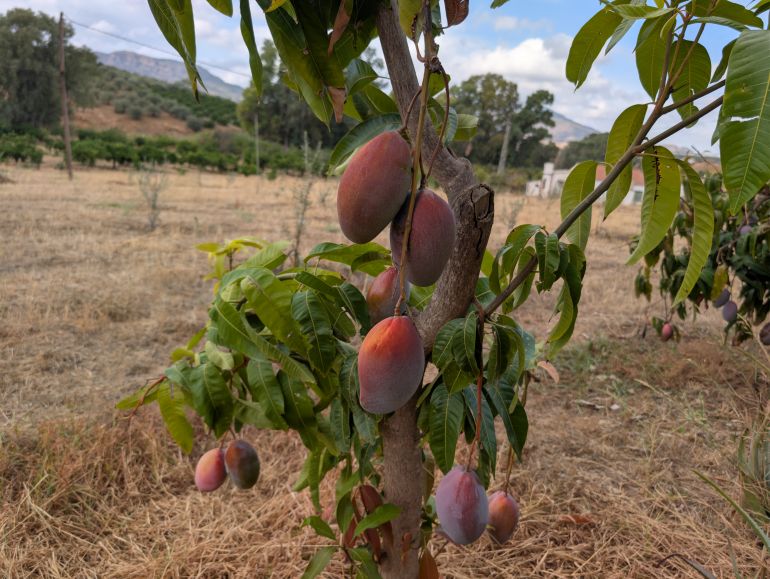
Oranges flourish here, as do figs and avocados. And mangoes that are better than those from South Asia, Henrietta emphatically declares.
As we drive further into the mountains, Henrietta gestures towards a neighbouring property. “That’s my neighbour, Juan Garcia.”
Henrietta buys lemons, avocados and honey from him. Sometimes he comes over to help with the olives. It’s this sense of community and neighbourliness she found harder to come by in Britain, where she has lived since 2001, marrying Ajmal a year later.
“I feel like an outsider there. I’m still not ‘one of us’ after more than 20 years.”
As a Muslim and as a European, she says, Spain feels familiar in a way no other place does. Hungary was never an option, she adds, describing its government as “racist and right-wing”. And in Britain, she says, being Muslim can feel unavoidably political, her faith viewed through headlines and public arguments about Islam.
In the mountains above Alora, she feels her neighbours meet her first as Henrietta: the woman who lives up the track and joins in village life.
“Practising Islam here is just easier,” she adds.
Yet Spain is not immune to the political currents sweeping across Europe. The far-right Vox party has made opposition to immigration and what it calls the “Islamisation” of Spain central to its campaigning, raising questions about how secure that sense of belonging might be.
With a sigh, Henrietta acknowledges that being Muslim can be difficult anywhere in the world today. But she prefers to focus on what she can build, rather than on political circumstances beyond her control. “Circumstances change, but community, connections and faith don’t,” she says.
For her, that means building relationships with neighbours, even when they hold different beliefs. A sense of community, she argues, is forged through everyday encounters rather than political rhetoric.
On a visit to Juan Garcia’s home, his 79-year-old mother, Maria, is curious about the scarf wrapped around Henrietta’s hair.
The women are standing in Maria’s living room, its shutters drawn against the afternoon sun. A portrait of Jesus hangs on the wall.
Henrietta explains that she is Muslim and that covering her hair is part of her faith, a way to feel closer to God. Maria is Catholic. The conversation turns to the Virgin Mary, who also covered her hair.
But Maria insists all that matters is being a good person. If you cannot be good, none of the outward signs of faith means very much.
There is no awkwardness between them, no need to defend or explain their beliefs. The conversation moves on.
It is such ordinary encounters that have made Andalucia feel like home, Henrietta says. But her connection to this part of Spain runs deeper than the friendships she is making. It also stems from a deep respect for a history that stretches back more than 1,000 years.

For British Muslim travel writer and historian Tharik Hussain, author of Muslim Europe, the fascination is understandable. Al-Andalus was the medieval Muslim-ruled territory of modern-day Spain and Portugal. Its heartland lay in the south, in what is now Andalucia, home to cities such as Cordoba, Seville and Granada, where surviving monuments still evoke a period when Muslims helped shape European civilisation.
Its eventual loss, he says, has given it an almost “Atlantis-like aura” in the Muslim imagination, a longing reflected in Muslim literature over the centuries, from the 17th-century historian al-Maqqari to the 20th-century poet Allama Iqbal.
For nearly eight centuries, Muslim dynasties ruled parts of the Iberian Peninsula, leaving behind palaces and fortresses with horseshoe arches, intricate zellij tilework, carved yeseria plasterwork, and curling Arabic calligraphy. Their legacy endured in irrigation channels known as acequias (from the Arabic al-saqiya), scholarship, language and traditions that continued to shape Spain long after the fall of Granada in 1492.
Britons have long headed to Andalucia in search of a place in the sun. But among those putting down roots here are Muslims drawn by something more: The chance to reconnect with a history in which Islam was part of Europe, and to build lives where their faith feels less like a defining difference.
Yet the Andalucia they are entering is not a vanished kingdom waiting to be rediscovered; it is modern Spain, with its own economic pressures, social divisions, and complicated relationship with the past.
What happens when the dream of al-Andalus meets the realities of living here?
Disclaimer : This story is auto aggregated by a computer programme and has not been created or edited by DOWNTHENEWS. Publisher: aljazeera.com