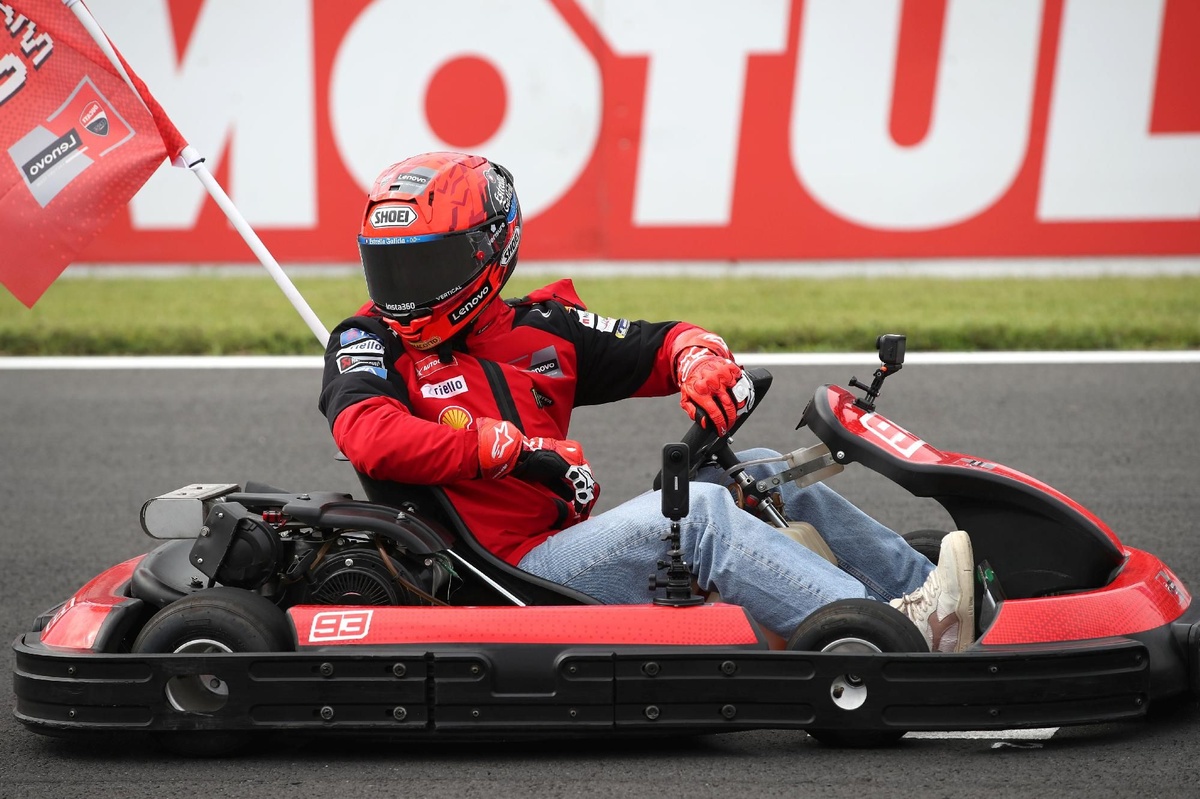
In Austria, Marc Marquez finished second in the sprint, but his expression on the podium did not quite fit a result that was, by any measure, a very good one. Even more striking was the seriousness of his face in Japan, immediately after winning his seventh sprint of the season, which he barely celebrated.
The reigning world champion’s lack of expression in what should have been a moment of joy led many to suspect that something was going on with the Ducati rider. Asked about it, the Spaniard explained that his restrained displays of emotion were no coincidence, but rather part of a strategy designed to conserve energy throughout the weekend and allow him to focus more of it on Sunday, when the biggest haul of points is up for grabs.
“It’s not that I’m serious; I’m saving my energy. Emotional ups and downs take a lot out of you. Physically, we can cope because we’re well trained. But during a Grand Prix, adrenaline levels rise sharply and then drop suddenly. That’s exhausting,” Marquez told Motorsport.com at the time.
In a recent conversation with him at Phillip Island, Márquez offered further insight into how he came to the conclusion that he needed to adopt this more emotionally restrained approach in the build-up to the main race.
It was during the first half of the season, when he struggled the most, largely because of the limitations caused by his right shoulder following the crash he suffered in Indonesia last year, shortly after celebrating the title.
The after-effects of that accident hampered him at the start of this season, until he underwent surgery during the French Grand Prix weekend. The operation resolved the episodes of sudden loss of sensation in his arm caused by compression of the radial nerve.
Nevertheless, the accumulated damage to his right upper body has forced him to devote more time to physiotherapy and recovery, adding a significant extra burden to the demands of a grand prix weekend — demands that have increased considerably since the format was changed in 2023 and sprint races were introduced.
“During the first half of the season, I was completely empty by Sunday. I would wake up and all I wanted to do was spend the whole day lying on the sofa. And it wasn’t a question of being physically unfit,” Márquez explained to Motorsport.com, before outlining the reasoning that led him to conclude that he needed to take a more serious approach to managing his energy.
Marc Márquez, Ducati
Photo by: Gold and Goose Photography / LAT Images / via Getty Images
“The data from my cycling sessions and other aspects of my training were good. Obviously, I had the problem with my arm, but from a cardiovascular point of view, I was fit,” the multiple world champion points out.
“Then I started to realise that when you have an injury or physical difficulties, the mental side has to bear a greater burden. It’s very difficult to switch off mentally. Even now, during this interview, I’m trying to concentrate fully on what you’re asking me and on my answers,” explains the #93, who has since tried to minimise the time he spends away from the garage or his office in the paddock.
“I realised that if I spent more time in my office and focused on looking after my physical condition, I felt better afterwards and had more energy. Perhaps it also helps that I’m convinced this method works. Sometimes, when a rider is certain about something, everything becomes easier. I’m convinced that I know what I need to do to perform at my best,” Marquez concludes.
We want your opinion!
What would you like to see on Motorsport.com?
– The Motorsport.com Team
Disclaimer : This story is auto aggregated by a computer programme and has not been created or edited by DOWNTHENEWS. Publisher: motorsport.com