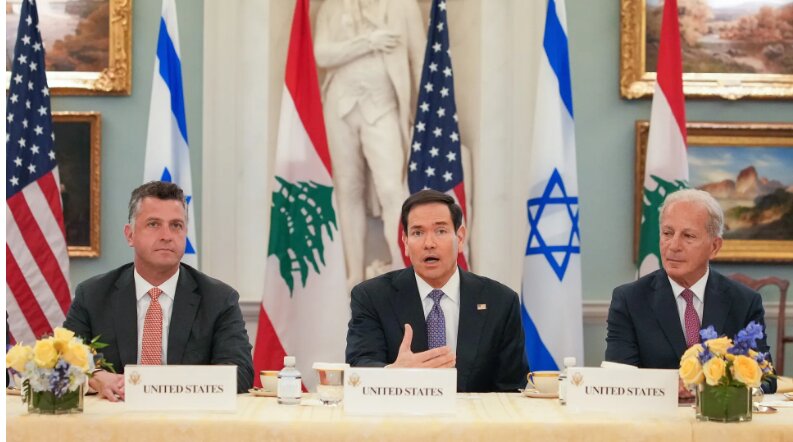
Talks between Lebanese and Israeli officials, hosted by the US in Tampa, Florida, this week, concluded without any breakthroughs, The New Arab reported on Thursday, citing its own sources.
The discussions were held at US Central Command headquarters, the Pentagon’s Middle East operations arm. They come as Israel has continued its attacks on Lebanon this month, carrying out air strikes and home demolitions in the Nabatieh, Bint Jbeil, and Sidon districts.
The New Arab said it was told there was “intransigence in Israeli positions, while the Lebanese side is holding firm to its demands that steps must be reciprocal”.
The Lebanese Armed Forces (LAF), largely funded by the US, has also rejected direct military-to-military coordination with the Israelis, instead preferring a third-party verification mechanism to be employed by the United Nations and allies such as France.
Israel has bombed Lebanon consistently since October 2023, after the Hamas-led attacks on southern Israel ignited the region.
A November 2024 ceasefire brokered by the former Biden administration did little to curb Israel’s insistence that it was targeting Hezbollah leaders and weapons depots across the country, including in the capital, Beirut.
But it wasn’t until this year that Israel significantly ramped up its military operations, mounted a ground invasion, and occupied long stretches of the south and east of Lebanon.
Since the US and Israel launched their joint war on Iran on 28 February, which prompted Hezbollah to launch attacks on Israel in defense of its ally, Israel has killed more than 4,300 Lebanese and displaced one million people in the country.
Lebanese officials have prioritized returning the displaced to their lands and demanded a timetable to do so from the Israelis, but there has been no movement on the issue since the US-sponsored framework was signed by the two sides in June.
Lebanon and Israel agreed to a trilateral framework with the Trump administration in Washington earlier this year, following five rounds of talks hosted by Secretary of State Marco Rubio.
The three countries held what was billed as a historic signing ceremony on 26 June.
Rubio said it was “the beginning of the beginning” in remarks to reporters at the time.
He later added the US would commit $100m in “humanitarian assistance in coordination with the UN” for affected communities, though he did not specify whether it was just for Lebanon or also for northern Israeli border towns.
Rubio said the LAF would be “reimbursed” by the Trump administration to the tune of $30m.
The framework led to the creation of the Military Coordination Group for Lebanon, which Washington would facilitate.
But the “pilot zones” that the Israelis pledged to withdraw from, in order to allow the LAF to take over, have not been expanded since July, with the Israelis claiming that the LAF have not had the capacity to disarm Hezbollah fighters.
Hezbollah is the key party to the conflict that was not represented in the talks.
It remains the country’s most powerful military organization and far outmatches the LAF’s capabilities. It was formed in the 1980s in response to the illegal Israeli occupation of Lebanon.
It has insisted that it cannot disarm while Israel remains a threat to Lebanon, and as Israeli officials normalize rhetoric about expanding Israel’s borders to the north.
Disclaimer : This story is auto aggregated by a computer programme and has not been created or edited by DOWNTHENEWS. Publisher: tehrantimes.com