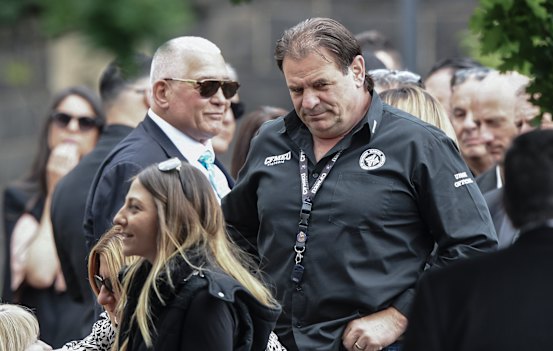
Leaked texts reveal how John Setka raged, survived and stayed at the top of the CFMEU through a domestic violence scandal, with unwavering support from his gangland friend and some Labor insiders.
The sky was a blanket of unrelenting grey and large droplets clung to the leaves of the red flowering gums lining the road in Melbourne’s west as a thickset man with thinning hair scrolled through his mobile phone. Australia’s most powerful union leader wanted advice. If anyone knew how to navigate bad press and criminal allegations it was Domenic “Mick” Gatto.
Any other union or political leader facing criminal accusations of stalking and terrorising their wife would have been penning their resignation letter. But not the towering trade union chief now focused on his phone. As usual, the boss of Australia’s construction union, a division of the CFMEU, was defiant.
And why wouldn’t he be? He was John Setka, son of a blue-collar worker who in 1970, when John was only six, had survived one of Australia’s worst industrial accidents. John’s dad had ridden a slab of the West Gate Bridge as it plummeted through nearly 50 metres of icy Melbourne air. The same slab of concrete and iron had claimed the lives of 35 others.
Forty years after his father’s escape from death, John Setka had led tens of thousands of chanting protesters through Melbourne’s CBD, unfazed by the cops on horseback or those sweating on foot in their riot gear.
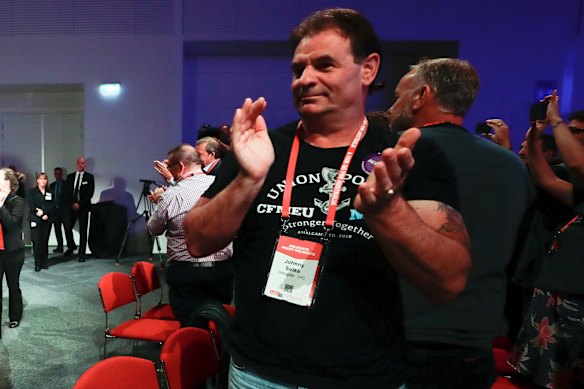
In 2018, he had stormed out of the national conference of Australia’s oldest political party having labelled its former leader Kevin Rudd a “f—ing dog” and a “maggot” as the ex-prime minister was awarded his Labor Party life membership.
The rain was still falling, the sky growing ever greyer. Setka knew his so-called union comrades were now judging him. F— ’em. Setka tapped furiously on his phone. “F— these prim and proper people have never done it hard in the [sic] whole lives,” Setka texted his mate. “I’m sick of all these squareheads trying to micro manage me and tell me who I can be seen with or who I can talk to. Yet when the shit hits the fan they’re nowhere to be seen.”
Setka was finding his rhythm. It is hard not to conclude he felt comfortable when he was raging which, of late, was more often than not. He continued his message to Gatto: “F— these people who should probably look up in the dictionary what mateship means.”
Setka’s fury had begun building days before when someone, probably a dirty cop or a grubby lawyer, leaked the details of the domestic violence case in early 2019 that had been lodged against him in the Melbourne Magistrates’ Court. One of the police witnesses, a former female judicial officer who was friends with Emma Walters, Setka’s wife, had given a sworn statement describing how John’s “anger” toward Walters had left her feeling “extremely distressed”. Walters had been repeatedly harassed and intimidated by Setka, the witness had said.
The evidence extracted earlier from the phone Setka was now using to text Gatto was similarly damning. Police analysis had revealed that, on a single evening, he had rung Emma 25 times and sent her 45 text messages, calling her a “weak f—en piece of shit”, a “treacherous Aussie f—en c—” and a “f—en dog”.
When the police case had been splashed all over the front page of The Age, along with leaked disparaging comments Setka had made about anti-domestic violence campaigner Rosie Batty, the pile-on had begun. It included Australian Council of Trade Unions (ACTU) secretary Sally McManus, who had publicly called for Setka to resign, asking him to consider that ‘no one is bigger than the movement’. She opined: “While John is elected by his members, he also needs to consider the interests of working people and the wider union movement.” According to McManus, Setka had left “the union movement’s reputation damaged”.
Australia’s largest unions, including those representing teachers, nurses and truck drivers, had publicly agreed and piled on too. Senior Labor figures Anthony Albanese and then-Victorian premier Daniel Andrews weighed in, criticising Setka.
And yet, behind the scenes, it wasn’t all bad for Setka. He was also fielding support, and not only from Mick Gatto. It said something of Setka’s power and reach that it wasn’t just several of his male comrades offering him backroom support, but women too. Even when Albanese was the newly installed opposition leader and moved to turf Setka from the party, Setka’s phone had lit up with text messages from female federal and state Labor politicians and union figures.
Victorian MP Bronwyn Halfpenny had assured Setka she was “thinking of you and hope everything will be OK”. She had texted: “You are a great comrade to working people so the establishment will always want to bring u down. Hope to see you soon. Xxx.”
Rail, Tram and Bus Union secretary Luba Grigorovitch (now a state Labor MP and minister) had repeatedly sent messages of support, vowing to direct her union to back Setka. “We will get through this John xx,” she had promised.

Grigorovitch advised Setka to rely on the behind-the-scenes advice of communications expert and Labor political adviser Tanja Kovac, who also headed EMILY’s List, a group devoted to promoting ALP women into parliament. Kovac had also texted Setka, telling him to craft his public messaging carefully. Setka had decided to plead guilty to a charge of harassment and breaching a family violence order, but Kovac warned Setka that he not only had to survive the Magistrates’ Court but the court of public opinion as well.
It was vital that Setka be seen to publicly champion “the need to talk about family and gendered violence”, texted Kovac. “Be strong, genuine, sorry & the leader I know you are,” she had advised, finishing her text with the words: “Thinking of you.” Kovac also suggested that Setka find supporters willing to support him publicly.
Mick Gatto required no cajoling. Of all Setka’s backers, he had been the most unflinching. Gatto was, in underworld parlance, staunch. Where Kovac urged Setka to display contrition, Gatto urged him to fight. “Sorry you are going through all this nonsense. If I was you I would reconsider pleading guilty,” Gatto advised.
Governments and the “establishment” had also come after him, Gatto told Setka. They had changed the law to stop him from running his boxing promotion company. Now they were coming after Setka because of all he had done for the hundreds of thousands of building workers around the country. Gatto wasn’t having any of it. “Thanks john for publicly defending our friendship,” he texted. “I do love ya. Without you the union is gone.”
Setka hadn’t bothered to respond to some of his other supporters, but for Gatto he had only love. “Thanks brother. I really appreciate the support and I’ll never forget it,” he told his ally.
Setka’s union would also not forget Gatto’s support. A month after Setka took to the steps of the Melbourne Magistrates’ Court, with Emma by his side, to publicly “take responsibility” for the criminal harassment and intimidation of his wife, another man appeared on the steps of the neighbouring Supreme Court.
Gangland identity Faruk Orman had just been released from prison, his murder conviction quashed after a court had found he’d been denied a fair trial because his lawyer engaged in serious misconduct.
Before being jailed for 12 years, Orman had worked as Mick Gatto’s driver. But it was the accusation that he had acted as the wheelman for an underworld hitman that had landed Orman in prison. Orman had entered prison with a boyish face and a skinny frame; he’d left with jowls, a slight paunch, and no desire to drive any more gangland figures around town.
The criminal cases of Setka and Orman had little in common save for two things: both men had a close connection to Gatto, and both would leave their respective court ordeals with the assured future support of the CFMEU.
After his sentencing, Setka was welcomed back to union headquarters as the CFMEU’s most powerful official, as if nothing had ever happened. Orman’s visit to the union would come in time. And when it did, it would sow the seeds of one of the biggest corruption scandals in recent Australian history.
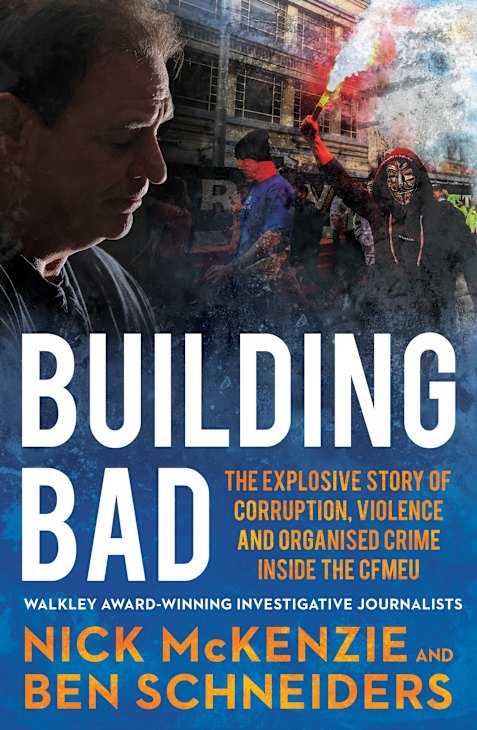
This is an edited extract from Building Bad: The explosive inside story of the CFMEU by Nick McKenzie and Ben Schneiders (Hachette), out on Tuesday.
Disclaimer : This story is auto aggregated by a computer programme and has not been created or edited by DOWNTHENEWS. Publisher: www.smh.com.au