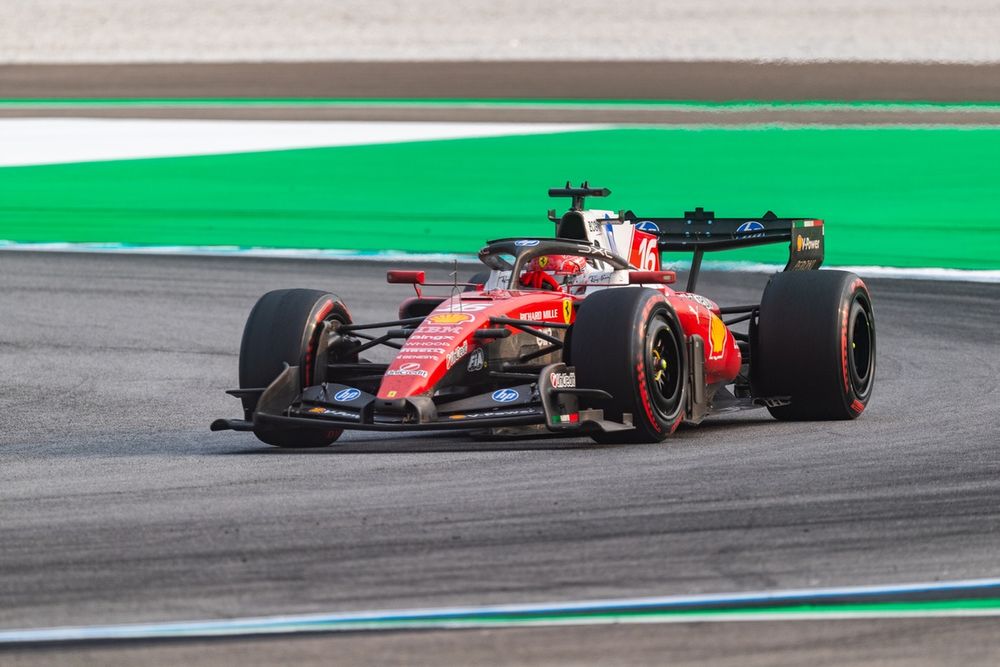
Ferrari had been pegged as the team to beat after practice at the United States Grand Prix, but ultimately found itself wanting when it came to qualifying and failed to find enough progression through Q3.
Charles Leclerc had headlined both Friday practice sessions, while Lewis Hamilton took the honours in FP3 after Leclerc’s best lap was deleted, and it looked as though the team was primed to battle against Red Bull’s Max Verstappen for pole position.
As the session unfolded, Mercedes entered the fray; Kimi Antonelli then reeled off a strong first effort in Q3 which proved good enough to clinch pole over Verstappen. Leclerc could only manage fourth, with Hamilton fifth on Sunday’s Formula 1 grid as its pace appeared to plateau at the business end of qualifying.
There were two strands to this: Ferrari’s straightline speed, and its difficulty in getting the tyres sufficiently prepared for the final part of qualifying.
The Ferrari demonstrated strong performance in the low-speed corners, and through practice had also been able to find time between Turns 6-10 at the end of the esses section, and through the high-speed Turns 16-19. But as the pace ratcheted up through the qualifying session, the Ferraris couldn’t quite respond.
Leclerc reckons the source of Ferrari’s flat end to Q3 was partly down to the change in track temperature. The Ferrari chassis manages to maintain reasonably cool tyre temperatures in race trim, but this comes at the expense of single-lap pace in qualifying as it becomes much harder to load them with the right level of heat. When the track dropped in temperature, it made the right tyre window more difficult to find.
“It’s very disappointing because I think there are some other weekends where we’ve been strong in free practice, but then coming to quali it’s very clear that the others are just having a lot more in the straights and it’s very difficult for us to match that,” the Monegasque explained.
Charles Leclerc, Ferrari
Photo by: Kym Illman / Getty Images
“I feel like today it’s a qualifying where we had the potential in the car, but the car also includes tyres and in Q3 unfortunately we were not in the right place. It was like one or two degrees less in Q3 and for me it was a huge difference; I just really struggled in the out-lap, I was sliding quite a lot already from the out-lap and that made it very difficult after that.
“There are reasons for [the plateau] and so at the same time I think we just need to work harder and try and understand those tyres even better than what we are doing now. The others I think normally have a bit more, it’s a bit easier for them to extract the lap time in Q3 than it is for us and as soon as we are a tiny bit outside the window, we pay a lot the price, so this is something that we need to look into.
“Our car for some reason, it’s very difficult to put some heat in those tyres which is a good thing for us on a Sunday, but in qualifying it makes it very tricky when the track temp goes down.”
Hamilton, on the other hand, didn’t experience the same issues as Leclerc; conversely, he felt that he’d had a “really good” out-lap to prepare the tyres and had enjoyed a relatively clean run with his final lap of the session.
Instead, he theorised that it was simply a matter of how Ferrari was running its power unit – partly due to overall power, and partly due to the cut-off in power from the electrical systems.
“I haven’t looked at the data,” said Hamilton, “but we know through the weekend we look at the straight, like just up to Turn 1 [compared to] Max, when we cut power they just keep pulling. That’s similar in other places like going into Turn 11.
“I think we might be similar in maybe Turn 12 within the rest of the lap. You see it on the overlay. I don’t know what happened, my car felt really good. Lap was solid, so they were just quicker.
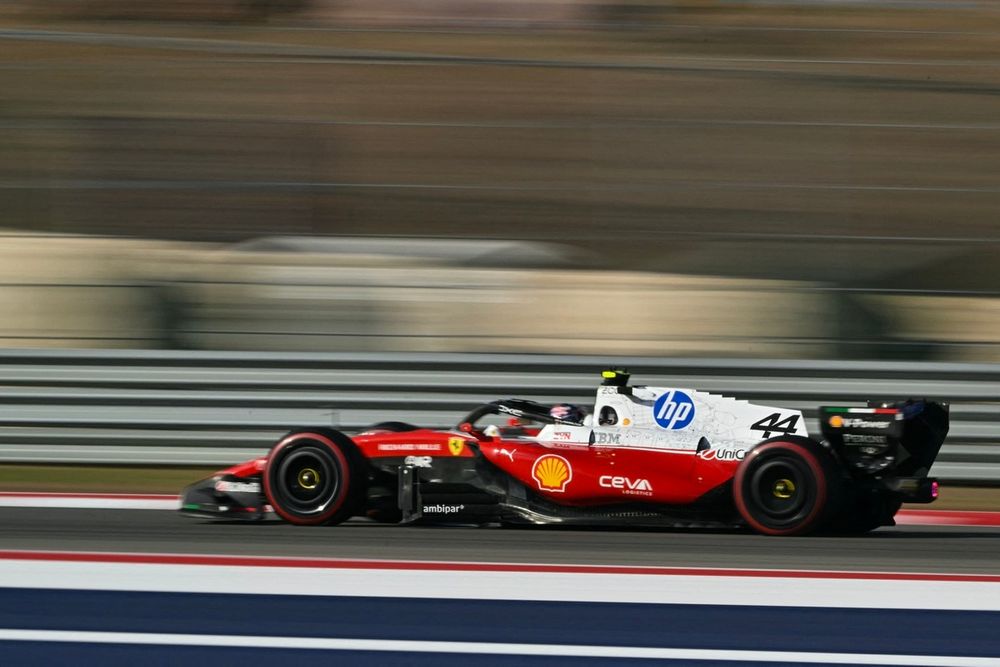
Lewis Hamilton, Ferrari
Photo by: Angela Weiss / AFP via Getty Images
“I think [power unit is] the only place we lose. I think our car is really solid: at least as good, maybe slightly better than the others, but I think they have closed up on chassis.
“We’ve seen the Red Bull closed up on their downforce. Mercedes took a three-tenths step of upgrade at least from a couple of races ago. I think they’re starting to figure out how to utilise that.
“They’re now matching us through the corners, we’re not able to take that step in this season to close that speed on the straight.”
Putting a number to that powertrain deficit to the Red Bull-Ford unit, Hamilton’s assessment was that the practice pace suggested a swing of around three to four tenths of a second on the straights, and that Ferrari simply couldn’t match up to that through its cornering speed alone.
If the situation is indeed tyre-related, then Ferrari will be confident that it can manage temperatures through the course of the grand prix – but engine power, especially on the lengthy back straight, will be harder to compensate for.
We want your opinion!
What would you like to see on Motorsport.com?
– The Motorsport.com Team
Disclaimer : This story is auto aggregated by a computer programme and has not been created or edited by DOWNTHENEWS. Publisher: motorsport.com