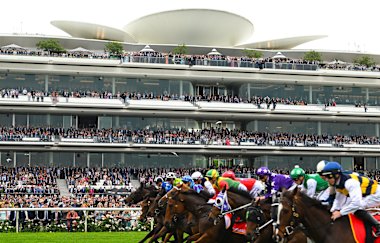

Ladies and gentlemen of the Flemington members’ stands, start your engines.
A coveted place at one of the most prestigious tables in this country’s sporting landscape is up for grabs – a seat on the Victoria Racing Club board – and the contest is shaping somewhere between a demolition derby and a boat race.
Nominations to join the board opened last week, and if trackside chatter is to be believed there will be some robust jostling, and behind-the-scenes campaigning, to get to the front of the queue.
At least one seat will be filled by a new face. Club chair Neil Wilson announced his resignation last month and will be stepping away from the role at the annual general meeting in December.
But adding spice to the mix is the fact that Wilson’s anointed successor, director Vin Cox, as well as club treasurer Glenn Carmody and fellow committee member Michael Saadie are all up for re-election. That’s four seats up for grabs.
This throws up some startling possibilities.
If more than one nomination is ratified, and there is behind-the-scenes talk of up to five interested parties, it will lead to an election that could change the composition of a long-stable VRC board.
The director with the most to lose, or gain, is Cox.
Firstly, he needs to be re-elected before accepting the chair’s role from Wilson at the coming AGM – a controversial succession plan decided by a secret ballot last month.
The Age quoted an inside source two weeks ago who claimed Cox was given the nod 6-5 – in a vote involving 11 directors – over vice-chairman Michael Ramsden.
Secondly, if Cox is re-elected, he then needs to quickly reaffirm numbers at the boardroom table to quell speculation of a coup.
In theory, a 6-5 vote in favour of Cox is easily reversed with at least one director being replaced.
But there are even wider ramifications than Cox’s potential rocky ascension to the throne, including the future direction of the VRC, which governs Flemington and runs Melbourne Cup week.
Wilson has long been loyal to the VRC’s history and need for independence.
He has continually shut down merger talks, as racing looks for new ways to make Melbourne’s three major clubs more efficient, and recently opposed changes to government legislation because he felt it would strip autonomy from his club.
Only time will tell whether a Wilson-less VRC board will offer the same resistance. Nominations close on Oaks Day.
Cosmic question No.1
As far as stand-in venues go, Flemington provided a worthy home for a one-off Cox Plate.
Racegoers were treated to a stirring three-horse finish, an unlucky loser with well-known AFL connections in Birdman and a winning storyline worthy of the past in female trainer Andrea Leek.
But one question remained unanswered: would her galloper Cosmic Crusader have beaten Sheza Alibi?
It is a question that historically would have had an answer.
In the trouble-free years before New South Wales’ self-serving creation of a $10 million pop-up race – the Golden Eagle – the country’s best four-year-olds ran in the country’s best weight-for-age race. Anamoe won at four in 2022, Winx in 2015, So You Think in 2010, Sunline in 1999 and Saintly in 1996.
Not any more. History is being rewritten and Australia’s racing pattern (fixture) is in disarray. As the Cox Plate shows, we no longer have the best horses competing against each other in our grand final races.
Instead, we have split the pack and become racing’s version of LIV Golf.
Sheza Alibi, trained by Peter Moody and Katherine Coleman, is a case in point. Her connections have bypassed the $6 million Cox Plate, and a clash with Cosmic Crusader, to chase greater riches.
She will start odds-on favourite in Saturday’s $10 million 1500m Golden Eagle at Randwick – a race restricted to four-year-olds that was surprisingly awarded group 1 status by the Asian Racing Federation this year.
Or, it should have been surprising had Racing Australia not been so impotent while the landscape was being reshaped – we say for the worse – by NSW in recent years.
Cosmic question No,2
The second question to emerge from Saturday’s Cox Plate meeting is also unanswerable, but equally worthy of debate.
Would Cosmic Crusader have beaten the same Cox Plate field on the tight-turning circuit of Moonee Valley instead of the long, wide straight of Flemington?
No one will ever know, of course, but will next year be any different?
Because if a rebuilt Moonee Valley is to reclaim its standing as the race’s spiritual home in 2027, as most believe it should, it needs to have its house on order to become a worthy host.
That’s no easy feat when a crowd of 30,000 punters are clicking through your turnstiles, and you don’t have a grandstand. In comparison, Flemington has three.
The pressure is on the Valley hierarchy to get it right.
Their promise of hosting members and dignitaries in elaborate Birdcage-like structures that line a new, longer straight is one thing, but catering for the rank-and-file punters, the backbone of the sport, is another.
They will need somewhere to sit, like a mega temporary grandstand.
Without it, Cosmic Crusader could be defending his crown back at Flemington. Heaven forbid.
Odds against punters. Again
Flicking through the World Pool tote dividends continues to make for depressing reading.
Those who placed a TAB tote bet on Flemington races on Saturday were once again sold short.
Cox Plate winner Cosmic Crusader paid $9.50 TAB fixed odds and just $8.20 on the TAB’s World Pool tote; Moonee Valley Gold Cup winner Juja Kibo paid $8 fixed compared to $6.35 World Pool; and Crystal Mile winner Surfin Bird paid $2.80 fixed and $2.35 world pool.
That’s a significant difference, and all nine races at Flemington had a negative price discrepancy.
The problem, as this column has raised before, is the takeout.
The World Pool tote, which merges with the Australian tote for big race days, continually operates above 120 per cent.
This means for every $120 bet, it keeps $20, meaning a poorer return for punters.
When the Hong Kong-based World Pool merges with our tote for Australian races, it creates a bigger cash pool and a bigger turnover by attracting international punters, which then increases returns to the industry and rebates for professional syndicates, but leaves the grassroots punter worse off.
Leek jumps for joy
Despite its many detractors, the shaky future of jumps racing must be given new consideration following the profound impact it has had on Melbourne’s spring.
The jumps jockeys have reigned supreme, and there has not been a hurdle in sight.
Consider these achievements.
Caulfield Cup winner Kingswood is trained by former jumps jockey Gavin Bedggood and ridden by part-time jumps jockey John Allen.
Cox Plate winner Cosmic Crusader is trained by former jumps jockey Andrea Leek, the first female trainer to win the race in 32 years.
And that is before we even start on Ciaron Maher – the one-time farm boy from Warrnambool who cut his teeth by tackling the jumps.
As career moves go, Maher’s decision to become a trainer has proven a masterstroke.
Not only is he neck-and-neck with Chris Waller as the country’s leading stable, he ran the trifecta in Saturday’s Moonee Valley Gold Cup with rising stayers Juja Kibo, Kings Valley and Mr Monaco.
Maher could have an unprecedented nine starters in next week’s Melbourne Cup, including Point Of Law, Saint George, Middle Earth, Shockletz, Zahrann and Royal Supremacy.
“A lot of jump jockeys are hands-on, where maybe the flat jockeys aren’t as hands on,” Leek said of her ability to train a horse.
“The flat jockeys are sort of on and off (the horse), where we do the background work as well.
“Everyone loves to get their horses fit, but we just do it that little bit differently. And I think having a jumping background, like Ciaron Maher is showing that and Gavin Bedggood, it really helps you know the differences in your horse.”
How does the racing industry place a price on that?
Bad day for Ballarat
Interesting to see the jockey fraternity vote with their feet on Friday, forcing the abandonment of the Ballarat meeting because of concerns over the surface.
The riders first raised the issue with trackside stewards after a runner slipped near the 1000m mark during the second race.
Quick repairs were ordered, but they did not do the trick.
From our partners
Disclaimer : This story is auto aggregated by a computer programme and has not been created or edited by DOWNTHENEWS. Publisher: www.smh.com.au