
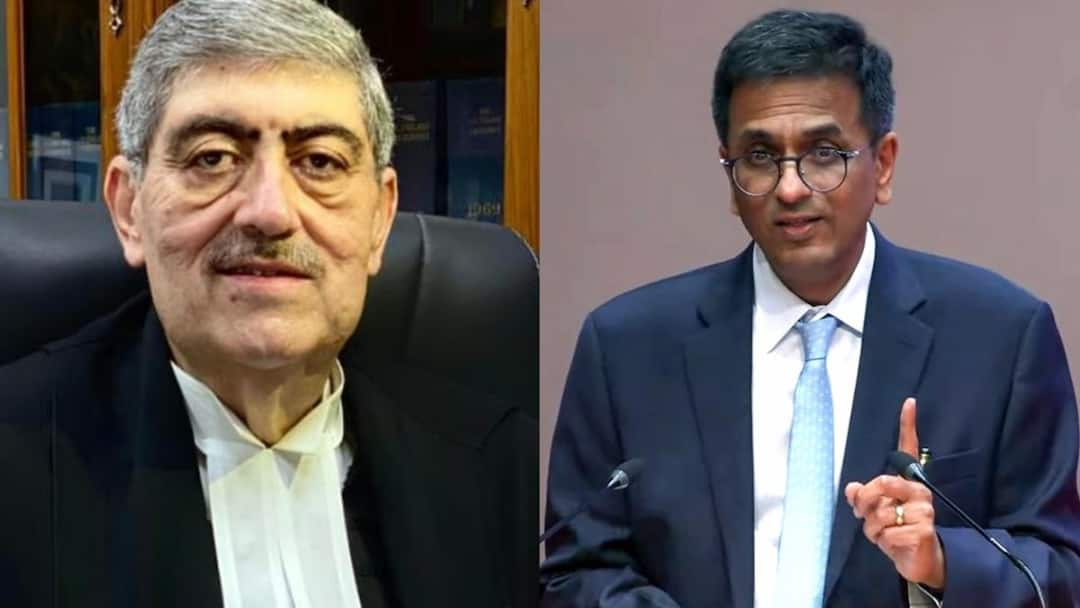
- He also questioned the unconsulted transfer of his PMLA bench.
Former Supreme Court judge Justice Sanjay Kishan Kaul has raised concerns over the process of judicial appointments during former Chief Justice of India (CJI) DY Chandrachud’s tenure, alleging that potential candidates were discussed with the government before formal Collegium deliberations. In an interview with The Wire, Kaul described his opposition to the practice, which he viewed as an attempt to secure prior government approval. The episode is also detailed in his forthcoming book, Without Fear or Favour, according to The Indian Express.
Collegium Row
Speaking to The Wire, Kaul recalled an incident in which Chandrachud took him aside during a Collegium meeting and asked whether the government should be contacted to seek its views on proposed judicial appointments.
Kaul said he opposed the suggestion, arguing that the names should first be discussed within the Collegium rather than being informally sounded out with the government before a formal decision.
According to Kaul, the Collegium had agreed on five names, but Chandrachud wanted to include a sixth candidate whose name had emerged at the last moment. Kaul and other members of the Collegium were not in favour of approving the additional name.
“There may have been some kind of prior approval from the government for the other names, including the sixth name,” Kaul suggested.
Asked by journalist Karan Thapar whether Chandrachud had obtained government approval before the Collegium reached its decision, Kaul said that discussing names with the government in advance was, unfortunately, an established practice.
He added that the practice predated Chandrachud’s tenure and continued afterwards, describing it as a matter that troubled him.
Approval Or Consultation?
Kaul clarified that he was not opposed to the government being consulted on judicial appointments. His objection was to discussions taking place before the Collegium had formally deliberated on the candidates.
He also distinguished between Chandrachud’s judicial abilities and his administrative approach. Asked whether he considered the former CJI a weak chief justice, Kaul said he had no concerns about Chandrachud’s judicial capabilities, intellectual ability or work ethic.
However, Kaul felt that Chandrachud was too accommodating towards the government in administrative matters, particularly when it came to consultations over judicial appointments. He suggested that the extent of such engagement went beyond what he considered appropriate.
PMLA Bench Change
Kaul also raised concerns over an incident involving a case under the Prevention of Money Laundering Act (PMLA).
He said a bench headed by him had questioned aspects of an earlier Supreme Court judgment and raised the possibility of reconsidering them. The matter was subsequently transferred to another bench without consultation with him, he recalled.
Kaul viewed the episode as another cause for concern, raising questions about the handling of sensitive cases and the independence of judicial decision-making.
Also Read: ‘Thanks BJP For Supporting’: Rahul Gandhi’s Swipe At Centre Over Nov 1 Delhi Protest Rally
Opposition Reacts
Senior Congress leader Jairam Ramesh said Kaul’s revelations raised serious questions about judicial independence under the Narendra Modi government.
In a post on X, Ramesh referred to the alleged government involvement in judicial appointments, discussions taking place before formal Collegium decisions and questions reportedly raised by the government about the caste of a judge from a minority community.
Ramesh argued that Kaul had recorded, in measured language, concerns that many people were reluctant to discuss openly.
He also questioned the absence of a clear denial from Chandrachud regarding discussions between the government and the Chief Justice before appointments were finalised. According to Ramesh, acknowledgements of communication between the government and the judiciary make it necessary to examine whether such interactions compromise judicial independence.
Referring to the PMLA case, Ramesh questioned whether government influence over appointments, combined with changes to benches hearing sensitive matters, could place pressure on the judiciary.
He said an institution responsible for safeguarding the Constitution must remain free from pressure exerted by those in power, adding that judicial independence was indispensable to democracy.
Uddhav Sena leader Priyanka Chaturvedi also took to X to criticise Chandrachud for being excessively accommodating towards the government.
Trinamool Congress leader Abhishek Banerjee offered a sharper assessment, writing on X: “BJP has failed India politically. Supreme Court has failed India institutionally. The second betrayal runs far deeper.”
Also Read: Congress Asks MPs To Remain In Delhi From Oct 30 To Nov 1 Amid ‘Vote Chori’ Protests
Disclaimer : This story is auto aggregated by a computer programme and has not been created or edited by DOWNTHENEWS. Publisher: abplive.com




