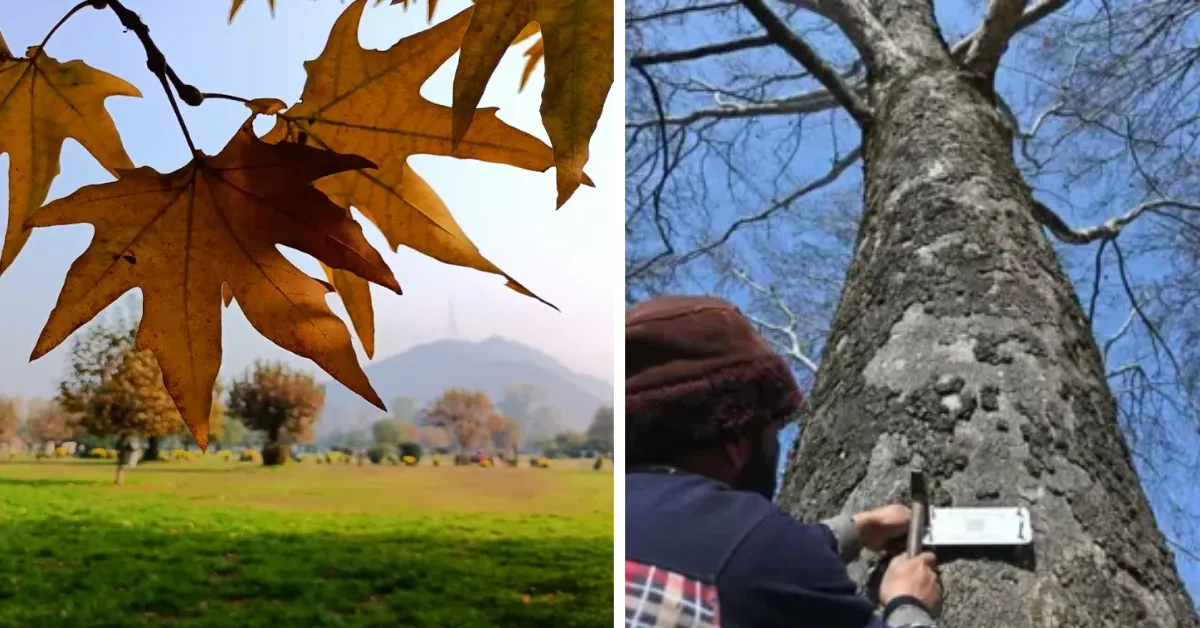
Every October, something beautiful begins to happen across Kashmir.
The broad green leaves of the chinar trees slowly turn yellow. Soon, shades of orange and red begin to appear. By November, entire trees seem to glow in the autumn sunlight, their branches covered in leaves ranging from golden yellow to deep crimson.
For Kashmiris, this is a familiar sign that winter is approaching.
Known locally as boen or buen, the chinar (Platanus orientalis) is Jammu and Kashmir’s state tree. Its enormous canopy provides shade through summer, while its changing colours have become one of the Valley’s most recognisable autumn sights.
But have you ever wondered why chinars turn such beautiful shades of red while so many trees in warmer parts of India stay green?
The answer begins inside a single leaf.
What happens to a leaf when winter approaches?
Throughout spring and summer, chinar leaves are busy making food for the tree.
Their green colour comes from chlorophyll, a natural substance that helps leaves absorb sunlight. Using this energy, the leaves turn water and carbon dioxide into sugars that help the tree grow.
But as autumn arrives, Kashmir’s days become shorter and temperatures begin to fall.
The tree senses that winter is approaching and starts preparing for the colder months.
Girls walk in a garden covered with fallen Chinar leaves during the autumn season in Kashmir https://t.co/byT5eUWu2C
— Basit Zargar (باسط) (@basiitzargar) November 27, 2021
Before shedding its leaves, it draws back useful nutrients that can be stored and used again when spring arrives. As this happens, the green chlorophyll gradually breaks down.
And something fascinating follows.
Colours that were hidden beneath the green begin to appear.
In their February 2011 Science Reporter article, Fiery Chinar, researchers Mohammad Imran Kozgar and Samiullah Khan explain how falling temperatures and declining chlorophyll reveal two groups of pigments called carotenes and xanthophylls.
These are responsible for yellow and orange shades.
In simple terms, the colours were already present in the leaves. The green was simply hiding them.
But where does that beautiful red come from?
Red leaves have another interesting story.
In many trees that change colour during autumn, red and purple shades come from pigments called anthocyanins.
Unlike the yellow and orange pigments, these can be produced as autumn progresses. Their formation is influenced by sunlight, temperature and the amount of sugar present in the leaves.
However, scientists have not established exactly which pigments produce every shade of crimson seen in Kashmir’s chinars. The 2011 article specifically explains the appearance of yellow and orange pigments.
Kashmir’s climate plays an important role in this seasonal transformation.
Chinars are deciduous trees, meaning they shed their leaves before winter. The Valley’s shorter autumn days and falling temperatures help trigger this process.
In warmer parts of India, many trees follow different seasonal patterns. Some remain green throughout the year, while others shed leaves during the dry season.
For chinars, the changing colours mark a natural process of preparing for winter and conserving resources for the next growing season.
Why Kashmir is working to save these trees
The chinar’s place in Kashmir extends far beyond its autumn colours.
Mughal rulers planted these trees across the Valley, including at Srinagar’s famous Naseem Bagh near Dal Lake. Their distinctive leaves continue to appear in Kashmiri embroidery, carpets and papier-mâché.
But the trees have faced threats from damage, neglect and unauthorised cutting.
In January 2025, The Indian Express reported on Jammu and Kashmir’s Tree Aadhaar initiative, which gives individual chinars a unique identity to help authorities protect them.
Project coordinator Dr Syed Tariq said that 28,560 trees had been geo-tagged at the time. Their records include location, age, size, health and possible threats, helping authorities keep track of individual trees.
As Kashmir’s chinars prepare to shed their leaves each winter, efforts to protect them carry a simple hope: that future generations will still be able to walk beneath their shade in summer and watch their leaves turn gold and crimson every autumn.
Sources:
‘Geo-tagging and ‘Aadhaar’: How, why the J&K govt is trying to conserve chinar trees’: Bashaarat Masood, Published on 26 January 2025
‘Fiery Chinar’: By Mohd. Imran Kozgar and Samiullah Khan, Published in February 2011
Disclaimer : This story is auto aggregated by a computer programme and has not been created or edited by DOWNTHENEWS. Publisher: thebetterindia.com