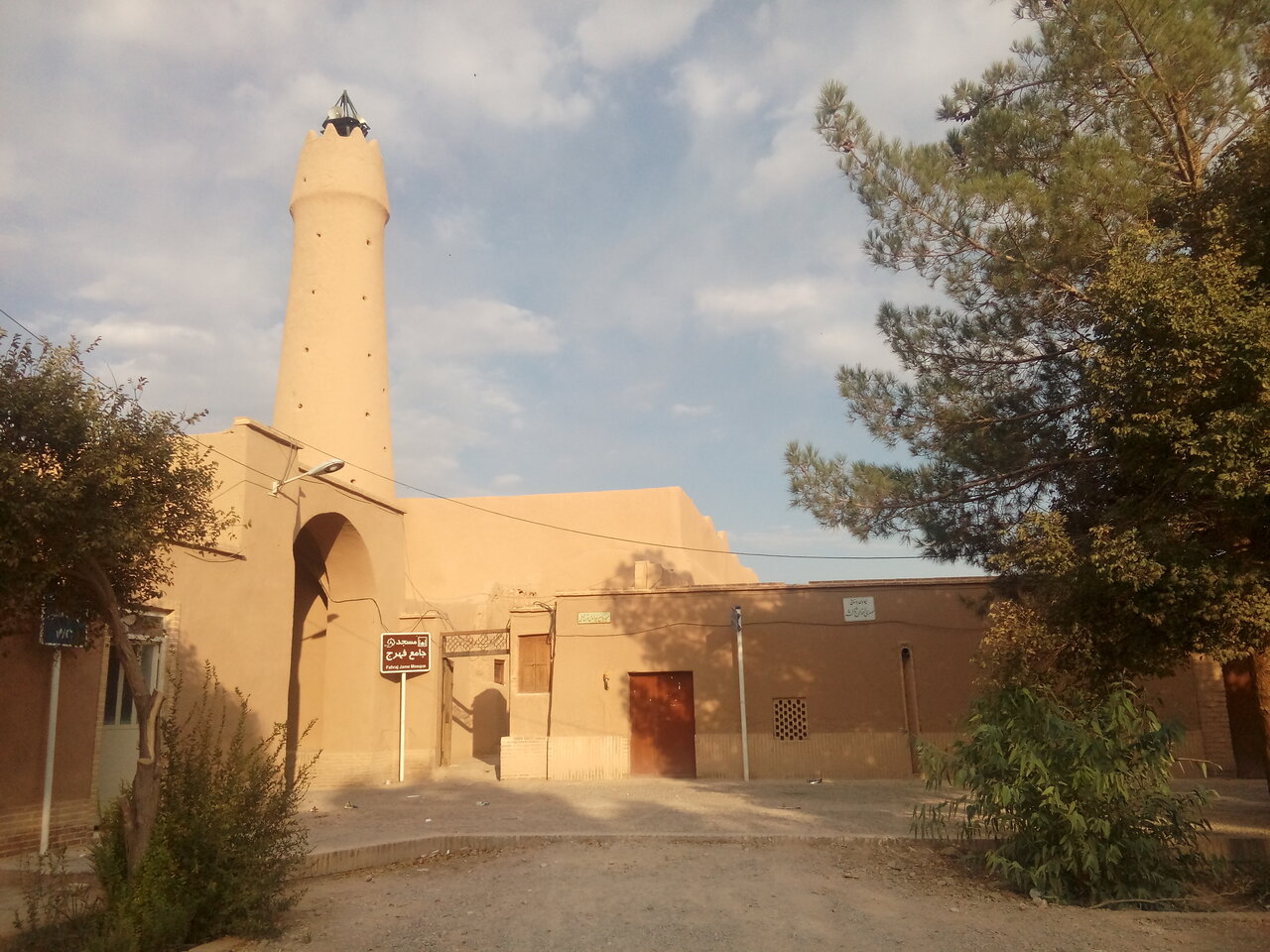
TEHRAN – Located near the historic city of Yazd in central Iran, the Jameh Mosque of Fahraj, also known as Masjid-i Jami of Fahraj, is a remarkable destination for travelers interested in history, architecture and Iran’s Islamic heritage. Distinguished by its simple earthen construction, ancient vaults and historic minaret, the mosque offers a glimpse into an important period in the evolution of Iranian religious architecture.
The mosque stands in Fahraj, approximately 25 to 30 kilometers southeast of Yazd, along the historic route connecting Yazd with Bafq. Situated in an arid landscape near the edge of the desert, the village reflects the region’s long-standing adaptation to dry conditions and traditional water systems, including qanats and deep wells.
A landmark of early Islamic architecture
The Jameh Mosque of Fahraj is widely recognized as one of the oldest surviving mosques in Iran. Historical accounts associate its construction with the early Islamic period, following the conquest of Yazd by Muslim armies in the first century AH. However, its exact construction date, original patron and earliest building history have not been conclusively established. The possibility of an earlier origin has also been raised, partly because of the region’s pre-Islamic heritage and the historical practice of adapting existing sacred sites for new religious purposes.
The mosque holds particular architectural significance because it preserves features associated with the transition from early post-and-lintel building systems to more developed vaulted structures. Alongside the Tarikhaneh Mosque in Damghan, Semnan province, it illustrates an important stage in the development of Iranian mosque architecture, when substantial piers increasingly replaced columns as primary structural supports.
Built largely from mud bricks and sun-dried clay materials, the mosque demonstrates how local construction techniques were adapted to religious architecture in a challenging desert environment. Its restrained appearance, with little decorative ornamentation, distinguishes it from many of Iran’s later monumental mosques.
A courtyard framed by ancient arches
The mosque’s architectural composition centers on an enclosed courtyard surrounded by arcades and a vaulted prayer hall. The courtyard, lined with clay tiles, contains a central ablution tank that is now dry. Thick rectangular piers divide the arcades into arched bays, creating a balanced rhythm across the interior façades.
The prayer hall features traditional Iranian barrel vaults, supported by sturdy brick piers. These vaults, together with the building’s oval-shaped arches and pointed arches above the entrances, reflect a combination of structural ingenuity and architectural traditions associated with the transition from the Sassanid era to the Islamic period.
The prayer hall has three entrances, with the central entrance wider than the two side entrances. This arrangement reflects the importance of the main axis leading toward the qibla, the direction of prayer. The building also contains two mihrabs, or prayer niches, positioned close to one another. The larger, principal mihrab is made of plaster and measures approximately 2.32 meters wide and 3.24 meters high.
Unlike many famous Iranian mosques, the Jameh Mosque of Fahraj has no prominent dome, elaborate tilework or extensive inscriptions. Its architectural interest lies instead in its proportions, construction methods and preservation of early building forms.
An early example of the Iranian minaret
One of the mosque’s most notable features is its clay minaret, which is believed to have been added later, possibly during the 10th century. Together with the early minaret at the ancient city of Na’in, it represents an important surviving example of the development of the Iranian minaret.
The structure takes the form of a tapering cylinder, with an internal spiral staircase illuminated by narrow openings in its exterior walls. A projecting balcony and triangular crenellations emphasize its vertical profile, creating a striking contrast with the mosque’s low, horizontal roofline.
The minaret is significant beyond its immediate setting. The development of the cylindrical minaret became an influential feature of Islamic architecture, with related forms spreading across regions including Iraq, Syria, Anatolia, Afghanistan and India over subsequent centuries.
A rewarding stop for cultural travelers
For visitors exploring Yazd and its surrounding historic settlements, the Jameh Mosque of Fahraj offers an opportunity to discover a lesser-known architectural landmark away from the region’s more elaborate monuments. Its understated appearance invites closer attention to the details of early Islamic construction, from the arrangement of its arches and piers to the geometry of its vaulted prayer hall.
The mosque is particularly appealing to travelers interested in architectural history, archaeology and the cultural connections between pre-Islamic Persia and the Islamic period. Its location in Fahraj also makes it a potential stop on a journey through the villages and desert landscapes southeast of Yazd.
The mosque’s simplicity, however, has contributed to its receiving less public attention than some of Iran’s more decorative historic buildings. Its historical importance rests precisely in the architectural innovations it preserves, features that were gradually overshadowed by later mosque designs, including the four-iwan plan that became prominent under the Seljuks.
For those seeking to understand Iran beyond its celebrated tiled domes and monumental courtyards, the Jameh Mosque of Fahraj provides a compelling encounter with the foundations of the country’s Islamic architectural heritage. It is a reminder that some of the most significant historic places are not necessarily the most ornate, but those that preserve traces of how architectural traditions evolved across centuries.
AM
Disclaimer : This story is auto aggregated by a computer programme and has not been created or edited by DOWNTHENEWS. Publisher: tehrantimes.com