
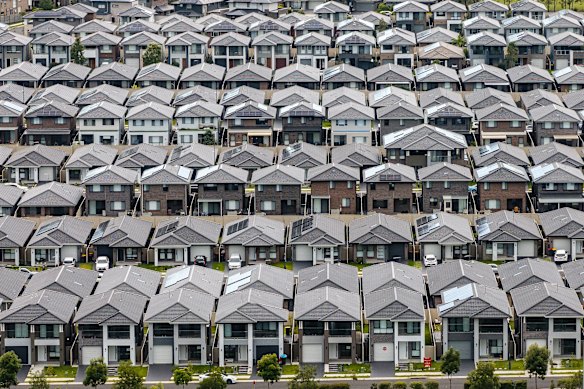

Sydney has long been cast as ground zero for Australia’s housing affordability crisis.
The share of residents who live in a home they own is at historic lows, astronomical prices are a persistent source of public anxiety, and ambitious building targets have been set in the hope of making housing more attainable.
Now Sydney is in the midst of a sustained property downturn. Since peaking in December 2025 the city’s median house price has fallen 7.9 per cent, Domain figures released this week show.
Dr Nicola Powell, Domain’s chief economist, says home values in Sydney have dropped faster than in any capital city this year.
“This is an entrenched downturn now for Sydney, and it is broadening,” she says.
Many aspiring home buyers will welcome the recent pullback in prices, although four interest rate hikes by the Reserve Bank this year, which has driven the downturn, have made it harder for new home borrowers to service a mortgage.
The property slump and rising interest rates have also affected the outlook for residential building across the city. Economists warn falling property values and higher borrowing costs could hamper the construction of new homes, at least in the short term.
So what does Sydney’s property price slump mean for the longer-term supply challenge at the heart of the housing crisis?
‘Classic’ Sydney downturn
Sydney’s median home value rose by 60 per cent between 2019 and 2025, reaching a record $1.8 million just before Christmas. That median has since fallen by $143,062 to $1.66 million, according to Domain’s data. Prices dropped almost 5 per cent in the three months to September 30, the steepest quarterly decline in four years.
The value of a typical Sydney home is now back to where it was in late 2024.
Property prices in Sydney were quick to react to the upward shift in official interest rates which began with a 0.25 percentage point increase in February. The Reserve Bank subsequently hiked rates in March, May and September, and some forecasters believe another increase is possible before Christmas.
Powell says the downturn has followed a traditional pattern for Sydney, with much bigger falls in premium-priced suburbs in the city’s north and east than in more affordable outer suburbs.
On Sydney’s north shore house prices are nearly 18 per cent lower than a year ago, while the northern beaches and eastern suburbs have registered falls of about 10 per cent.
However, property values continue to rise in pockets of western Sydney and the Central Coast. The median house price in Prospect is up more than 20 per cent on an annual basis, while the median unit price in the Blacktown area is about 2 per cent higher than a year ago.
“This is classic downturn territory for Sydney,” says Powell. “It is following the drumbeat of what we would normally see – the more premium suburbs react first, it then starts to ripple out and broaden geographically, and that is the point we’re at now.”
The median price for a unit in Sydney – a housing option favoured by first home buyers – is down 4.5 per cent after peaking in the March quarter, a smaller decline than for houses.
The affordability paradox
Aspiring first home buyers confront a paradox as Sydney’s housing market weakens; prices may be falling but the main driver of the downturn – higher interest rates – has made servicing a new home loan more difficult.
Two separate measures of housing affordability – one published by the Housing Industry Association and another by realestate.com.au – showed affordability deteriorated during the June quarter in Sydney because the fall in house prices was not enough to offset the financial hit to new buyers from interest rate rises.
Sydney has led the national property downturn, but the city’s median house price is still $509,000 – or 44 per cent – higher than Australia’s second most expensive city, Brisbane (with a median price of $1.15 million).
Sydney remains the hardest place in Australia to purchase a home, the Housing Industry Association’s affordability measure showed.
Peter Tulip, chief economist at the Centre for Independent Studies, says the “public is still stressed out” about the long-term deterioration in housing affordability despite recent price falls.
“The big issue we face as a society is not how do we get property prices back to the level of 2025 or 2024, but how do we get the affordability of housing back to what it was in the 1980s and 1990s,” he said.
“We are a very long way from that.”
The future of housing supply
In 2024, the NSW government adopted a target to build 377,000 new homes by 2029 (including about 263,00 in Greater Sydney).
Nearly 50,000 new homes were completed across the state last year, the highest in five years, but that was still well short of the annual rate needed to reach the 2029 goal.
KPMG urban economist Terry Rawnsley expects Sydney’s property price slump to make the “housing supply crunch worse” in about 12 months’ time.
“Developers will be doing their sums now and saying ‘if prices are falling, and they keep going down, my project’s not feasible, so I’ll just put that on ice,’” he said. “That’s usually something like a 6 to 12 month lag.”
That disruption will make it even harder for the NSW government to achieve its building target.
“It’s a bit like a one-day international,” says Rawnsley. “The run rate required to reach the victory target is going in the wrong direction and a few maidens is only going to build the pressure.”
Rawnsley says the house price downturn comes at a difficult time for the residential construction sector.
“I think it impacts confidence,” he says. “It’s been a torrid five or six years for the development sector in NSW – they’ve had the COVID shock, supply shocks, they’ve had a lot of insolvencies, and they’ve seen their profit margins squeezed; so if they now feel nervous about being able to sell a product, they’re going to be cautiously pulling back on projects, or re-cutting them.”
Average profits in the construction sector were less than half that across all industry sectors between 2022-23 and 2024-25, Rawnsley’s analysis of Bureau of Statistics industry data shows.
A report by the NSW Productivity and Equality Commission published in July found the cost of building a typical mid-rise apartment in Sydney rose from $918,000 in 2023 to $1.05 million in 2025. The increase was “driven by higher construction costs and interest rates”.
Tulip says many residential projects in Sydney are no longer profitable because the developers “did their sums” when property prices were still on the rise.
“In the long run land prices will adjust to make these projects profitable again, but there’ll be a transition, and we are going to see a slowdown in construction until land prices reflect the higher interest rates and higher construction costs,” he says.
Tulip describes the property price downturn as a “setback” for housing supply in NSW, but he expects the effects will be relatively short-term.
“In most of Sydney property development is still very profitable in terms of sale prices relative to construction costs,” he says.
Tulip believes recent state government planning reforms that allow higher residential density in well-located suburbs is “making hundreds of thousands of developments in Sydney financially feasible”. He thinks this will have a much bigger influence on housing supply over time than recent house price falls.
Some key indicators of future residential construction, including building approvals, have held up despite falling house prices and rising interest rates.
Tulip also points to robust growth in the lodgement of development applications as a positive for future housing supply.
Nearly 20,000 DAs for new residential projects were lodged in NSW last month, the highest since the data series began in 2021.
“Even though there are these financial pressures, builders are expressing more interest in building than they have for a long time,” he says.
Start the day with a summary of the day’s most important and interesting stories, analysis and insights. Sign up for our Morning Edition newsletter.

From our partners
Disclaimer : This story is auto aggregated by a computer programme and has not been created or edited by DOWNTHENEWS. Publisher: www.smh.com.au






