Hebron, the biggest city in the West Bank, had paid little attention to Israel’s looming elections until it found itself suddenly in the midst of them, a proving ground for Benjamin Netanyahu’s security credentials in the run-up to Tuesday’s vote.
A gun attack on an Israeli military checkpoint on Friday in which two soldiers were killed brought immediate televised visits from Netanyahu and his finance minister, Bezalel Smotrich, whose ruling coalition is narrowly trailing with two days of campaigning left.
They vowed abrupt and sweeping retribution, and the prime minister warned of imminent military operations on a scale the West Bank has not seen in nearly 60 years of occupation.
Within hours, the whole city of 250,000 people had been sealed off and the neighbourhood of Farsh al-Hawa, closest to the site of Friday’s attack, had been flattened. By Sunday morning, there was nothing left but rubble of an industrial area that had been full of car workshops, a big ceramics plant and other enterprises.
As the bulldozers were at work there, another district a few kilometres away was being systematically emptied. Ein Deir Baha was allegedly home to at least one of the two men involved in the attack (both of whom were killed on the spot), and on Friday its residents paid the price.
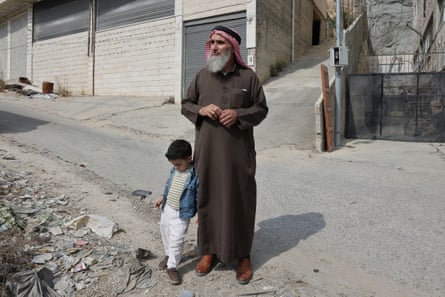
The imam from the local mosque, Fahed Ahmaro, was woken at about midnight by the loudspeakers from military vehicles patrolling the street, telling homeowners to vacate their homes immediately for their own safety.
Ahmaro had 30 members of his family living in his house. He rushed his frail mother and some of his grandchildren to his daughter’s house in another part of Hebron, and was on his way back in the hope of picking up some of his possessions when his neighbour phoned him.
“He told me not to come back, and the army had blown up the gates to the house. I don’t know what they have done to it by now. I heard they destroyed the furniture,” Ahmaro said. “You don’t know what you have until you lose it. Now I realise how devastating it is to lose your home.”
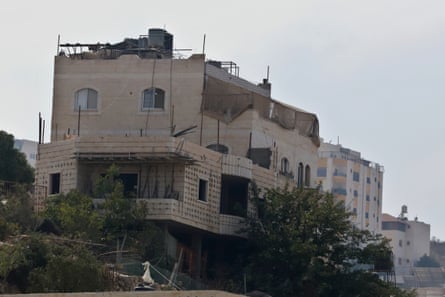
At midday on Sunday, he was in a Hebron market shopping for a change of clothes for his grandchildren, uncertain how long the family’s exile would last.
He had heard that the house was being used as a base by Israeli soldiers and looking up at the house, perched on the side of a steep hill, he could see some lights on but no sign of life.
The Hebron municipality said that 370 families, nearly 2,000 people, had been displaced by the army sweep through Ein Deir Baha. In its official comments, the Israeli army had said that the displaced population had left voluntarily, that “civilians who wished to evacuate were permitted to temporarily leave the area”.
Ahmaro was outraged at the suggestion that he had any choice about fleeing.
“Never, never, never. Why should I leave my house?” he asked.
Abdul Halim al-Tamimi tried to stay put when the military came at 1.30am. The 77-year-old was told his family had only 10 minutes to vacate their home.
“An intelligence officer told me if we didn’t go, they would displace us the same way they have done it in Gaza,” he said. “We stood there in front of the house, and we refused to leave until we were faced by three military vehicles and they forced us out.”
By the time the Tamimi family left, it was 3am on Saturday morning. On Sunday morning their home was festooned with large Israeli flags and ringed with military vehicles. The army had turned the substantial villa into its headquarters.
In its statement, the Israeli military claimed that 2,000 local people were from the Jaba’a clan, from which the gunmen were allegedly drawn, and which the army claimed was “associated with Hamas”.
The claim drew consternation and derision from people in Ein Deir Baha. They numbered the extent of the Jaba’a clan at 150 at most, with no known reputation for radicalism.
“We are from a completely different family. We are innocent people. We have nothing to do with the whole thing,” Tamimi said. “I don’t know what they are using it for, other than maybe election publicity.”
Palestinians in the occupied West Bank have no vote in Tuesday’s elections, but their lives could be deeply affected by the outcome.
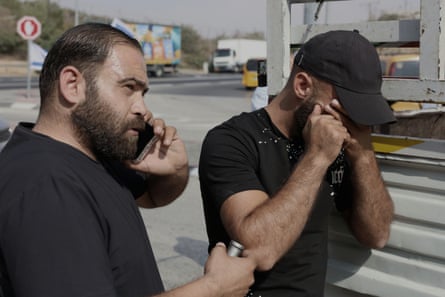
By Sunday evening, all roads in and out of the city remained closed to cars, with heavy steel barriers swung across them. The only traffic was on foot, with taxi drivers squabbling for fares. The driver of a delivery truck, Wasam Sadi, pulled in at one checkpoint with the cab windshield smashed and glass fragments in his eyes. He had been attacked by settlers at a nearby junction, he said.
“It’s collective punishment,” said Hebron’s mayor, Yousef al-Jabari. “They have dragged people from their houses, and they have prevented the media from getting into the district in order to cover up what is happening.
“Netanyahu and his gang are using Palestinian land to displace Palestinian people, closing the city, closing the mosque, in order to achieve their political goals.”
Disclaimer : This story is auto aggregated by a computer programme and has not been created or edited by DOWNTHENEWS. Publisher: theguardian.com