The Middle East’s ability to solve its problems has been held back by America’s 50-year insistence that the Gulf states should view Iran as a security threat, Oman’s foreign minister said on Monday in a significant speech designed to break the deadlock over the region’s future.
Badr Albusaidi called for a non-aggression security pact involving all six Gulf states as well as Iran and Iraq. The US would in future no longer be the primary provider of security, he said.
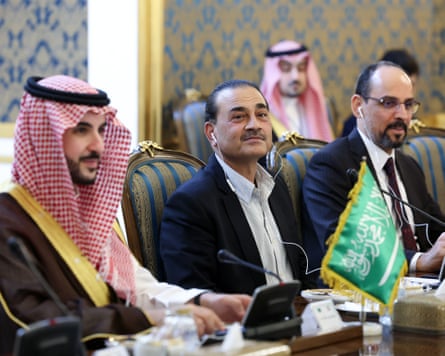
He was speaking on the day high level defence and intelligence officials from Turkey, Pakistan and Saudi Arabia travelled to Tehran in an attempt to prevent a renewed outbreak of fighting between the US and Iran.
Tehran said the meeting also explored future security arrangements in the region. The high stakes were underlined by the sight of the Saudi defence minister, Khalid bin Salman, in Tehran weeks after Iran had struck Saudi infrastructure and as Iran-backed Houthis continue to send missiles towards Riyadh.
Albusaidi is the first Gulf leader so explicitly to break ranks by calling for the mainly Sunni Gulf states to form a security alliance with Iran, a long-term aspiration of Tehran’s.
Speaking at Girton College, Cambridge, he said the talks might be difficult and the proposal appeared counterintuitive, but “issues such as the strait of Hormuz have become impossible to resolve because external powers continue to define the terms of engagement, while regional powers are unable to take collective responsibility for making their own security arrangements and reach a consensus on them”.
He added: “What holds us back is that issues which ought to be handled at a regional level by the states of the Gulf themselves, are made more complex, more intractable and sometimes simply impossible to resolve because the region’s security arrangements are insufficiently developed.
“And they are insufficiently developed because they have relied for too long on the involvement of external powers.”
He said that for half a century Iran “had been systematically excluded from playing any meaningful role in the security arrangements of the region”. This had led to “profoundly negative consequences, not just for Iran, but for the region as a whole”, including the imposition of priorities on the region by external powers such as “the entirely false perception that there is a fundamental regional antagonism between Iran and the Arab states of the Gulf.”
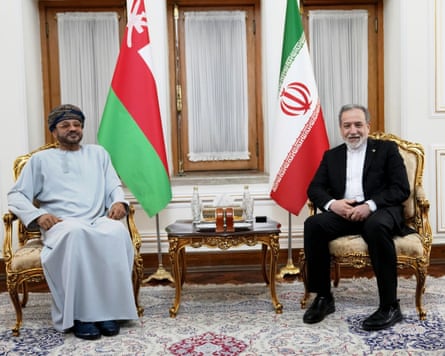
He added: “Perhaps the most damaging of the priorities imposed on the region from the outside has been the requirement that Iran be excluded. Not just excluded. Worse. Positioned as the threat against which regional security had to be organised.”
Oman is on the southern side of the strait of Hormuz, with Iran on the northern shores. The two countries have reached a temporary agreement on how shipping traffic should be managed in the strait, but the plan is on hold until the US and Iran lift their respective blockades of the waterway.
Albusaidi also indirectly challenged Donald Trump’s case for a further attack on Iran by saying he believed the previous round of talks between the US and Iran in February, which Oman mediated, were “making significant progress, and that an agreement was within reach. We still stand by that judgment today.”
The Iranian foreign ministry has often proposed a security pact for the region in which Iran, as opposed to the US, plays a role, and the US-Iran conflict has potentially reopened the debate among Gulf states about whether the heavy presence of US bases in their countries is a source of reassurance or insecurity. Oman is one Gulf state to have explored a regional security pact that includes Iran.
No Gulf state openly supported the US-Israeli attacks on Iran last year or this February, but some have covertly cooperated in the operations. Iran has sought to defend itself by attacking US bases and energy infrastructure in the Gulf states.
The meeting in Tehran was taking place against a backdrop of continued Pentagon briefings about a major US military buildup in preparation for a possible assault after the midterm elections. Qatari mediators spent much of Sunday in Tehran seeking terms for Iran to reopen the strait of Hormuz.
Israeli media reports claimed that the country’s prime minister, Benjamin Netanyahu, has been trying to browbeat the military into provoking a war with Iran before the Israeli elections on Tuesday.
Donald Trump’s repeated call for Netanyahu to be re-elected only adds to the mood in the region that the US and Israel have the potential to be a long-term source of insecurity in the region.
The idea of a security pact with Iran will be resisted in large parts of the Middle East after the damage Tehran has been prepared to inflict on the economies of the region, either directly or through the use of intermediaries such as the Houthis. Iranian hardliners also increasingly say Iran’s security best lies in trying to assemble a nuclear bomb.
A pact that is likely to take many months to negotiate may also not be a solution to Washington’s demand that Iran reopen the strait of Hormuz before US sanctions are lifted.
Disclaimer : This story is auto aggregated by a computer programme and has not been created or edited by DOWNTHENEWS. Publisher: theguardian.com