
Pennsylvania’s EQT will become the nation’s top natural gas producer with the $12.8 billion, all-stock acquisition of rival Range Resources announced Monday.
The deal comes as EQT prepares for a future of surging gas demand both domestically from power and the data center boom, and from rising exports to fuel the world, highlighted this year by the Iran war and the resulting gas shortages throughout much of Europe and Asia. That’s why EQT was willing to pay a nearly 21% premium for Range during a time of deflated premiums in oil and gas dealmaking.
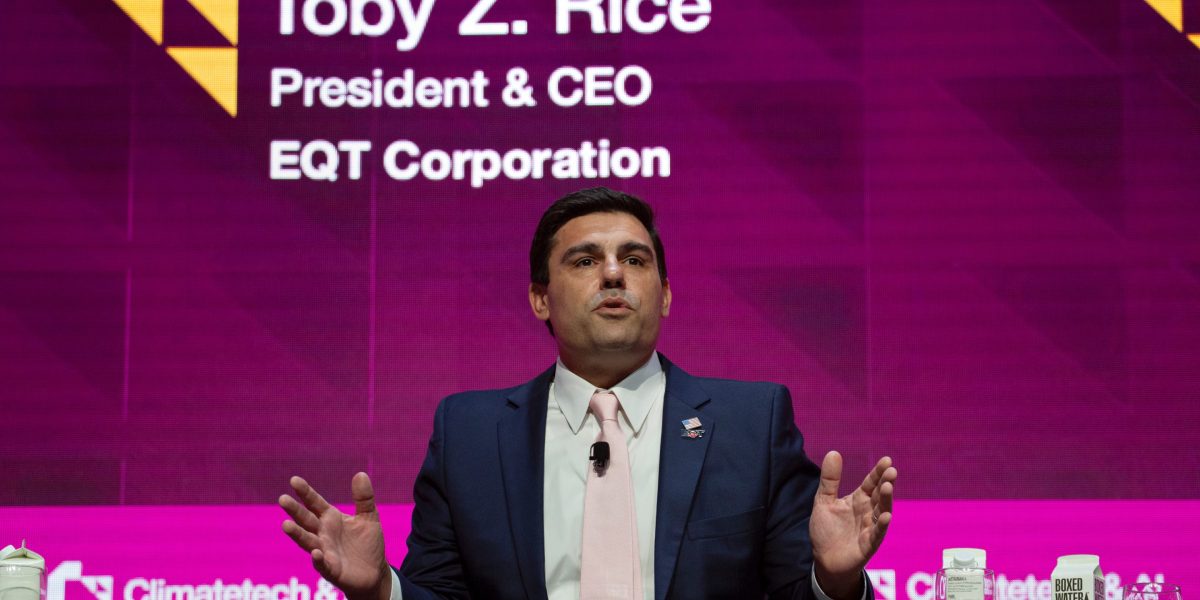
“This transaction comes at a pivotal moment for America’s economy as the convergence of modern industry and energy ushers in a new era of growth,” said EQT CEO Toby Rice in a conference call. “With a significant inflection in natural gas demand on the horizon, proven by new power generation facilities, and expanding pipeline infrastructure, we believe this combination supercharges EQT’s positioning.”
Much of this growth is focused on demand spikes anticipated near 2030 and beyond from AI and the ongoing wave of construction of liquefied natural gas export facilities along the U.S. Guif Coast.
“This is all about preparing today for what that future will look like,” said Rice, who is arguably the biggest industry evangelist of natural gas.
The deal, which is slated to close in the first quarter of 2027, would expand EQT to an enterprise value of roughly $50 billion. The companies are largely concentrated in the Appalachia region, specifically the Marcellus Shale in Pennsylvania, West Virginia, and Ohio.
The combined EQT would produce more than 9 billion cubic feet of natural gas per day—the most in the U.S.—including natural gas liquids, such as butane, propane, and ethane, which is the leading petrochemical feedstock in the Western Hemisphere. Rice said the combined company could easily scale up to 17 billion cubic feet a day and eventually hit 20 billion if demand requires it.
The deal also would include 2.8 million combined net acres with more than 30 years of drilling inventory at sustained rates, as well as 3,700 miles of pipelines.
Energy analysts such as Brett Donnes of William Blair, Kevin MacCurdy of Pickering Energy Partners, and Andrew Dittmar of Enverus largely praised the deal and said the premium payment was justified. Dittmar said EQT is the new “Appalachian juggernaut” and Donnes called it the “long-term, low-cost behemoth” for gas and power. “Buying [Range] establishes EQT as the dominant Appalachia producer and a must own for investors wanting natural gas exposure,” MacCurdy added.
Patrick Harris, senior editor at Infralogic analytics firm, said the deal seems sound for EQT based on growth projections, but there are contrarian risks. “What if Russia and Ukraine reach a peace agreement and Russian gas flows back to Europe, reducing the demand for LNG? What if Middle Eastern LNG producers are no longer hampered by transit risk through the Strait of Hormuz? What if the expected demand for data centers is dramatically reduced by a slowdown in AI rollout or by new technologies reducing the size and power requirement?”
Appalachia boom
By pure happenstance, the EQT-Range deal was announced Oct. 26 on the 22nd anniversary of Range drilling the well in Pennsylvania that would essentially launch the Marcellus Shale gas boom that continues to expand.
Range CEO Dennis Degner, who will join the EQT board, said he knew the anniversary was in October, but didn’t realize the exact date. But it was Oct. 26, 2004, when Range drilled the historic Renz #1 well in Washington County, Pennsylvania that unlocked the Appalachia gas revolution.
“Is this destiny? I don’t know,” Rice said during the call.
Degner said Range was still happy to take the “go-it-alone approach” and didn’t feel the need to merge, but that the EQT deal was the “leading combination” amongst other options, in part because of the “compelling premium” for shareholders. Their assets fit together as neighbors, and Rice said there are more than $300 million in long-term synergies that should be created—not counting $325 million in more immediate savings from synergies.
“We share EQT’s vision for the future of our industry and their convention that the Appalachian Basin remains the crown jewel of the world’s natural gas resources,” Degner said. Range shareholders would hold 27% of the combined company.
The EQT-Range deal is the second-largest oil and gas deal of 2026 after the early February acquisition of Coterra Energy for $26 billion by Devon Energy. Since the Iran war began in late February, most dealmaking has gone on hold amid inflated valuations of oil companies. But EQT and Range are focused almost exclusively on gas, which is driven by power and LNG demand.
Prior to the announcement, Range’s stock was up 23% in 12 months. But most oil companies are up by close to 40% or more during the same timeframe. For comparison, ExxonMobil is up about 60% and oil refiner Marathon Petroleum is up 140%.
The only comparable natural gas deal in recent years was in 2024 when Chesapeake Energy acquired Southwestern Energy in an all-stock deal for $7.4 billion. The merger-of-near-equals resulted in the newly named and Houston-based Expand Energy, which is currently the nation’s natural gas producer. The Range deal would allow EQT to surpass Expand.
That is why Rice proudly touted EQT as “America’s natural gas champion” and the “undisputed leading natural gas platform in North America.”
Disclaimer : This story is auto aggregated by a computer programme and has not been created or edited by DOWNTHENEWS. Publisher: fortune.com




