King Charles’s upcoming Caribbean tour could accelerate moves to remove him as head of state in several countries unless he does more to confront the monarchy’s historic links to slavery, campaigners have warned.
The king will embark on a nine-day tour on Tuesday, visiting the Bahamas and Guyana before travelling to Antigua and Barbuda, and will attend the Commonwealth heads of government meeting (Chogm).
Patrick Vernon, a cultural historian and UK representative of the Global Jamaica Diaspora Council, said the stakes for this trip could not be higher for the future of the royal family’s standing in the region, warning: “I think it’s the biggest crossroads for the Commonwealth since its creation.”
Charles is expected to deliver three significant speeches during the trip, but will follow government advice not to issue a formal apology for Britain’s role in the transatlantic slave trade. The British government has also ruled out paying reparations.
The visit is expected to be met with protests over the monarchy’s colonial legacy and demands for a formal apology and reparations. It comes four years after the Prince and Princess of Wales’s controversial 2022 Caribbean tour, where images of the couple greeting Jamaican children through a wire fence sparked widespread criticism across the region.
Although Charles has gone further than his predecessors in acknowledging the monarchy’s historic links to slavery, he arrives in a region transformed.
Recent developments include aUN resolution, tabled by Ghana, declaring the transatlantic slave trade the gravest crime against humanity and calling for reparatory justice, as well as Jamaica’s unprecedented slavery reparations petition to the king, which is due to be heard by the UK-based privy council next March.
“I think his visit is pivotal,” Vernon said. “If the visit does not meet the needs and expectations of a lot of the Commonwealth heads, it raises a big question about the future of the Commonwealth. What’s the point of being in the Commonwealth when one of the biggest crimes against humanity, which has been recognised at international level, where you can’t even have a proper dialogue, conversation and exploration?”
The Labour MP Bell Ribeiro-Addy, who chairs the all-party parliamentary group for Afrikan reparations, said the royal family and UK government had failed to reckon with a sea change happening across the world on this issue.
“I think it would be wrong to think that we can continue with platitudes. You’ve got ‘atrocity’, ‘deep regret’, ‘sorrow’, and now they’re going to say ‘darkest days’,” she said. “I think the king needs to realise that people wouldn’t keep raising it if what he was doing was anywhere near enough.
“You can tell that the Commonwealth means something to the monarchy, and I’m sure he would not want to be the monarch under which it crumbles.”
Prof Robert Beckford, a theologian at the University of Wolverhampton, said: “I think what’s at stake fundamentally is credibility: credibility in the monarchy and that leadership based on his ability to empathise and lead as the head of the Commonwealth. And the credibility rests on the ability to empathise with Caribbean history.”
While there were widespread calls for apologies, Beckford, also a broadcaster, said a “creative way” for the king to navigate the reparations debate would be to back a national truth and reconciliation commission examining Britain’s role in slavery.
“It would also provide us with the opportunity to take the nation on a journey into history, and understanding how slavery and colonialism operated as systems of extraction,” he said.
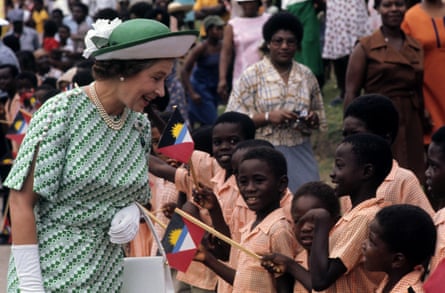
Protests over slavery reparations during royal visits to former colonies in the Caribbean are not a new occurrence. High Priest Richmond McKinney, a Rastafarian leader who is organising a protest during Charles’s visit to the Bahamas on Tuesday and Wednesday, was involved in demonstrations against Queen Elizabeth II in the 1980s.
“The cry remains the same: freedom, redemption and international repatriation. So we see it fitting to agitate and lobby and even have a protest against the crown now that it’s her son King Charles,” McKinney said. “You say you regret slavery, but your regret is not good enough. We want a full apology from you.”
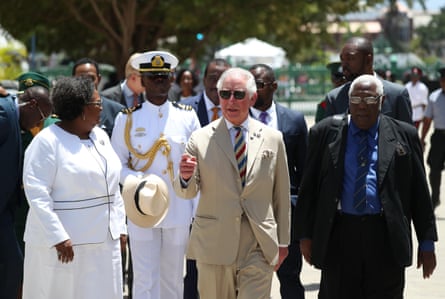
Guyana’s president, Irfaan Ali, has made it clear ahead of the king’s visit that he wants progress towards reparations, beginning with an apology.
Currently, there are no formal agenda items on reparations at this year’s Commonwealth leaders’ summit in Antigua.
However, the chair of the Caribbean community reparations commission, Prof Sir Hilary Beckles, has said: “I can assure you that [for] everyone in the Caribbean right now, everyone who’s going to be at that meeting from the Caribbean, with an interest in the Caribbean, from Africa, and an interest in the global African movement, this will be the number one item on the table.”
Dr Niambi Hall Campbell-Dean, the committee’s chair, said: “We [are] spending hundreds of thousands of dollars to host the person who is responsible for the enslavement and colonisation of our ancestors, and what are we really getting out of it? So I think that the protests are twofold. It’s one for the king to be aware that we are still demanding that reparations be made, and then two to just [raise] awareness of more Bahamians and to cause us to really question our relationship to this crown.”
For Ribeiro-Addy, a successful trip would include an apology that quickly jumped to questions of “How do we move forward from this?”
“And the most important point to make is that the Netherlands’ king apologised. Their world didn’t end,” she said.
Disclaimer : This story is auto aggregated by a computer programme and has not been created or edited by DOWNTHENEWS. Publisher: theguardian.com