Documentary filmmaker Mary Robertson knows that her projects work best when her subjects are united against a shared villain.
“Quiet on Set: The Dark Side of Kids TV,” the 2024 Emmy-nominated miniseries she and Emma Schwartz directed for Investigation Discovery, looked at tween TV kingpin Dan Schneider and others accused of toxic and unsafe work environments at Nickelodeon. She was an executive producer on the ID miniseries “The Fall of Diddy,” about the rise and downfall of music mogul Sean Combs, and of “The New York Times Presents,” the FX documentary series that covered everything from Britney Spears’ conservatorship to Facebook scammers. She even directed a CNN miniseries about Richard Nixon.
But in Robertson’s latest directing project, the Netflix docuseries “The One About Matthew Perry,” the Big Bad isn’t so much a who but a what.
In this case, Robertson says in a recent video call, “the common enemy is a disease, not a person.”
Her three-part documentary features interviews with close friends, former girlfriends and co-workers who speak about the late “Friends” star on an intimate level (editor’s note: Times culture critic Mary McNamara is among those interviewed). It premieres Tuesday on the streamer, and that timing is intentional. On Oct. 28, 2023, nearly three years ago to the date, Perry was found dead in his hot tub, having drowned with illegally sourced ketamine in his system. He was 54.
In this interview, which has been edited for length and clarity, Robertson spoke about the behind-the-scenes struggles of a man immortalized for making other people laugh.
I read an interview you did for “Quiet on Set” where you talked about the ways those tween shows subtly normalized the sexualization of young people. Perry talked about this in his memoir, the 2022 bestseller “Friends, Lovers, and the Big Terrible Thing,” but do you think the fact that “Friends” was on for so long, and that audiences therefore witnessed his body transformations, maybe it didn’t normalize addiction but at least humanized it?
I don’t think that most people who were watching “Friends” [then] or who watch “Friends” today — because, of course, it’s still consumed by the world by people of all ages — really understood what Matthew was grappling with at the time. There were some tabloid covers, but I think most of it was quite private.
I think that what Matthew ultimately did before his memoir, but in the most complete way with his memoir, was speak in a really transparent manner about the fact that he was an alcoholic, that he was someone who struggled with addiction, and he could say it and not feel as though it were a shameful admission to make. He believed that by naming it and by affiliating himself with this disease, that he could be helpful to others.
I think a lot of people who have struggled with addiction, or love someone who is struggling with addiction, probably saw Matthew be open about what he was grappling with and felt as though they could be more comfortable in their own diagnosis.
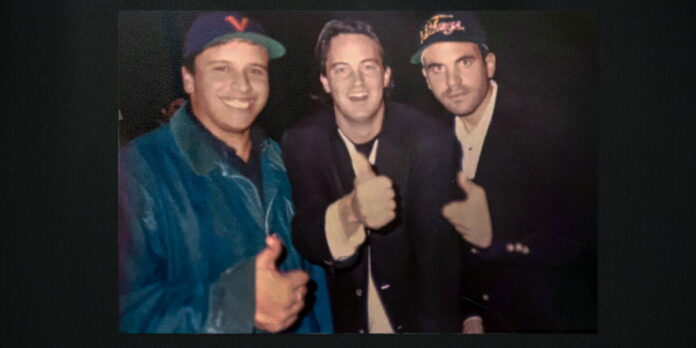
Perry flanked by his best friends Roger Castillo and David Pressman.
(Netflix)
One of Perry’s longtime friends, David Pressman, says toward the end of the documentary that Perry would want people to talk in the documentary about how funny he was. He made an immensely successful career out of being funny, but your documentary also shows his humor behind the scenes.
I believe that Matthew was committed to being funny professionally, and that some of that was a God-given gift. But I think, as the film makes clear, he also worked incredibly hard at it, and he studied great physical comics [like] Chevy Chase.
But I also think it was his private passion. It was his way of being. It’s the way he was with his friends. It’s the way they were with him. It’s how they punctured every silence and how they endured the hard parts of life that we all must endure.
After spending so much time with David and Roger [Castillo], who are two of Matthew’s best friends, I felt a deep desire to be a funnier person. And I also felt this solemn obligation to make this film funny. It was just clear to me that Matthew, if he were involved in this project, would want the film to be funny.
I grew up watching “Friends” and I used to watch reruns to relax. It’s hard for me to do that now. Are you still able to watch it?
I love watching “Friends.” I still watch “Friends” on almost every transcontinental flight … But now, knowing Matthew better than I knew him from the first time I watched him, I find new delight and detail and nuance in his performance. Lately, I have been focusing on the physical comedy. There’s a great scene that I was recently appreciating where [his character] Chandler poses with Monica [Courteney Cox] for engagement photos and the joke is that he’s terrible at posing for photos. I’m a terrible actress, and a terrible comedian. If someone said, “act like you’re terrible at posing for photos,” I don’t know what I would do. He did something absolutely brilliant, and it’s hysterical, and it works without words.

Mia Perry Bowick, Perry’s sister, was the only family member interviewed in the documentary.
(Netflix)
You interviewed one of Perry’s sisters, Mia Perry Bowick — who became a licensed psychotherapist because of her brother’s struggles — but you don’t interview other family members. The remaining “Friends” stars, and series creators Marta Kauffman and David Crane, declined to participate. Why?
I think that many who were close to Matthew were obviously grieving him but also processing and trying to understand and make sense of how they lost him and why they lost him. They [are struggling] how to make sense of a world that he wasn’t in physically any longer … We’re really thrilled that [those who participated] supported this project at a really early stage and understood that it could be tender and unflinching; that it could be a love letter to Matthew.
A love letter doesn’t just include the parts where someone is flawless. A love letter also includes the struggles and includes the stumbles. So it’s a love letter, but it’s a love letter that’s full of the moments when Matthew stumbled, which he was so clear about himself during his lifetime and when he wrote his memoir too.
[His friends and family] did not have editorial control over this project. And there’s been so much written and said about Matthew over the years that’s really been sensationalized or derogatory. I think that they’ve learned to fear that any account of Matthew might slip into that. [For those who did participate,] I really appreciate their trust. I really appreciate their candor. They have taught me so much about loyalty as friends.
A judge recently threw out Dan Schneider’s defamation suit against you and others involved with “Quiet on Set.” Are you allowed to comment on that?
I’m very happy that the courts have protected our 1st Amendment.
More to Read
Disclaimer : This story is auto aggregated by a computer programme and has not been created or edited by DOWNTHENEWS. Publisher: latimes.com