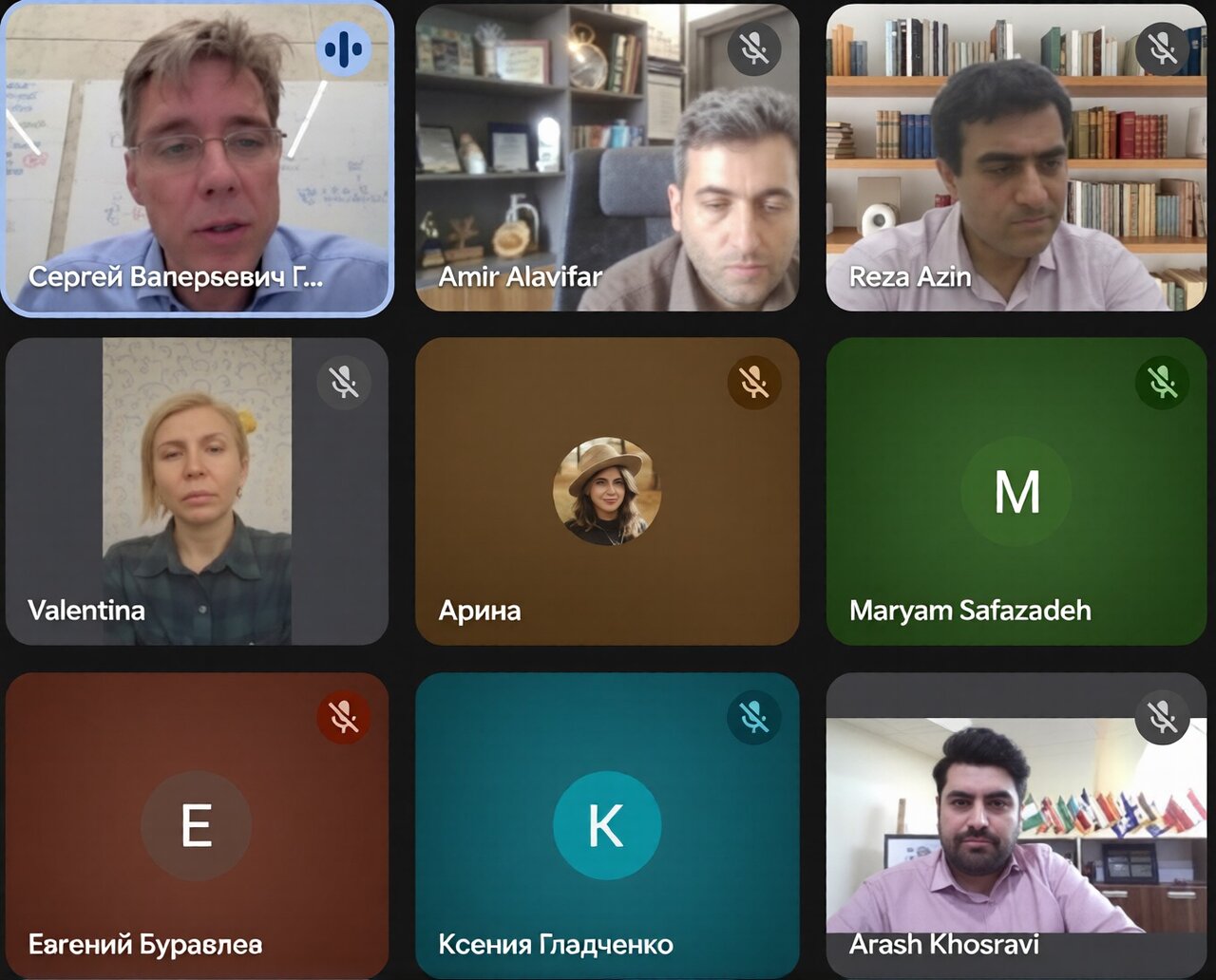
TEHRAN – Iran’s Persian Gulf University and Russia’s Novosibirsk State University have discussed ways to strengthen scientific cooperation and expand joint research initiatives.
During an online meeting, the two universities outlined their respective capacities, explored potential areas of collaboration, and agreed to examine mobility programs involving industry participation in both countries.
Persian Gulf University initiatives are primarily focused on three strategic areas of excellence: energy, petroleum, gas, and petrochemistry; marine studies; and international business and commerce. By prioritizing these areas of scientific knowledge and academic activity, Persian Gulf University aims to strengthen its constructively important role in establishing and maintaining peaceful coexistence and sustainable development, as well as enhancing human prosperity and well-being in the Persian Gulf region.
The university’s internationalization project has begun in recent years, and there has been significant growth in the international indicators, including the number of international academic members, international students, and international events. The university’s mission is to become a third-generation international university with excellence in science, technology, and entrepreneurship to respond to the surrounding society’s needs and create value for society, develop competent citizens, and perform its social roles.
Persian Gulf University has an excellent reputation for teaching quality, academic research, and graduate employability. Admission is limited to students who pass the national entrance examination administered annually by the Iranian Ministry of Science, Research, and Technology.
Novosibirsk region is home to one of Russia’s most prominent universities—a symbol of the research-oriented university model in Siberia—situated in the heart of the science city, Akademgorodok.
Relying on high-quality education, fundamental research, and close collaboration with institutions of the Russian Academy of Sciences, the university holds a distinguished position within the country’s science and technology system.
The combination of a dynamic academic environment, an international scholarly community, and a focus on basic sciences and advanced technologies has established it as a key center for cultivating the next generation of scientists and innovators—both in Russia and globally.
Tehran, Moscow set to establish joint science and technology commission
Iran and Russia are preparing to establish a joint commission on science and technology, with a document on international scientific cooperation between the two countries set to be signed at a meeting of the commission.
In September, Ehsan Qaboul, head of the Ministry of Science, Research and Technology’s Center for International Scientific Cooperation, said Iran is firmly committed to expanding ties with Russia, outlining the next steps by Tehran and Moscow to strengthen bilateral cooperation, including the formation of the joint science and technology commission.
Qaboul added that the Minister of Science, Research and Technology is scheduled to travel to Moscow within the next three months to finalize the document on international scientific cooperation between Iran and Russia.
He also announced plans for 500 cooperation programs with Russian universities and scientific institutions.
The programs include holding 100 joint educational courses involving Russian professors, enabling 100 doctoral and master’s students to choose a second academic supervisor from among professors at
Russian universities, and organizing 100 technology events aimed at expanding bilateral cooperation from science and education into the technology sector.
Qaboul further said that 100 joint cultural events with Russian universities and academic and educational institutions, as well as 100 scholarships for Russian students, are also among the planned initiatives. The scholarships will give priority to students seeking to study Persian language and literature.
The official also stressed Iran’s support for Persian-language programs at Russian universities, saying Iranian professors are ready to teach Persian to Russian speakers either in person or online.
In June, Iranian Science, Research and Technology Minister, Hossein Simaei-Sarraf, and Russian Science and Higher Education Minister, Valery Falkov, reviewed strategies for developing scientific, educational, and academic cooperation between the two countries, with an emphasis on expanding professor and student exchanges, strengthening research cooperation, and facilitating academic interactions.
Simaei-Sarraf considered the development of Russian language chairs in Iranian universities and Persian language chairs in Russian universities as a sign of deepening scientific and cultural ties between the two countries.
Falkov, for his part, pointed out the beginning of a new university admission period in Russia and the welcoming of Iranian students to study at the country’s universities, emphasizing the importance of providing employment opportunities and utilizing the academic potential of graduates after their return to Iran.
MT/MG
Disclaimer : This story is auto aggregated by a computer programme and has not been created or edited by DOWNTHENEWS. Publisher: tehrantimes.com