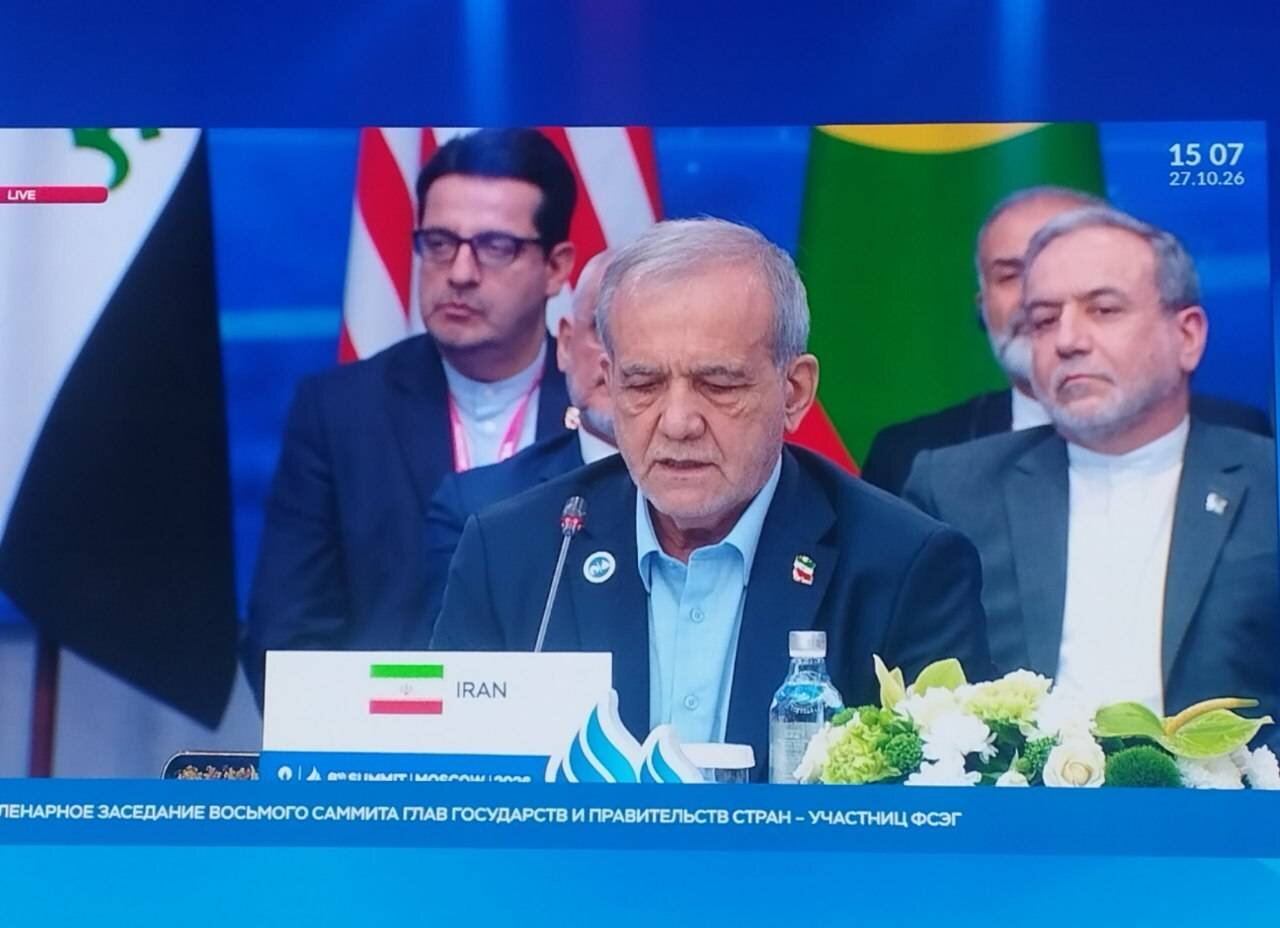
TEHRAN— Iranian President Masoud Pezeshkian has called on major natural gas producers to strengthen strategic and technical cooperation to safeguard global energy security, warning that unilateral sanctions and US military interventions in the Persian Gulf are destabilizing energy markets and threatening economic growth worldwide.
Addressing the eighth summit of the Gas Exporting Countries Forum (GECF) in Moscow on Tuesday, Pezeshkian said geopolitical tensions and unilateral measures had exposed the global energy market to serious risks, emphasizing the need for coordinated action by gas-producing countries to maintain market stability, expand trade and strengthen investment across the natural gas value chain.
He condemned the US-Israeli military aggression against Iran, saying attacks on the country’s energy infrastructure and disruptions to energy transfers had endangered global energy security and the wider economy.
The Iranian president also denounced ‘US economic coercion,’ including unilateral sanctions, a naval and air blockade against Iran, and pressure on other countries to comply with the restrictions. He called on major energy suppliers to condemn and effectively counter such measures, arguing that US military interventions in the Persian Gulf had consequences far beyond the region by disrupting energy pricing, supply and transportation.
Iran ready to expand role in global gas markets
Pezeshkian said Iran, a founding member of the GECF and home to the world’s second-largest proven natural gas reserves, was prepared to play a more active role in multilateral energy diplomacy, technological cooperation and investment in gas infrastructure.
Despite years of unilateral sanctions, he said, Iran had developed its domestic capabilities and maintained its position as the world’s third-largest natural gas producer. He put the country’s annual gas production capacity at 280 billion cubic meters in his speech.
Natural gas accounts for around 70 percent of Iran’s energy mix, Pezeshkian said, adding that the national gas network covers approximately 95 percent of the population.
He invited foreign investors, particularly from GECF member states, to explore opportunities in Iran’s upstream and downstream gas industries, infrastructure development, and gas trade, citing the country’s strategic location along major energy corridors and its potential for mutually beneficial cooperation.
GECF urged to turn potential into joint projects
The president described the GECF as an important platform for multilateral diplomacy, the exchange of expertise and closer coordination among gas-producing countries. He called for the effective implementation of the forum’s charter, long-term strategy and summit declarations.
Pezeshkian said cooperation should focus on two principal areas: strategic governance and management, and technical and engineering operations.
On the strategic front, he stressed the importance of stabilizing markets and increasing natural gas trade at regional and international levels. On the technical side, he called for joint investment throughout the gas value chain, from production and processing to transportation and consumption.
He also emphasized the need to upgrade technological capabilities, improve productivity and reduce the environmental impact of natural gas production and use. Existing capacities, he said, should be translated into practical projects and shared economic interests, with cooperation aligned with long-term supply and demand trends.
Pezeshkian further called for stronger efforts to expand regional and global gas markets, maximize the value of natural gas resources and combat energy poverty.
Regional cooperation and multilateralism
The summit comes as Iran and Russia seek to deepen cooperation in energy and other sectors. Speaking to reporters upon arriving in Moscow on Monday, Pezeshkian said relations between the two countries had advanced beyond the signing of memoranda of understanding, with both sides working to implement their comprehensive strategic treaty across economic, scientific, cultural, security and political fields.
He described unilateralism and the use of pressure to advance national agendas as major challenges to international cooperation, saying Iran, Russia and other countries were working to strengthen multilateralism.
On the sidelines of the summit, Pezeshkian also met Qatar’s Emir, Sheikh Tamim bin Hamad Al Thani. The two leaders reviewed bilateral relations and emphasized the expansion of political and economic cooperation, particularly in energy, trade and coordination among natural gas-exporting countries.
Iranian Ambassador to Moscow Kazem Jalali, meanwhile, said Iran and Russia had considerable potential to help shape a fairer global energy architecture. In an article published by Russia’s TASS news agency, Jalali argued that the future of the global gas market should be based on pluralism, diversified supply sources and respect for the sovereignty of energy suppliers.
The GECF summit brings together major gas-producing countries to discuss energy cooperation and the future of global gas markets. Pezeshkian concluded that constructive engagement among member and observer states could strengthen the security of supply and demand, support fair valuation of natural gas, and reinforce its role in the global energy mix while taking environmental considerations into account.
Disclaimer : This story is auto aggregated by a computer programme and has not been created or edited by DOWNTHENEWS. Publisher: tehrantimes.com