
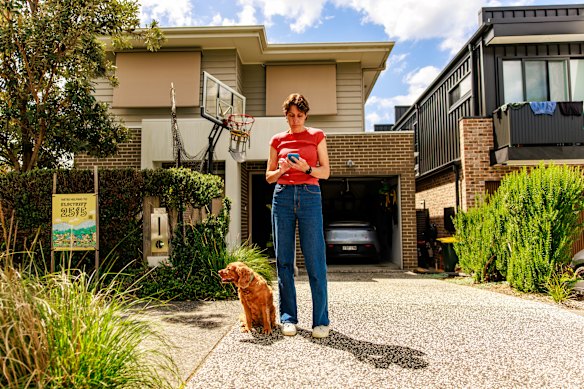

Bronwyn Batten wishes there had been a gas ban in place when she built her home a decade ago because it would have saved her from a costly mistake – connecting to gas in the first place.
The 48-year-old home owner is part of a growing movement of households across Australia voluntarily disconnecting from the gas network, or moving into homes that never had gas piped in.
In Victoria, a statewide ban on domestic gas in new builds will take effect on January 1, 2027, with a separate ban on gas hot-water systems to follow, unless overturned by a change in government. In NSW, about a dozen council areas have similar bans, mostly in Sydney.
But when Batten was building her project home on the NSW Illawarra coast north of Wollongong in 2016, a gas connection, hot-water system and stove were just part of the package. And she did not think to question it.
“If I was doing it today, I’d be so much more informed and not wanting to go with those choices,” Batten says.
“We need to be getting off gas to reduce emissions – it’s a no-brainer in terms of saving people money, it’s decreasing health impacts, and it’s what we need to do environmentally. It just makes no sense whatsoever to be having new connections.”
While gas is expected to have an ongoing role in the energy transition for some industry and as back-up electricity generation to support renewables, this is not the case for domestic use of the fossil fuel. Residential and small commercial gas demand on the east coast is expected to fall by about 79 per cent over the next 20 years, an Australian Energy Market Operator forecast says, reflecting consumer-led electrification and the push to net zero.
It raises the question about who will pay for the costs of the gas network as the customer base shrinks. Will the remaining customers be forced to foot a bigger bill, and if so how soon should that be to spread the cost fairly? Or will the owners and investors in the gas networks bear some financial risk as a natural consequence of privatisation?
Batten has spent tens of thousands of dollars on household electrification – she was an early adopter of an electric vehicle, she installed solar panels and a battery, and eventually bit the bullet to replace the gas hot-water system and stove and then sever the gas connection. In the final push, she was part of Electrify 2515, a partnership between Rewiring Australia, Brighte and Endeavour Energy with federal funding to attempt to electrify an entire suburb.
While driven mainly by environmental concerns, Batten says the effect on her bills has been “pretty awesome” as well, and cooking on an induction stove has given her much greater control than gas or older-style electric cooktops.
But low-income households can’t necessarily afford to make the same investments even with subsidies, and renters don’t have the authority to make such decisions. The worry is that these are the people who will pay the price.
This concern prompted two consumer advocacy groups, Energy Consumers Australia and the Justice and Equity Centre, to ask the Australian Energy Market Commission (AEMC), which sets the rules, to intervene. But they are unhappy with AEMC’s proposed response, which came out in draft form in August and will be finalised in December.
Dominic Adams, chief operations officer at Energy Networks Australia, an industry body representing both electricity and gas networks, says the issue of how to fairly manage structural decline is one of several conundrums in energy policy.
“An analogy of customers leaving the gas network is a little bit like if you have four friends go into a share house, they sign a long-term lease … then two of them leave, and the others can’t find other tenants,” Adams says. “What is the fair [amount] that everyone should pay going forward?”
The difference is that the energy market is heavily regulated, and price rises for individual consumers are not a given because providers have to apply for regulatory approval. There is a principle that they should be able to recoup efficient costs, and to date this has been based on a five-year outlook. Yet, the underlying assumption that customer numbers will continue to grow is no longer true.
AEMC issued a draft rule in August that takes a longer-term outlook. It would allow gas networks to recoup more of the costs from today’s customers rather than future customers, which AEMC chair Anna Collyer acknowledges would likely mean price rises are imminent.
“For some gas networks, this could mean modest cost increases for those who continue to use gas in the near-term,” Collyer says. “This gives gas providers a reasonable opportunity to recover their past investments, while reducing the risk of high and volatile prices for future consumers. It would also support a safe and reliable future gas supply for those customers that continue to rely on gas.”
The draft decision prompted about 30 submissions, including a joint response from Energy Consumers Australia and 13 other groups representing consumer interests, social justice and environmental causes.
Dr Brendan French, chief executive of Energy Consumers Australia, says the proposal will unfairly add cost to every gas user’s bill.
“We think this is not the correct approach, and we’re quite animated by it because we feel that it puts 100 per cent of the responsibility for covering this capital charge onto consumers, so it shifts all of the risk from investors in the gas networks to everyday mum-and-dad and small-business consumers today,” French says.
The Australian Energy Regulator (AER), which enforces but does not set the rules, is also opposed, saying the proposal “carries the risk of consumer harm” because it reweights the regulatory framework in favour of network providers recovering capital costs. While the AER would still have to approve price rises, it says it has limited power to knock back proposals put forward by energy companies if they comply with the rules set by AEMC.
The AER rejected the assumption that gas networks would moderate price rises to avoid triggering early customer defection, on the basis that its recent reviews had included networks pitching large accelerated depreciation proposals that “if approved, would have significantly increased customer bills”.
Collyer said the draft package also allows the regulator to reduce the value of a service provider’s asset base to make sure that consumers don’t pay more than necessary.
“While gas providers would be able to recover some of their investment earlier upfront, this means that they have no cost-recovery guarantee for past and future investments,” Collyer says.
But the AER submission says the conditions for this power to be triggered are not workable.
The gas industry is supportive of some parts of the draft rule, but opposed to the regulator being able to write down assets because there is so much uncertainty. Adams from Energy Networks Australia points to the Victorian situation where just two years ago residential gas demand looked set to decline rapidly, but now with a state election looming “we might find ourselves in a future where a new government has a very different gas policy, and there would be very different outcomes”.
Energy Networks Australia does not have a position on residential gas bans. However, one of its members, the Australian Gas Infrastructure Group, has been lobbying to overturn the Victorian gas bans.
A leaked AGIG document sent to members of the Victorian government says current modelling shows price increases of $100 a year per household because of the government’s policies. The document uses bold font to highlight a warning that this will become public and be politically unpopular.
Environment Victoria chief executive Jono Lanauze says the document uses “questionable modelling” and “effectively threatens a misinformation campaign”. Premier Ben Carroll has resisted the pressure, but Liberal leader Jess Wilson has promised to overturn the gas ban.
“AGIG is a foreign-owned gas pipeline company, and they’re running a dirty tricks campaign to try and pressure Victorian politicians into overturning laws, so that their profits would be put ahead of the interests of ordinary Victorians,” Lanauze says. “They want to change the law to discourage Victorians from electrifying their homes, and the effect of that will be that Victorians actually end up paying more to power their homes.”
An AGIG spokesperson says the document was developed in response to a government request, and that the cost-modelling reflects analysis being shared with customers through the regulatory review process.
Lanauze says the issues are national, but heightened in Victoria because of historical dependence on gas heating and the dwindling reserves in the Bass Strait.
In NSW, Premier Chris Minns has previously ruled out a statewide ban on gas connections, but a number of councils have implemented, or are exploring, similar policies through development controls, a trend welcomed by developers as delivering certainty to the market and cheaper prices for consumers. These include City of Sydney, Waverley, Woollahra, Inner West, Canada Bay, Canterbury-Bankstown, City of Parramatta, Ryde, Lane Cove, North Sydney, Hornsby, Blue Mountains, Newcastle and Byron Shire.
Get to the heart of what’s happening with climate change and the environment. Sign up for our fortnightly Environment newsletter.
 Caitlin Fitzsimmons is the environment and climate reporter for The Sydney Morning Herald. She was previously the social affairs reporter and the Money editor.Connect via email.
From our partners
Disclaimer : This story is auto aggregated by a computer programme and has not been created or edited by DOWNTHENEWS. Publisher: www.smh.com.au




