Updated ,first published
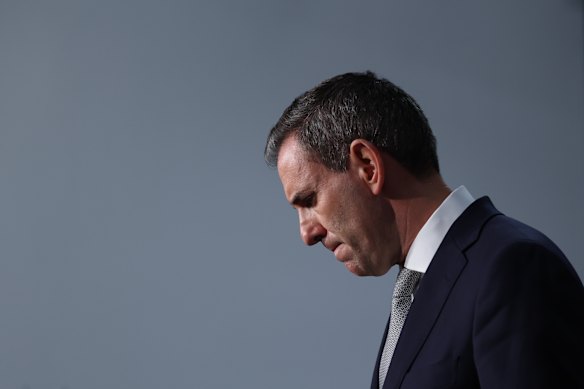
Treasurer Jim Chalmers is considering cuts to infrastructure projects to help ease pressure on the economy after new inflation figures all but guaranteed the Reserve Bank will push interest rates to an 18-year high on Melbourne Cup Day.
Under mounting political and economic pressure after the Australian Bureau of Statistics reported monthly inflation climbed to a higher-than-expected 4.3 per cent in September, Chalmers revealed cuts to government spending including on infrastructure were being considered as part of a mid-year budget savings package.
Ahead of the inflation data, financial markets believed there was a 64 per cent chance of a rate rise at the Reserve’s monetary policy committee meeting on Tuesday. After the figures, this had been pushed up to almost a 90 per cent chance.
A quarter percentage point rise would take the cash rate to 4.85 per cent, its highest level since 2008. It would be the fifth rate rise this year which, cumulatively, would have added almost $500 to the monthly repayments on a $600,000 mortgage.
Inflation, which had been 4 per cent in August, was pushed up by higher oil prices caused by the war in the Middle East. Petrol prices jumped by 9.4 per cent in September after a 14.8 per cent increase in August. High fuel costs accounted for more than 40 per cent of the lift in inflation last month.
There have also been large increases in the cost of overseas and domestic holidays, partly driven by higher oil prices.
The figures also revealed the growing impact of the AI data centre construction boom. Costs of games and toys have lifted by 15.5 per cent over the past year, with the bureau attributing much of that to the global increase in memory and computer storage components.
Chalmers rejected suggestions that government spending was behind the lift in inflation, but confirmed broad spending cuts are being considered as part of the mid-year budget update.
In the government’s first term, it aroused the ire of the states but saved up to $33 billion by axing 50 yet-to-be-started infrastructure projects expected to suffer blowout in their construction costs.
The treasurer made clear further cuts to infrastructure were on the agenda.
“We have to strike the right balance. We have to balance the need for more infrastructure with the pressures on our economy, including the pressures on our workforce, and from budget to budget, and budget update to budget update, we try to strike the best balance that we can,” he said.
Inflation is only below the 4.3 per cent national rate in one city, at 4 per cent in Melbourne, while it is at 4.3 per cent in Sydney. Inflation is much higher in Adelaide (5 per cent), Hobart (5.3 per cent) and Darwin (5.2 per cent).
Shadow treasurer Tim Wilson said it was a bad day for Australian households and proved the government was making Australia’s inflation outcome worse because of its spending.
“The numbers today show that underlying inflation persists because of the government’s spending addiction and sets the Reserve Bank up to have its hands forced next Tuesday for a potential interest rate rise. Australians desperately need hope,” he told reporters.
Bank governor Michele Bullock, appearing before a Senate hearing, said inflation was being pushed up by global pressures, including the price of oil and the AI data construction boom, on top of excess demand in the local economy.
But she pushed back at assertions from the Coalition that domestic factors were the main reason for Australia’s high inflation rate.
“I don’t think you can draw that conclusion at all,” she said. “I think the problem for us is that we started from a position of excess demand. Other countries did not.”
Commonwealth Bank chief economist Belinda Allen, who expects an interest rate hike next week, said the state of the local economy plus the fallout from the war against Iran and the surge in capital expenditure by AI firms would force the RBA’s hand.
“We see the hike in November as an insurance hike to protect against these forces. Acting early and acting decisively should manage the risk of inflation being higher for even longer,” she said.
Annual inflation for housing costs lifted to 5.2 per cent, with the bureau reporting new dwelling costs up by 4.7 per cent as builders passed on higher construction and labour costs.
Master Builders Australia chief economist Shane Garrett said inflation was pushing up housing costs and adding to price pressures across the country.
“The cost of creating new homes has outpaced general inflation over an extended period. Our construction businesses want to deliver new homes more quickly and less expensively, but policy settings are preventing this,” he said.
There are concerns that further interest rate rises, on top of a jobs market that is softening, could drive the economy into recession.
Reserve Bank chief economist Sarah Hunter said the institution was tracking a range of economic indicators including unemployment and household spending.
“At the moment our assessment is that none of those indicators are suggesting that the economy is in or heading into a recession in the near term. So that’s not what we’re seeing or expect to see over forecast horizon,” she said.
But ACOSS chief executive Cassandra Goldie said the risk of a recession was growing with every rate rise, noting the number of people out of work had climbed, with one million people now relying on JobSeeker payments.
“The risk of recession next year – reversing post-pandemic job gains – is higher now that official interest rates have risen four times this year,” she told this masthead.
Treasury secretary and Reserve Bank monetary policy committee member Jenny Wilkinson said global economic conditions were becoming more difficult to absorb.
Addressing a Senate estimates hearing, Wilkinson said across the world, there were continuing “geopolitical disruption and uncertainty, elevated inflation, increased demand for capital and tighter financial conditions”.
Cut through the noise of federal politics with news, views and expert analysis. Subscribers can sign up to our weekly Inside Politics newsletter.
 Shane Wright is a senior economics correspondent for The Sydney Morning Herald and The Age.Connect via X or email.
 Brittany Busch is a federal politics reporter for The Age and The Sydney Morning Herald.Connect via email.
From our partners
Disclaimer : This story is auto aggregated by a computer programme and has not been created or edited by DOWNTHENEWS. Publisher: www.smh.com.au