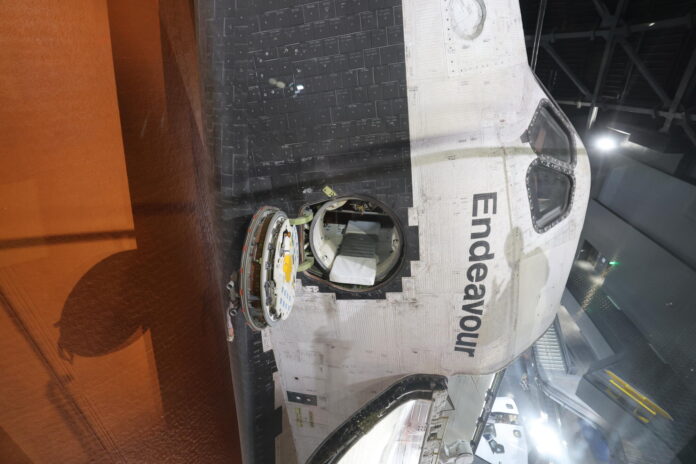
Peer inside the open hatch of the space shuttle Endeavour, and you’ll see a few things: a ladder from the mid-deck to the flight deck (horizontal, since the orbiter is in vertical launch position); pads used to crawl into the hatch and prevent damage to its seal; and small patches of blue Velcro to secure pens, clipboards or procedural notes, so they don’t float away.
Astronaut John Daniel “Danny” Olivas remembers his crews storing tortillas near the blue Velcro. There’s a cold plate there to keep the avionics system cool, and they’d stash the tortillas nearby so they’d stay fresher for longer (“We didn’t have a refrigerator on the space shuttle”). Tortillas, as it turns out, have a long and storied history in space, first brought there in 1985 by payload specialist Rodolfo Neri Vela, the first Mexican astronaut. (Neri Vela requested that they be included in his food supply, and they solved the serious problem of floating crumbs.)
A close-up view of the crew hatch, mid-deck and flight deck of the space shuttle Endeavour. The hatch provided astronauts with access to the crew compartment before launch and after landing, while serving as a sealed barrier during spaceflight. The cockpit contains the flight instruments, displays and controls used to operate the spacecraft during missions in Earth‘s orbit.
(Allen J. Schaben / Los Angeles Times)
There’s something fitting about the tortilla anecdote in multicultural L.A., home to the Samuel Oschin Air and Space Center — the $450-million, 200,000-square-foot expansion to the California Science Center — which now houses Endeavour. On Nov. 13, when the center opens to the public, it will become the only place in the world to see a complete space shuttle system with an orbiter that has actually seen flight (25 missions). That space shuttle system, or “shuttle stack,” includes the orbiter (the part of the shuttle that holds the crew and cargo); a solid rocket booster on either side; and an orange external fuel tank. The entire crew from the Endeavour’s last mission in 2011 plans to attend the center’s opening.
Space shuttles (there have only been five in the U.S., plus one prototype) stand apart for myriad reasons, chief among them are the sheer number of their astronauts, 355, as well as their diversity.

-
Share via
Astronaut Danny Olivas explains the space shuttle program’s significance and what it means for Endeavour to return to launch position in Southern California.
“Because the space shuttle program came forth, we started seeing people: the first female astronaut, the first African American astronaut, first African American female astronaut, the first Hispanic astronaut,” Olivas said on a recent tour of the new gallery. “So the space shuttle program, to me, is near and dear because it ushered in a level of diversity that represented what America was all about. And what makes her [Endeavour] special, being here in Southern California, is that this is the place she was born. All the space shuttles were born here. This is the heart of the aerospace industry.”
Olivas didn’t fly on the Endeavour, but he did fly two missions, one on the shuttle Atlantis and one on Discovery, for a total of almost 28 days. He ventured into outer space itself (“extravehicular activity”) on both missions, for a total of more than 34 hours. Plus, he and Endeavour go way back.

The Samuel Oschin Shuttle Gallery built a nearly 200-foot-tall space to display Endeavour’s orbiter in a vertical launch configuration, flanked by its external fuel tank and two solid rocket boosters.
(Allen J. Schaben / Los Angeles Times)
NASA selected Olivas as an astronaut candidate in 1998, and invited him and the other candidates to Edwards Air Force Base, in the Mojave Desert’s Antelope Valley about 100 miles northeast of Los Angeles. The Endeavour was being refurbished there, and he had the opportunity to go inside the crew module — the flight deck, the mid-deck and the airlock — all now visible in the new gallery.
The Endeavour was Olivas’ first encounter with any space shuttle, and he studied the spacecraft closely in the wake of the 2003 space shuttle Columbia accident. In many ways, he’s been inside the Endeavour much more personally than if he had flown on it. All of this is to say that he’s the perfect guide for today’s mission — getting to know this particular spacecraft.
“As an astronaut, you don’t get to share with the public all that space is,” Olivas said. “During the space shuttle program, the closest you could get to the space shuttle was three miles away,” as a civilian. “But this is an opportunity for space enthusiasts to get an up-close-and-personal look at the things that we had the privilege and honor to fly. … It’s nice to share this with the American people, because, ultimately, this is their ship.”

Jeff Rudolph, president and CEO of the California Science Center, left, and astronaut Danny Olivas on the 115-foot Shuttle Descent Slide, designed to simulate the descent of a shuttle returning to Earth. “It was no more than a flying brick,” Olivas said. “You had no engines, you had no motors to come home. Unlike the jet engines that you have when you land at LAX, you got nothing.”
(Allen J. Schaben / Los Angeles Times)
It’s been a long journey through time and space for the Endeavour to reach Exposition Park. The Times’ visit to the new gallery in early October happened to mark 15 years to the day since NASA transferred the title and ownership of the shuttle (yes, like a car) to the California Science Center, to the tune of a $1,980,674,785 valuation. (This was largely a donation, although the Science Center did pay for its transportation.)
“The most rewarding thing is watching the people that come through, of all ages, from little kids to senior citizens,” said Jeffrey N. Rudolph, president and CEO of the California Science Center. “Everybody is absolutely thrilled, and I think the sense of awe and wonder that we wanted to create really works.”

A worker inspects the base of one of the solid rocket boosters beneath the space shuttle. During launch, two explosives embedded in the “hold-down nuts” here would detonate, splitting them in half and releasing the shuttle stack from the bolts that held it to the launchpad.
(Allen J. Schaben / Los Angeles Times)
You may remember the orbiter itself or the 154-foot orange fuel tank parading slowly through L.A.’s streets to reach their new home, in 2012 and 2016, respectively. Their voyages were iconic: The former piggybacked atop a Boeing 747, past the Hollywood Sign and Griffith Observatory, before landing at LAX. The latter traversed the Panama Canal on a tugboat named the Shannon Dann, which rescued four fishermen off the coast of Baja California, tangerine behemoth and all.
That external tank, also known as an ET, was like a gas tank for the Endeavour. This one, ET-94, is the last flight-qualified external tank in existence. When full, it contains 1,629,577 pounds of propellants, as well as liquid oxygen and liquid hydrogen, both of which are extremely cold materials.
In the heat and humidity of Florida’s Kennedy Space Center, that meant the shuttle stack would start to drip like a water bottle on a muggy day. “I equate it to the way a thoroughbred would be when you loaded them into a starting gate,” Olivas said. “The cryogenic material would cause the metal to creak and moan due to thermal contraction and thermal expansion. You hear all the hissing of the vent lines, and you hear all the support equipment essentially running to get ready for the launch, and it really came to life. That’s the one thing that you’re missing here.”

Astronaut Danny Olivas shows off the wide-open payload bay of the space shuttle Endeavour. The shuttle’s large cargo bay carried satellites, scientific instruments and other payloads into orbit and helped support missions to construct the International Space Station.
(Allen J. Schaben / Los Angeles Times)
That visceral hissing is basically the only thing not present at the Oschin Center. This shuttle stack sits in flight configuration, almost exactly as it would look on the cusp of liftoff, besides the yellow torque tubes lining the orbiter’s white shell like external ribs. Inside the Science Center, Endeavour’s payload bay doors are cracked wide open, like a car’s lifted hood — but they were built for space, not Earth’s gravity. Here, without the support of those yellow bars, the doors could warp or crumple.
You could get lost in the grandeur of the rocket boosters, full of solid rocket propellant like a firework, or the steampunk bell curve of the main engines, which shoot the spacecraft to more than 17,000 miles per hour in orbit. But each and every piece is incredibly important, as are the teams of people who made them. “There’s no insignificant or small part about space exploration,” Olivas said. “Every single thing has a role to play.”
The space shuttle Columbia disintegrated during reentry because of a piece of foam that the astronaut estimates might have weighed about as much as a Styrofoam container. In 1986, the Challenger exploded during launch because of a tiny rubber O-ring. Olivas himself hung off the end of Atlantis’ robotic arm (the Endeavour has one too) to close a 4-inch hole in the heat-shielding thermal blanket with a medical stapler (the flight surgeon’s idea).

Astronaut Danny Olivas watches a historical montage about the space shuttle program. Unlike previous spacecraft, “the space shuttle was essentially built to be a work platform,” he said, “so not only did it get astronauts into space, but once it got into space, it was reconfigured from a rocket ship or spaceship into an on-orbit work platform.”
(Allen J. Schaben / Los Angeles Times)
Nothing like that had ever happened before; there was no planned repair — so they innovated. Building a space shuttle (or fixing one) is a testament to what humanity can do when we put our minds to it, Olivas said. We can achieve that which has never even been imagined.
“You take this beautiful bird, and you dock to the space station, a colony that’s been formed in space, and was built since the first element was launched in 1998,” Olivas said. “Human beings have lived in space since the year 2000. It’s an oasis that we, as human beings, built.”
Eight and a half minutes after liftoff, when the spacecraft reaches orbital speed, the main engines cut off (this is called MECO). Just like that, everything’s floating. This particular astronaut turned to look at the bright blue planet below and thought: “When we work together, we can accomplish phenomenal things.” But we choose to focus on the things that make us different, he said. And in doing so, we find conflict.
“But yet, the 99.9999% of you, me, all of us here, we’re all the same,” Olivas said. “We all want the same thing: a happy, healthy life. From space, you look down at the Earth — the only border that you see is between the ocean and the land.”
More to Read
Disclaimer : This story is auto aggregated by a computer programme and has not been created or edited by DOWNTHENEWS. Publisher: latimes.com