Waking early, I put a small jar of my sauerkraut into my messenger bag, hop on my bicycle, ride to Seattle’s King Street Station, and board a train heading to the Portland Fermentation Festival, the yearly gathering affectionately nicknamed “Stinkfest.”
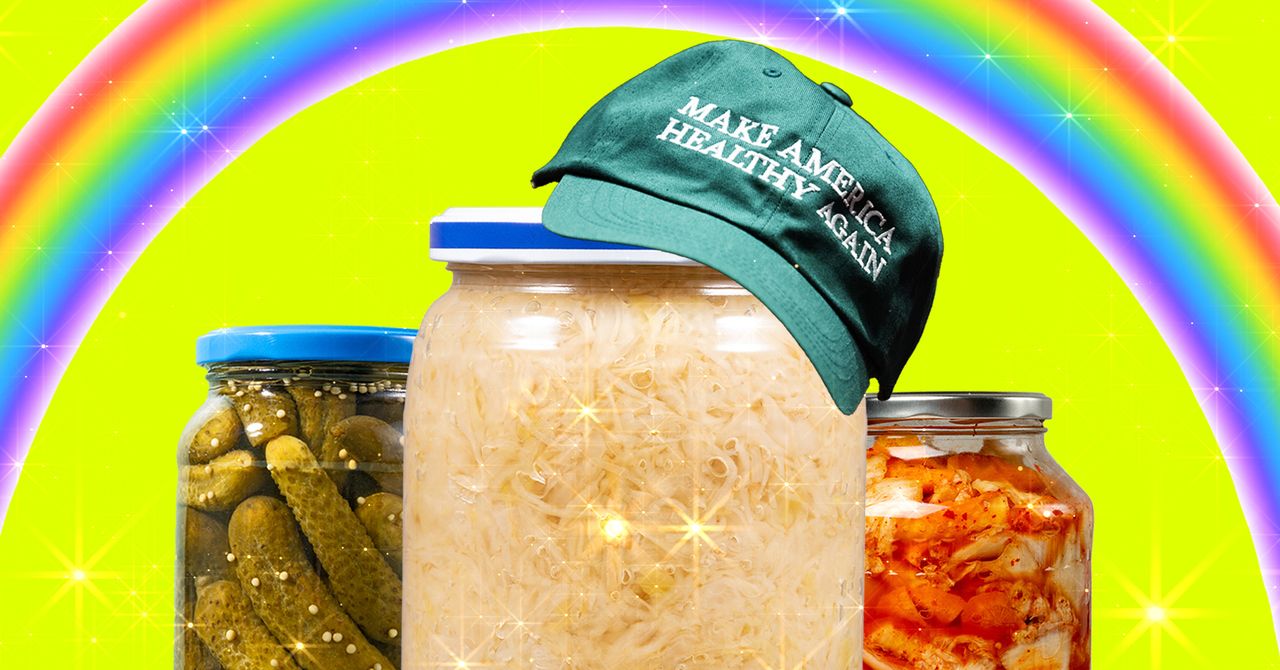
Usually the sheer existence of a festival like this is enough to get people revved up to come together and talk about their favorite ferments, but in an interesting twist, fermented foods are enjoying a popularity boost from a different crowd. The MAHA movement, and particularly the Donald Trump cabinet, are big into fermented food, eating meat, usually steak, with fermented sides like kimchi or sauerkraut at every meal.
I’ve come to Portland, Oregon, wondering if there was going to be any overlap in the Venn diagram between festival attendees and the MAHA steak-and-ferment crowd. I mentioned this to my cousin-in-law Erick, who’s been part of the Portland food scene for years, and he laughed out loud.
“It’ll be more like a Venn dumbbell,” he said, making a pair of thumb-and-forefinger circles and tracing a line in the air between them. “No overlap, but food will be the bridge.”
Still, I was curious. I’d check.
The festival is almost exactly what the fermentation-friendly might hope to find. Right inside the main door next to the check-in desk is a bacterial petting zoo—a common thing at this sort of event—and a table where attendees can drop off their own ferments to share. Further on, lining every wall of the main room, are exhibitors who have paid a grand total of 25 bucks for a table, handing out free samples of fermented foods.
The space quickly fills up–several hundred people flow through over the course of the evening–and it appears that there’s both a line in front of each exhibitor and perhaps a more organic continuous line with people flowing clockwise from one exhibitor to the next. People are notably excited and happy. There’s a kid walking around with a tray of handmade pickle pins he’s giving people to wear and there’s a collective gasp when 20 or 30 minutes in, Dillon T. Pickle, the mascot of the Portland Pickles West Coast League baseball team, walks into the room. At one point, a big baby crawls across most of the main floor, unhindered and happy.
In the middle of it all is festival co-organizer, journalist, and cookbook author Liz Crain. She explains that the Fest, now in its 14th installment, was started in 2009 by friends who love to ferment. There were members of a little company called Pickleopolis and a club called The Kraut Collective, and, with some help from author and fermentation rockstar Sandor Katz, they launched a Portland tradition.
When I ask how the festival has evolved since its first year, she gets a little philosophical.
“Cheap. Portland. Weird. People get excited,” she says in a tone where several punctuation options would be in the spirit of the festival. “People lined up on the sidewalk all the way around the building for the first one. I poured hard cider that I made from a tree in my backyard.”
“There’s nothing for sale, and that gives it a potluck-y party style. Most big festivals have consumers and purveyors, but without those distinctions here, it makes conversations a bit deeper, a bit more personal,” she says. “There’s no gatekeeping, no secret recipes. It’s always been wacky and fun.”
She isn’t sure how much MAHA crossover I’ll encounter, but she has an openness to it.
“RFK is certainly infatuated with sauerkraut and steak. There’s some good to be found in the overall MAHA tenets, but so much of it has been muddied by the anti-vax stance and ludicrous conspiracy theories,” she says, though she believes it’s important to “look closely and critically at pesticides and favor less-processed foods.”
“But a diet that’s based solely on meat, particularly beef, animal fats, and sauerkraut … well that’s not a very diverse diet,” she says. “Let’s just say I wouldn’t want to sit next to that person on a plane or be stuck in an elevator with them.”
I pick up on these ideas with Chris Curtin, a fermentation microbiology researcher at Oregon State University.
“Historically, everything has shown that narrowing the scope of your diet misses some things. They don’t turn out to be the best in the long run,” he says. An Australian living in the US for the last decade, he can clearly see the way trends are moving and notes that registered dietitians have consistently put fermented foods at the top of their superfood lists for the past decade.
Curtin describes his work as caring about what happens when we mess around with microbes to see what happens to the raw material. As he puts it, “I’m interested in tinkering if it involves microbe wrangling.” He also gets the festival’s popularity among those who ferment.
“Fermenting is such a readily accessible scientific experiment that you can do in your kitchen. People go, find foods they like and want to make in their own kitchens. It’s accessible and tactile.”
This plays out at the festival as I begin to sample the merchandise. The first thing I taste is an “orange whey Julius” that includes whey and OJ and is pleasingly reminiscent of the Orange Julius I’d get as a treat as a kid at the Mall of New Hampshire.
Next to that is Nat West’s booth with Peruvian corn beer called chicha. West has run a cider company, dabbled in politics, driven a TriMet city bus in Portland, and now runs the Vancouver, Washington, farmers’ market. In a chicha, the fermentation starts by the brewer chewing ground field corn. At the festival, attendees are drinking what West has chewed. As people in line joke about drinking this guy’s spit, or at least the byproducts of it, West interjects, “nobody’s died yet!”
“The ptyalin enzymes in the saliva kickstart the starch-to-sugar process,” he explains as I take a sip and gaze longingly at the draft beer in the hands of someone who’s wandered into the show from the Hotlips pizza next door.
Further along, Portland’s Jorinji Miso has a double booth with samples of miso soup with bonito flakes along with koji (rice fermented with Aspergillus oryzae spores) and amazake, a koji-based drink.
The couple who run Maypop Wine Co. have their hands full at the Fest. The company’s cofounder Vince Kelsea explains that they make “anything but pinot” in the Willamette Valley—a lush north-south valley in Oregon renowned for its pinot noir. Making unfiltered, low-intervention wines like Maypop in a region famous for its pinot sounds like they’re making things hard for themselves, but the attendees maintain a several-deep line at the booth all night long.
In one corner is Kiyomi Hasagewa, a third-generation Japanese bean purveyor. She’s sharing tastes of a 15-year-old miso she dehydrated and ground so she could bring it from Hokkaido to the festival. She sprinkles it over the rice and tops it with a wedge of sun-dried daikon which her elderly mother fermented in a mashed pumpkin paste. It is easily the most interesting bite in the room.
Back in the entry hall are my personal favorites, the ferments that attendees have brought to share. Liz Crain has brought along plum and dandelion wines, pickle brine, a blackberry-blueberry-lemon water kefir, and a monster jar of sour dills. I note with pride that the jar of sauerkraut I brought is next to Liz’s pickles, near-empty. Nearby is another giant jar of “fermented carrot coins, cherry bomb, garlic, ginger, horseradish,” which I anticipate as a pleasant assault on my senses, but it’s really just pleasant. A garlic blast for sure, but one with all of the harsh edges smoothed by time and beneficial bacteria into something lovely.
Also at the community table are Portland occupational therapist Eva Ortega and her fermentation buddy Letti Kittel who drove down from Seattle.
“I’ve only made unsuccessful ferments so far,” says Ortega, undeterred. “I’m here to learn.”
Kittel says she’s been nerding out on fermenting for about a year and has brought a kombucha starter with its bacteria-and-yeast scoby for others to bring home and try. And while both of them have no comment about the MAHA connection, Ortega puts some of Kittel’s starter in a little jar and drops it into her purse.
I’m expecting another round of “no comment” when the MAHA diet comes up with three other fermenting friends, Megan Andricos, Josh Monifi, and Desiré Demarest, but Andricos, aka DJ Sappho, followed a similar diet 20 years ago in what they call their “fermented-pickled food and protein phase,” which consisted of “mostly kimchi and meat.”
They’re off that diet now, but they liked being on it. “Kimchi evens out my gut biome. I felt better. Not superhuman, but better.”
Also on the community table is something called “Higgins Kraut,” made with Napa cabbage, carrots, garlic, and ginger, which, with a lovely melding of flavors, won my personal Best-in-Show award.
Turns out it’s made by one of the show’s other founders, George Winborn, who was involved for the first 10 years. He’d been farming in Dallas when he moved to Portland, to a place that had no yard and nowhere to farm.
“Doing the Fest helped scratch the itch,” he says. He’s now getting Wellspring Farm in Gresham, Oregon, off the ground and noted how the festival has become a bit more commercial, a bit less homemade. But all that’s relative, considering we’re standing here over our jars of sauerkraut, and the exhibitors are very small businesses, if they’re businesses at all.
“I still love the DIY and starter tables,” he says. “It reminds you that everyone can do this.”
Disclaimer : This story is auto aggregated by a computer programme and has not been created or edited by DOWNTHENEWS. Publisher: wired.com