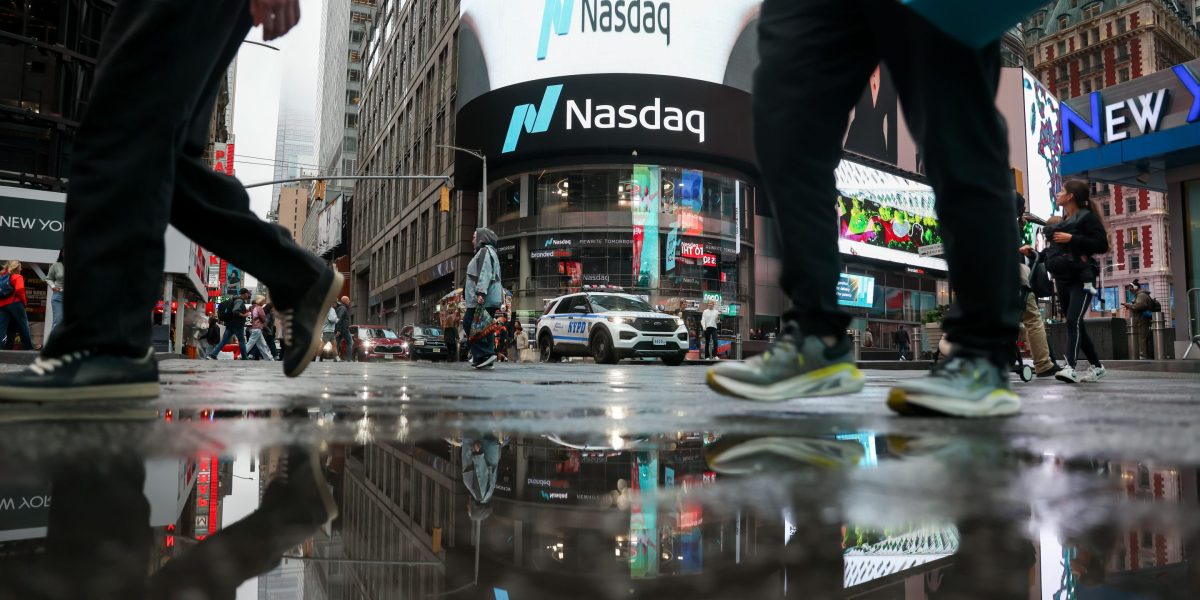
Good morning. General Motors announced yesterday that it will move its listing from the New York Stock Exchange to Nasdaq on Nov. 17 as part of its “customer-focused, technology-driven strategy.” Hilton will move there on Nov. 5, with CEO Chris Nassetta telling investors yesterday that Nasdaq provides a “platform aligned with our innovation and growth ambitions and position[s] Hilton alongside some of the world’s most innovative companies.”
In some ways, this feels like debating where to sit in the high school cafeteria: old guard or new guard, the varsity table or the one filled with kids from the robotics club. How investors grade the innovation and growth prospects at GM or Hilton isn’t going to depend on where they list their shares. They’re sitting down with the same stuff on their trays, and both exchanges already trade each other’s stocks. But moving to Nasdaq is more than just a popularity contest. There are reasons why GM’s shares rose 6% yesterday on the news. Among them:
The Nasdaq 100 Index. Walmart got a 3% bump on Jan. 12, the day its Nasdaq 100 inclusion was announced, after it had moved from NYSE to Nasdaq a month earlier. That prestigious index, which tracks the exchange’s 100 largest non-financial companies, is volatile but consistently outperforms the much broader S&P 500. Unlike other indices, like the NYSE 100, companies must be members to qualify for the Nasdaq 100. Companies like Hilton and GM are solid contenders. While it may not be a primary reason to move, being part of a popular tech-focused index is attractive to companies that now see themselves as tech-first. And a new fast-track rule allows mega IPOs like SpaceX and Anthropic to become part of the index after 15 days of trading.
Follow the money. The NYSE was founded in 1792 and is housed in a Wall Street building that’s steeped in history. ”It’s the most recognized stock exchange in the world,” billionaire entrepreneur Brad Jacobs told me last year when he was getting ready to ring its famous opening bell for the 13th time. “All my companies are B2B. Being on the New York Stock Exchange helps us build a strong brand.” When I shared that quote with a CEO whose company is listed on Nasdaq, he laughed and said, “this is where I can get the most money.” It’s hard to prove that one way or the other, of course. Nasdaq used to get the scrappy companies like Apple or Amazon. Now they draw behemoths like SpaceX and Anthropic, too.
What you want in a friend. Nasdaq and NYSE compete fiercely for listings, especially as fewer companies go public. While the former is 100% electronic, the latter combines that with a physical trading floor and a human market maker to match buyers and sellers. Is there a little less excitement? Perhaps, but also less volatility and potentially less stress. When I reached out for comment, an NYSE Group spokesperson informed me that “companies transferring from NYSE to the Nasdaq 100 experienced compressed market valuations and increased share volatility, which is why half a trillion dollars of market capitalization transferred to the NYSE year to date.” (That calculation, by the way, is apparently based on 21 companies that left to join the Nasdaq 100 over the past 40 years, with their multiples calculated relative to their peers.) Among those who have transferred to NYSE are three companies that used to be in the Nasdaq 100 Index: Skydance, Kraft Heinz, and AstraZeneca. The good thing about being public is there’s always a new place to have lunch.
Contact CEO Daily via Diane Brady at diane.brady@fortune.com
Top leadership news
Anthropic’s IPO filing puts OpenAI’s advantages in focus
Anthropic reported $16.3 billion in revenue in the first half of 2026, but warned in its IPO filing that its rapid growth may not last. Investors told Fortune that OpenAI’s consumer business could give it an edge as it expands into advertising and new devices. Still, both companies face questions about whether they can turn their growth into permanent profits, particularly as competition grows and prices fall.
JPMorgan asks judge to dismiss sexual harassment lawsuit
JPMorgan asked a judge to dismiss former banker Chirayu Rana’s lawsuit after his sister said he had coached her testimony, while a third law firm sought to stop representing him. Rana accused an executive of drugging and sexually coercing him; both the executive and the bank deny his allegations.
Forecast gives Democrats an edge in 5 Republican-held Senate seats
A betting-market model developed by Northwestern data scientist Thomas Miller favors Democrats in North Carolina, Ohio, Alaska, Texas, and Maine—enough to flip control of the Senate. Miller told Fortune that the races tend to move together, though Republicans’ chances have recently improved slightly, and the numbers remain a snapshot, not a prediction of the final result.
The markets
S&P 500 futures are up 0.11% this morning. The last session closed up 0.60%. The STOXX Europe 600 was down 0.07% in early trading. The U.K.’s FTSE 100 was down 0.34% in early trading. Japan’s Nikkei 225 was up 1.08%. South Korea’s KOSPI was up 6.63%. China’s CSI 300 was up 0.85%. Hong Kong’s Hang Seng was up 0.23%. India’s NIFTY 50 was down 0.18%. Bitcoin is up at $81k.
Around the watercooler
Elon Musk promised an AI epic to rival Christopher Nolan. Viewers got a seven-minute glitch by Marco Quiroz-Gutierrez
Newsom agrees smart glasses need privacy rules—just not the ones California lawmakers wrote by Tatiana Sataua
Cisco’s CMO has to generate more revenue on the same budget. Here’s where she’s placing her bets by Ruth Umoh
The humanist at the top of real estate’s automation machine: ‘I happen to despise the term headcount in the world of AI’ by Nick Lichtenberg
CEO Daily is curated and edited by Joseph Abrams, Jason Ma, Claire Zillman, and Lee Clifford.
Disclaimer : This story is auto aggregated by a computer programme and has not been created or edited by DOWNTHENEWS. Publisher: fortune.com