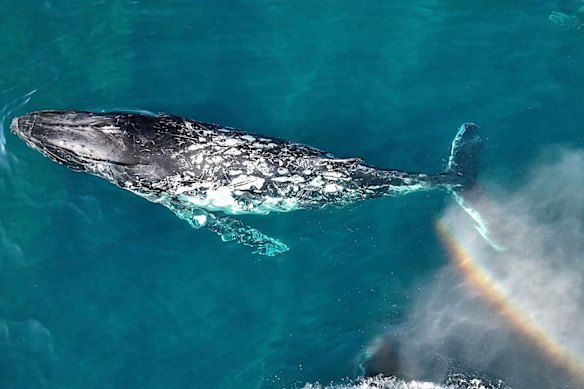

The number of whales migrating along Western Australia’s coastline is at its lowest in decades, with climate change, declining krill abundance, and illness all possible reasons for the decline.
And scientists believe there is a likely correlation between poorer conditions and the number of whale carcasses that have washed up along Perth beaches over the past month and triggered shark warnings from authorities.
Capri Jolliffe, research chairwoman at Geographe Marine Research, said while there had been no quantifiable study, “it certainly does seem like we’ve had a lot more carcasses wash up on Perth beaches than we typically would”.
Sorrento Beach was closed on Sunday morning following reports of a carcass floating just offshore, and, days earlier, a juvenile whale washed ashore at South Cottesloe’s Dutch Inn Beach.
At the end of September, the carcass of a 13-metre humpback whale was discovered along South City Beach.
Jolliffe said there could be a host of reasons for the increase in carcasses.
“We’ve got a super El Nino event going on in the world at the moment. The ocean temperatures and currents are a little bit different to what they normally are so it could just be a matter of currents running slightly differently to what they normally would, which may be favouring these carcasses washing up on the beaches,” she said.
“But it’s been a really odd season for us this year, particularly with the humpback whale population – there definitely seems to be a pattern emerging in terms of that population and resource limitations.”
Jolliffe said strong numbers were typically recorded through October, but this year numbers had been declining since late September.
“There’s been way fewer calves than what we would normally see, probably in the order of 50 to 60 per cent less,” she said.
“Up in Exmouth, where they would typically have seen up to 12 calves a day, they only had two on average, so that’s a concerningly low number and certainly raised some more flags around the humpback whale population.
“In our southbound observations of animals coming through Geographe Bay, we’ve also had really low numbers compared to what we would normally see.”
Jolliffe said whales, like all mammals, would not reproduce if they did not have enough energy, and that krill numbers had been lower due to global warming melting Antarctic ice.
“We know humpbacks get most of their energy in their summer foraging grounds. They will stop for a snack along the way if there is abundant food resources but this year we’ve seen more foraging along their southbound migration than we’ve ever seen before, and we haven’t necessarily seen big amounts of prey,” she said.
“That could also point to the fact they haven’t had enough food to eat, and they’re trying to get as much as they possibly can every opportunity.”
She also said there had been concerning behaviour spotted in pods off the Perth coast.
“We’ve seen quite big groups of humpbacks seeming to go south one day, and then we see the same group the next day heading north, which is definitely not the direction they’re meant to be heading, then turning around and heading south, then north again,” Jolliffe said.
“We did also have an observation of a calf that had a really heavy whale lice infestation, which is a big indicator for us that something’s not right with that animal, that it’s moving slowly, that it’s unhealthy, and we don’t typically see that in calves.”
Cetacean Research Centre WA lead researcher John Totterdell said this year’s winter migration had recorded “fewer animals than we’ve seen in decades”.
“Most concerning is the drop in new-season calves, daily relative abundance off the Ningaloo Coast has plummeted,” he said.
“Colleagues in the Humpback Whale Sentinel Program report similar trends across Southern Hemisphere populations, pointing to a troubling link – reduced sea-ice habitat for krill, driven by warming seas off Antarctica.”
Curtin University School of Earth and Planetary Sciences adjunct professor Robert McCauley said newborn calves had the highest mortality rates, followed buy subadults up to the age of five.
But McCauley said the decline in humpback numbers more broadly did not mean there was “anything dramatic happening” and could instead be related to the fact the population had reached the limit of available resources after bouncing back following the end to whaling in Australia.
“What happens is the population reaches what’s called the carrying capacity when it’s at the limits of resources available,” he said.
“Then it overshoots, so it goes up a little bit, and then the population dies off, and then it oscillates around the carrying capacity, so it is quite possible we’ve reached that overshoot mark, and we’re now in the first decline.
“We’re seeing fewer whales come up because there’s less food in Antarctica for them so the females aren’t fit to come up and breed, so they stay down in the southern waters, continue feeding.
“That would match up with more carcasses washing up.”
In 2016, McCauley calculated 5000 tonnes of carcasses were available along the WA coast for scavengers – “not an insignificant amount, and that’s just with the normal mortality rate.”
 Holly Thompson is a journalist with WAtoday, specialising in education and the environment.Connect via X or email.
From our partners
Disclaimer : This story is auto aggregated by a computer programme and has not been created or edited by DOWNTHENEWS. Publisher: www.smh.com.au