
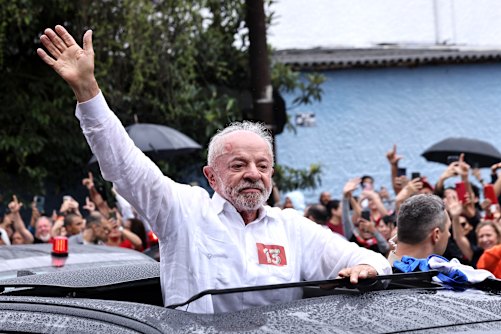

The world dodged a bullet on Monday morning (AEDT) when a Brazilian electoral court declared that President Luiz Inácio Lula da Silva had an insurmountable lead over challenger Flávio Bolsonaro and had won a fourth term in office.
Lula, as he is known, had secured 51.76 per cent of votes against Bolsonaro’s 48.24 per cent.
It is impossible to overstate how much is riding on that small margin. For Brazil, it is the difference between the continued defence of the democracy it achieved following the end of its military dictatorship in 1985.
Flávio, son of jailed former president Jair Bolsonaro, had campaigned on a promise to pardon his father, and clear his allies for their involvement in the coup attempt that followed Jair’s election loss to Lula in 2022.
For the world, it means that hopes to stabilise the planet’s climate have not been dashed. The Amazon rainforest, which sprawls across 6 million square kilometres, 60 per cent of which lies inside Brazil’s borders, produces between 6 and 9 per cent of the world’s total oxygen and acts as a carbon sink, absorbing more carbon dioxide than it emits.
That’s changing. Under Bolsonaro’s rule, clearing and burning for agriculture, beef production and mining had reached record highs, pushing it towards the point at which it may start to emit more carbon than it absorbs. In large sections that point has already been breached.
This was no accident.
In 2019, Jair Bolsonaro rejected data from Brazil’s National Institute for Space Research that detected a surge in deforestation since his election, telling foreign reporters, “You have to understand that the Amazon is Brazil’s, not yours,” and declaring: “If all this devastation you accuse us of doing was done in the past, the Amazon would have stopped existing – it would be a big desert.”
It is estimated that Lula’s efforts to preserve the forest over the past fours years has saved 20,000 square kilometres of the Amazon. As a result of his efforts, Brazil’s emissions fell 13 per cent in 2024 and a further 6 per cent last year.
Flavio Bolsonaro vowed to reverse course, telling agricultural interests during a recent campaign rally that if he won, “You will be able to plant, raise cattle, do whatever you want on your land; what you exploit from the land is yours. We are going to end those environmental obstacles that exist, especially for ideological reasons.”
Like his father, Flavio has questioned climate science in similar terms to sceptics across the world, declaring that the rapid heating caused by carbon emissions was the product of natural climate cycles.
“At the risk of sounding alarmist, I’ve been saying that Lula’s re-election is the only thing standing between us and a wide destruction of the Amazon,” Claudio Angelo, international policy co-ordinator at Brazil’s Climate Observatory, told Carbon Brief, a leading UK-based-based climate change and energy policy news website.
Though this was a victory for the climate movement, it is not clear it was one of that movement.
Flavio won the first round of elections, before a surge of voters mobilised by a massive turnout effort to put Lula over the top in the second round, the first time such a reversal has happened. This suggests that to many voters this was as much a battle over democracy as it was over climate.
When it appeared that Bolsonaro had an unassailable lead after the first round of voting, illegal clearing fires tripled, suggesting some farmers believed that conservation efforts and fines for illegal clearing would soon be abandoned.
Lula will now confront a national congress in which Bolsonaro’s far-right Liberal Party (PL) forms the biggest block in both houses. It holds 121 of 513 seats in the lower house, and 29 of 81 in the Senate, while Lula’s PT-coalition holds 88 and nine respectively. The PL is expected to use its numbers to continue its efforts to open Indigenous lands to mining and undermine environmental safeguards.
According to analysis by Brazil’s Climate Observatory, nearly 70 per cent of lower house MPs have low or very low alignment with environmental protection policies, a figure that rises to 79 per cent in the Senate. “The executive branch will have a crucial role to play in preventing setbacks in environmental and social legislation and ensuring that progress on environmental protection continues,” said Maurício Voivodic, executive director of WWF-Brazil.
Nonetheless, the climate movement is breathing a sigh of relief this week, while multilateral institutions consider how the world might better help finance the protection of rainforests.
“Science shows that we can still prevent the irreversible transformation of vast areas of the Amazon, but time is running out,” said Carlos Nobre, professor at the University of São Paulo and co-chair of the Science Panel for the Amazon, of Lula’s victory.
“The next four years will be decisive for the future of the world’s largest tropical rainforest and for climate stability in Brazil and around the world.”
Get to the heart of what’s happening with climate change and the environment. Sign up for our fortnightly Environment newsletter.
 Nick O’Malley is National Environment and Climate Editor for The Sydney Morning Herald and The Age. He is also a senior writer and a former US correspondent.Connect via email.
From our partners
Disclaimer : This story is auto aggregated by a computer programme and has not been created or edited by DOWNTHENEWS. Publisher: www.smh.com.au








