
-
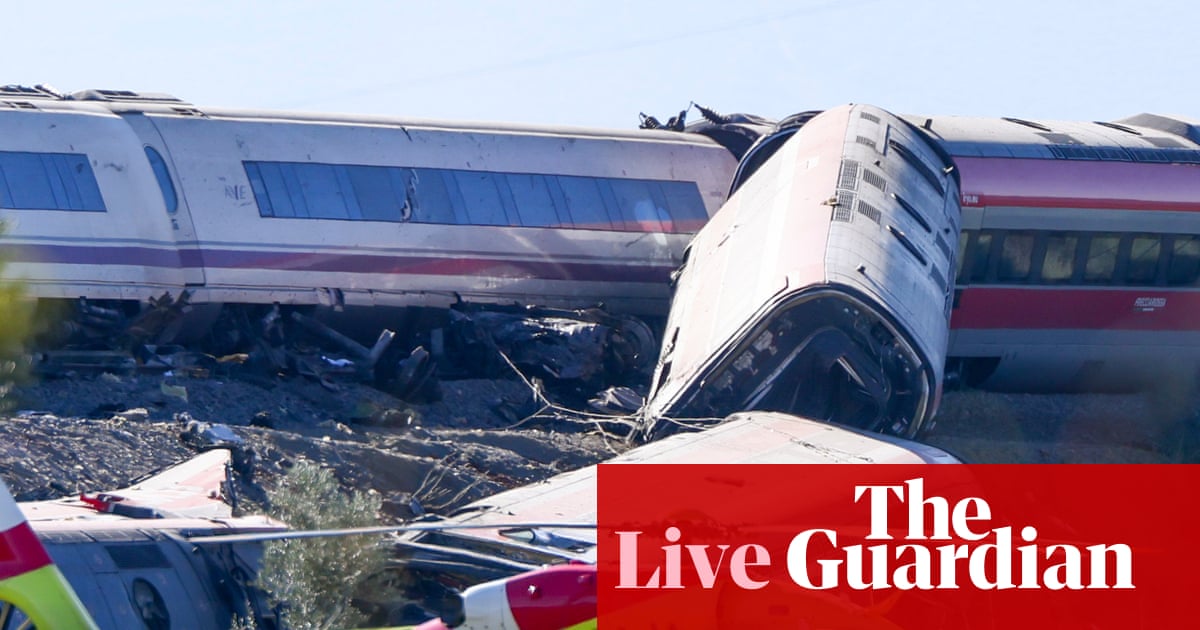
At least 68 people have been killed after two passenger trains collided in Toledro province in central Spain, and the death toll may rise further.
-
A similar number of people remain hospitalised, including 15 in serious or critical state (15:44).
-
The two trains with 544 people on board in total (10:46) were travelling in the same direction on the high-speed line from the Spanish capital, Madrid, to Seville in the south-west of the country.
-
Video footage from the scene showed extensive damage to both trains (12:23, 13:52).
-
Spain’s prime minister Pedro Sánchez said the country was “in mourning” as he insisted the government will get to the bottom of incident and address potential failures with “utmost firmness” (15:49).
-
Transport minister Óscar Puente said initial review of the evidence pointed to an “inexplicable” decision to order trains to go ahead after a signalling failure (15:01), implying a human error.
-
The investigation is likely to focus on 17 minutes between the trains were halted and the crash.
-
Spanish media reported that the controller responsible was questioned by investigators this afternoon (16:40).
-
Today’s collision is the second high-profile train crash in Spain this year (11:00), and the third deadliest incident on its railway in the last 50 years (12:55).
-
Spain is expected to declare three days of mourning later today (15:54).
-
Both main parties suspended their campaigning activities ahead of next month’s parliamentary election, but the far-right Vox party continued with its rallies (12:11).
The Health Department of Castilla-La Mancha has reduced the number of people in hospitals in the region to 53, after 56 were discharged, El Pais reported.
King Charles has contacted King Felipe of Spain.
The British monarch, who is currently out of the country visiting the Bahamas, “sent a private message of condolence” to his Spanish counterpart earlier today, a Buckingham Palace spokesperson said.
The CSIF civil servants’ union has called for the resignation of Transport Minister Óscar Puente following Wednesday’s train accident.
“The minister is shamefully using a worker as a scapegoat instead of taking responsibility,” the union said, adding: “The minister has evaded all responsibility despite the initial computer system failure that triggered the events.
“Throughout this year, CSIF has demanded increased investment in the maintenance of the railway sector: safety, review and updating of safety protocols, and greater investment in infrastructure maintenance, as well as in railway workshops.”
Elsewhere, around twenty riot police officers are guarding the main entrance to the Ministry of Transport, the original location for a demonstration which was later moved to the neighboring Plaza de San Juan de la Cruz, El Mundo reported.
Spain’s Civil Guard said one of its officers, Jose Manuel, died in the train crash.
The national law enforcement agency expressed its “deepest condolences” to his family, friends and colleagues.
The number of people in hospital has risen to 107, The Emergency Services of Castilla-La Mancha said.
The president of the Andalusian Regional Government, Juanma Moreno, has demanded the central government conducts a “ complete review of the railway lines “ in Andalusia and in particular the high-speed line connecting the region with Madrid.
“The AVE high-speed train that links Madrid and Andalusia is no longer a safe means of transport,” Moreno added in comments reported by El Mundo.
Josimar Medina woke a little before 9am on Wednesday to find himself airborne and hurtling through his carriage on the fast train from Madrid to Seville.
“I remember flying through the air and looking for my girlfriend, who was also shooting through the air,” said Medina, a 37-year-old tourist from the northern Peruvian city of Chiclayo.
Once he landed, he looked around and realised just how lucky he and his girlfriend, Vitoria Maia, had been.
“I saw people with cuts, people covered in blood, people missing limbs, and I saw one person who had nothing left below the chest,” said Medina. “I saw people with their heads crushed and people with mutilated arms.”
The Peruvian stood recounting the details of Wednesday’s deadly rail crash, in which at least 68 people were killed and dozens more were injured, wearing a light brown T-shirt stained with the blood of a young American man he had helped move to safety.
Medina and Maia had been in the seventh carriage of the state-operated Renfe train that smashed into the back of a train run by the private Iryo company on the same line from the capital to the south of Spain. Had they been any further forward, they could well have been among the accident’s fatalities.
As it was, the couple climbed out of the train and helped the injured while they waited for medics and Guardia Civil officers to arrive at the scene of the crash, which took place amid vineyards and olive groves near the small town of Urda in the central region of Castilla-La Mancha, near the city of Toledo.
Within hours of the crash, Urda had been transformed into a frantic emergency response centre, with a local sports centre pressed into service as a triage post for the walking wounded. Cars, vans and trucks from the emergency services in Castilla-La Mancha and neighbouring Madrid crowded the streets.
A total of 36 people who were traveling on the trains involved in the Toledo train crash received medical attention at Atocha station, El Pais reported.
At the same location, around 40 relatives of those affected by the accident also received mental health support.
The death toll remains at 68 as rescue teams work to remove the two worst-damaged carriages of the Iryo train.
But sources at the Advanced Command Post told El Pais they expected more bodies will be found.
Three large cranes are currently working on the rescue operation.
Disclaimer : This story is auto aggregated by a computer programme and has not been created or edited by DOWNTHENEWS. Publisher: theguardian.com









