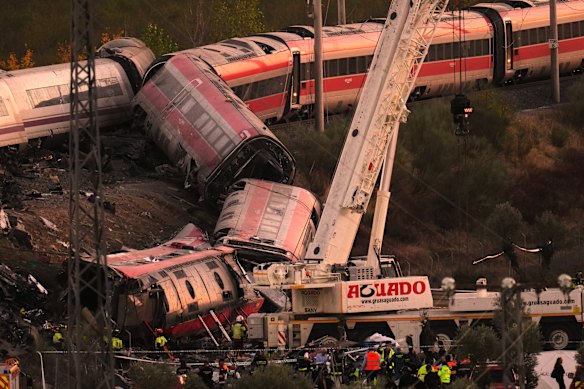
A high-speed passenger train slammed into the back of a stationary train in Spain on Wednesday morning (Spanish time), in one of the deadliest train crashes in Spanish history. As authorities investigate what went wrong, here’s what we know about the rail disaster.
Where did the crash occur?
The crash occurred near Urda, in the province of Toledo, about 130 kilometres south of Madrid, in central Spain.
It involved two high-speed trains travelling in the same direction from Madrid to Seville. One train was run by Spain’s state-owned railway company, Renfe, while the other – which was stationary – was run by Iryo, a private operator.
How did the crash occur?
According to Spain’s Transport Minister Óscar Puente, a computer failure at 8.30am on Wednesday brought six trains to a halt along a 63-kilometre stretch of track, including the two trains involved in the crash.
Shortly afterwards, a rail control centre worker ordered the drivers to start up again and continue “as normal” (meaning at high speed). But the driver of the Iryo train reported he was having difficulty starting back up and so was stationary.
This was reportedly not communicated to the other drivers, and at 8.53am, the Renfe train slammed into the stationary train, derailing several carriages and sending two down an embankment.
How many people were killed and injured?
According to Spanish media, the two trains were carrying a total of 544 passengers.
At least 68 people have been confirmed dead, with authorities warning the toll could rise as rescuers search the wreckage.
The latest reports indicate at least 108 people were injured, including 58 seriously. A major rescue operation is ongoing at the crash site near Urda, as hundreds of anxious families await news.
What have Spanish authorities said?
The Spanish government’s early statements indicate that as many as six trains on the same line had been stopped at some point on Wednesday morning due to problems with the signalling system.
Puente described the decision to allow the Renfe train to proceed, despite a red signal, as “inexplicable”. He said the train drivers were not to blame.
Prime Minister Pedro Sánchez travelled to the scene within hours of the crash.
“It’s not possible for a country like Spain to suffer two high-speed train accidents in one year,” he said.
He said that while Wednesday’s accident and a fatal January crash on the same line seemed unrelated, the country’s rail systems needed to be investigated and improved.
Sánchez declared three days of national mourning, saying “all of Spain” was grieving. He promised a thorough investigation and pledged support for victims and their families.
What’s the history of train crashes in Spain?
In January, 46 people were killed near Adamuz, in the province of Córdoba, when a high-speed Iryo train derailed and collided with an oncoming Renfe service, which triggered a debate about the level of investment in railway maintenance in recent years.
The accident is still under investigation. A preliminary report by Spain’s Civil Guard in February pointed to defects in the track, rail or weld between two sections of track as the main hypothesis for the accident, but kept seven other theories open.
The second deadly accident in less than a year will probably raise further questions over the country’s train infrastructure ahead of November’s snap election.
In July 2013, 80 people died when a train derailed on a sharp bend near Santiago de Compostela in north-western Spain while travelling at excessive speed, slamming into a concrete wall and bursting into flames.
A Transport Ministry commission concluded that accident was caused by excessive speed and the driver being distracted by a call from a superior, but a victims’ association blamed the accident not only on human error, but also on the railway’s security systems.
Accidents, including derailments and collisions, increased from 45 in 2016 to 57 in 2024 and 69 last year, according to Spain’s railway safety authority. In the same period, problems such as deterioration of, and breaks in, the rails rose from 494 to 667.
Spain spent an average of about €1.5 billion ($2.38 billion) a year from 2018 to 2022 on its high-speed network, more than any other country. However, the vast majority went to new infrastructure, with only about 16 per cent earmarked for maintenance, renewal and upgrades.
Reuters
Be the first to know when major news happens. Sign up for our breaking news alerts on email or turn on notifications in the app.
Disclaimer : This story is auto aggregated by a computer programme and has not been created or edited by DOWNTHENEWS. Publisher: www.smh.com.au